Basement Wall Repair Lifespan: Which Method Lasts Longest?
Compare the durability and expected lifespan of top basement wall repair methods, from carbon fiber straps to steel I-beams and exterior membranes.
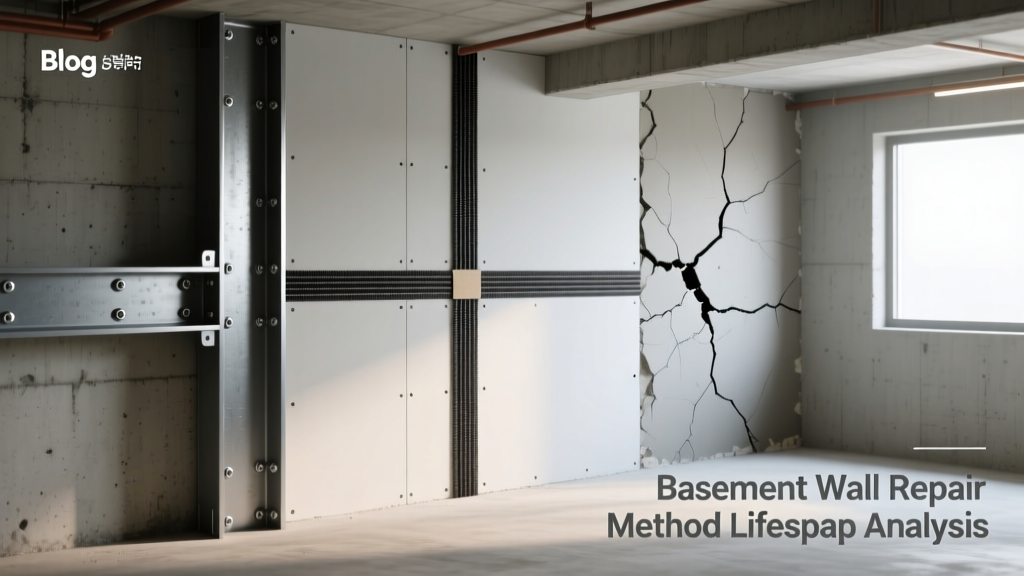
The True Cost of Basement Wall Repair: Lifespan vs. Upfront Price
Evaluating basement wall repair based solely on the initial contractor quote is a critical financial error. A $3,500 carbon fiber installation that delaminates in seven years yields a significantly higher annualized cost than an $8,000 steel I-beam system engineered to last half a century. When lateral soil pressure, hydrostatic loads, and structural fatigue are factored in, the durability of the repair method dictates the true return on investment. This analysis breaks down the expected lifespan, primary failure modes, and material science behind the most common foundation stabilization techniques used in modern construction.
Expected Lifespan Matrix: Common Repair Methods
| Repair Method | Expected Lifespan | Best Application | Primary Failure Mode | Avg. Cost (2026) |
|---|---|---|---|---|
| Carbon Fiber Straps | 25–50 Years | Minor bowing (<2 inches), poured concrete | Epoxy delamination from substrate moisture | $450–$650 / strap |
| Steel I-Beams (Braces) | 50–75+ Years | Moderate bowing, block or poured walls | Floor bracket punch-through, top bracket slip | $700–$950 / beam |
| Helical Tiebacks | 75–100+ Years | Severe leaning, expansive clay soils | Corrosion of ungalvanized shafts, soil creep | $1,200–$1,800 / anchor |
| Epoxy Crack Injection | 10–20 Years | Static, non-moving structural cracks | Secondary cracking adjacent to the rigid repair | $25–$40 / linear foot |
| Polyurethane Injection | 15–25 Years | Active leaking, hairline to 1/4-inch cracks | UV degradation (if exposed), mechanical tearing | $15–$25 / linear foot |
Deep Dive: Durability Analysis by Repair Type
Carbon Fiber Straps: The Tensile Strength Illusion
Carbon fiber straps, such as those manufactured by Fortress Stabilization or StablWall, boast tensile strengths exceeding 130,000 PSI. The carbon material itself will practically never snap under residential lateral loads. The vulnerability lies entirely in the bond between the strap and the concrete substrate. According to guidelines from the International Concrete Repair Institute (ICRI), the concrete surface must be prepared to a Concrete Surface Profile (CSP) of 3 or 4 via mechanical grinding. If the wall has an internal moisture vapor emission rate (MVER) exceeding 4%, standard structural epoxies will fail to cure properly, leading to delamination within 3 to 5 years. For damp basements, contractors must use moisture-tolerant epoxy primers, which adds roughly 15% to the material cost but secures the 50-year lifespan.
Steel I-Beams and Wall Braces: Mechanical Anchoring
Galvanized steel I-beams (e.g., PowerBrace or Grip-Tite systems) rely on mechanical leverage rather than chemical adhesion. Their lifespan is virtually indefinite, provided the anchor points hold. The most common failure mode is 'slab punch-through.' If the basement floor is a standard 3-inch unreinforced concrete pour, the immense downward and outward pressure transferred to the floor bracket can fracture the slab. To achieve a 75-year lifespan, the floor bracket must be anchored into the structural footing, or the slab must be locally reinforced with rebar and a thicker pour before the beam is tensioned. Furthermore, the top bracket must be secured to the floor joists; if the joists run parallel to the failing wall, a continuous steel angle-iron distribution plate must be bolted to multiple joists to prevent the beam from simply pushing through the rim board.
Helical Tiebacks: The Exterior Solution from the Inside
Helical tiebacks involve drilling a steel shaft through the basement wall and screwing a helical plate into the undisturbed, load-bearing soil outside. Because the anchor relies on deep soil friction rather than wall friction, it is immune to interior moisture and substrate degradation. Hot-dipped galvanized tiebacks from manufacturers like Earth Contact Products (ECP) resist soil corrosion for up to a century. The Foundation Performance Association (FPA) frequently cites helical anchors as the premier solution for expansive clay soils, where seasonal swelling generates lateral pressures that easily exceed the shear capacity of interior-only repairs.
No interior structural repair (carbon fiber, steel beams, or tiebacks) stops water infiltration. These systems manage structural loads and wall deflection. If hydrostatic pressure is not mitigated via exterior grading, gutter extensions, or an interior perimeter French drain system, the constant freeze-thaw cycling and water pressure will eventually degrade the concrete substrate itself, rendering the interior repair useless.
Crack Injection: Epoxy vs. Polyurethane Longevity
When addressing cracked basement walls, material selection dictates longevity based on soil mechanics.
- Structural Epoxy: Cures to a compressive strength of 3,000+ PSI, effectively welding the concrete back together. However, epoxy is rigid. If the wall is subjected to dynamic soil movement (expansive clay), the repaired crack will hold, but a new crack will inevitably form 6 to 12 inches away due to stress concentration. Lifespan is tied to soil stability, not the material itself.
- Hydrophobic Polyurethane: Expands up to 20 times its volume upon contact with water, filling micro-voids. It remains flexible with a high modulus of elasticity, allowing it to stretch and compress as the wall shifts slightly with seasonal temperature changes. It is the superior choice for active, weeping cracks, though it does not restore structural rigidity to the wall.
Decision Framework: Matching Repair to Soil and Structure
Selecting the correct repair method requires analyzing the geotechnical environment surrounding the foundation. Use this framework to maximize repair longevity:
| Soil Type & Condition | Lateral Load Profile | Recommended System for Max Lifespan | System to Avoid |
|---|---|---|---|
| Expansive Clay (High plasticity) | Extreme, seasonal swelling | Helical Tiebacks or Heavy-Duty Steel I-Beams | Carbon Fiber (will delaminate under high shear) |
| Sandy Loam / Granular | Moderate, consistent pressure | Carbon Fiber Straps (if bowing < 2 inches) | Epoxy Injection (soil shift will break the bond) |
| High Water Table / Poor Drainage | Hydrostatic + Lateral | Steel I-Beams + Interior Drain Tile System | Any adhesive-based system without moisture mitigation |
'A foundation repair is only as durable as the water management system surrounding it. You cannot engineer a permanent structural fix on a permanently wet substrate.' — Adapted from structural engineering principles published by the American Society of Civil Engineers (ASCE).
Maintenance Requirements to Maximize Repair Longevity
Even the most robust basement wall repair systems require specific maintenance intervals to reach their maximum engineered lifespan. Neglecting these steps voids most manufacturer lifetime warranties.
- Steel I-Beam Tensioning (Years 1, 3, and 5): Newly installed steel beams often require re-tensioning. As the wall settles into the brace and the floor bracket embeds slightly into the slab, the turnbuckle will lose tension. Use a torque wrench to re-tighten the turnbuckle to the manufacturer's specified foot-pounds (typically 150-250 ft-lbs) at 6 months, 1 year, and 3 years post-installation.
- Carbon Fiber Substrate Monitoring (Annual): Inspect the edges of the carbon fiber straps for 'hollow' sounds when tapped with a coin. A hollow sound indicates the epoxy bond has detached from the concrete. If caught early (less than 10% delamination), an epoxy injection behind the strap can save the system. If the delamination exceeds 20%, the strap must be removed, the concrete re-profiled, and a new strap installed.
- Weep Hole Clearance (Bi-Annual): If your repair system includes a drainage board or interior French drain tied to the wall base, ensure the weep holes drilled into the bottom course of block walls (or the cove joint) are clear of efflorescence and calcification. Use a wire brush and mild muriatic acid solution to clear mineral buildup annually.
- Exterior Grade Verification (Annual): Maintain a minimum 5% slope away from the foundation for the first 10 feet. A sinking exterior grade that pools water against the basement wall will increase lateral hydrostatic pressure by up to 62.4 pounds per square foot for every foot of standing water, accelerating fatigue on interior braces.