Cost of Foundation Building Materials in Riverside (2026)
Analyze 2026 costs for foundation building materials in Riverside, CA. Get local pricing for concrete, rebar, and specialized expansive soil systems.

The Riverside Foundation Cost Landscape in 2026
Constructing a structural foundation in Riverside, California, requires navigating a unique intersection of extreme Inland Empire summer heat, highly expansive clay soils, and stringent seismic building codes. When budgeting for foundation building materials in Riverside, general national averages are virtually useless. Local material availability, regional delivery logistics, and specific California Building Code (CBC) mandates dictate the true cost of your project.
In 2026, the Inland Empire construction market has seen stabilization in raw material costs, but labor and specialized engineering requirements continue to drive baseline prices upward. Whether you are pouring a standard slab-on-grade in Corona, engineering a raised stem-wall foundation in the foothills of Murrieta, or retrofitting a pier-and-beam system in historic downtown Riverside, understanding the granular costs of local materials is critical for accurate estimating.
Core Material Cost Breakdown: Concrete & Steel
The bulk of any foundation budget is consumed by ready-mix concrete and steel reinforcement. In Riverside, local batch plants operated by suppliers like CalPortland and Vulcan Materials price their materials based on mix design, admixtures, and delivery distance. Below is the current 2026 pricing matrix for primary foundation materials in the Inland Empire.
| Material | Specification / Grade | Unit | 2026 Riverside Cost |
|---|---|---|---|
| Ready-Mix Concrete | 3,000 PSI (Standard Slab) | Per Cubic Yard | $155 - $170 |
| Ready-Mix Concrete | 4,000 PSI (Sulfate Resistant) | Per Cubic Yard | $175 - $195 |
| Steel Rebar | #4 Grade 60 (1/2 inch) | Per Linear Foot | $0.85 - $0.95 |
| Steel Rebar | #5 Grade 60 (5/8 inch) | Per Linear Foot | $1.25 - $1.40 |
| Post-Tension Cable | 270 ksi Low-Relaxation Strand | Per Linear Foot | $1.45 - $1.65 |
| Vapor Barrier | 15-mil Polyethylene (Stego Wrap) | Per Sq. Ft. | $0.22 - $0.28 |
| Anchor Bolts | 1/2' x 12' Galvanized J-Bolt | Per Piece | $3.50 - $4.25 |
Ready-Mix Concrete Pricing Variables
When ordering concrete in Riverside, the base price per cubic yard is only the starting point. The National Ready Mixed Concrete Association notes that regional climate constraints heavily influence admixture costs. During Riverside's peak summer months (June through September), ambient temperatures routinely exceed 95°F. To prevent flash-setting and cold joints, batch plants must add ice retarders or utilize Type II cement, which adds approximately $12 to $18 per cubic yard to your final material ticket.
Specialized Foundation Systems for Expansive Soils
Standard slab-on-grade foundations are rarely sufficient in Riverside's eastern and southern sectors due to the high plasticity index (PI) of the native clay. When the soil expands during rare rain events and shrinks during droughts, conventional rebar grids often fail to prevent cracking. Engineers typically specify one of three specialized systems, each with distinct material cost profiles.
Post-Tension Slabs
Material Cost: $2.10 - $2.80 / sq. ft.
Best For: Moderate expansive soils. Uses high-strength steel tendons pulled tight after curing to compress the concrete, actively resisting soil uplift forces.
Stiffened Raft Slabs
Material Cost: $3.50 - $4.50 / sq. ft.
Best For: High-clay areas. Requires massive amounts of rebar and deep concrete grade beams (often 36+ inches deep) poured monolithically with the slab.
Helical Pier Systems
Material Cost: $280 - $350 / pier
Best For: Severe soil instability or hillside builds. Steel piers are driven past the active soil zone into bedrock, supporting a raised structural floor.
Inland Empire Logistics: Delivery & Pumping Fees
Material costs in Riverside are heavily impacted by the logistics of getting those materials from the batch plant or lumber yard to the job site. The Inland Empire's traffic corridors, particularly the I-215 and CA-91, dictate delivery windows and fuel surcharges.
- Short Load Fees: If your foundation requires less than 7 cubic yards (common for ADU foundations or room additions), local suppliers will charge a short load fee ranging from $75 to $120 per missing yard. Always calculate exact volumes with a 10% overage factor to avoid these penalties.
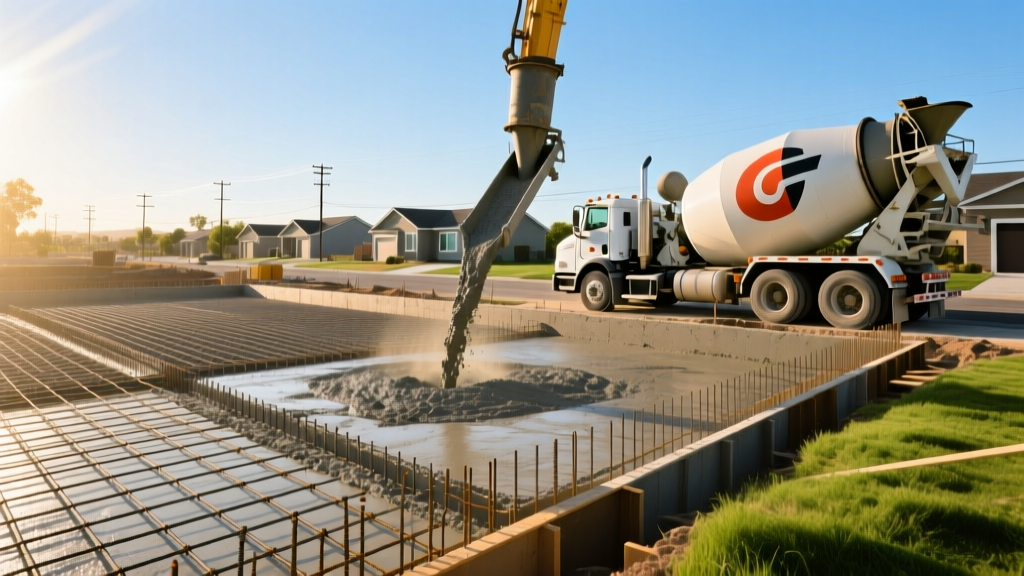
- Concrete Pump Trucks: If the pour site is inaccessible to a standard mixer truck (e.g., a backyard pool deck or a steep hillside in Canyon Crest), you will need a boom pump. Expect to pay a base mobilization fee of $850, plus $145 per hour, with a 4-hour minimum.
- Wait Time Penalties: Riverside batch plants allow 7 to 10 minutes of free unloading time per cubic yard. If your crew is slow or the pump truck backs up, demurrage fees of $3.50 per minute will be added to the final invoice.
Hidden Costs & Local Permitting Fees
Budgeting strictly for physical materials will leave your estimate dangerously short. The California Building Standards Commission enforces rigorous testing and inspection protocols that require secondary material purchases and engineering documentation.
- Geotechnical Soils Report: Mandatory for almost all new foundations in Riverside County. A licensed geologist will take core samples and dictate your required concrete mix and reinforcement. Cost: $2,800 to $4,500.
- Concrete Cylinder Testing: The building inspector will require a third-party testing agency to take physical cylinders of your wet concrete during the pour to test for compressive strength at 7 and 28 days. Cost: $350 to $500 per test set.
- Epoxy Anchor Adhesives: For structural sill plates, standard J-bolts are often insufficient under current seismic codes. You will need to drill and epoxy-set anchor bolts. A 22-oz cartridge of structural epoxy (like Simpson SET-XP) costs roughly $85 and covers approximately 15 standard anchor bolts.
Frequently Asked Questions
Can I use 2,500 PSI concrete for a residential foundation in Riverside?
No. While 2,500 PSI is acceptable for non-structural flatwork like sidewalks, the 2022/2025 California Building Code requires a minimum of 2,500 PSI for foundations, but local Riverside geotechnical reports almost universally mandate 3,000 PSI or 4,000 PSI due to sulfate presence in the soil and seismic load requirements.
Do I need a vapor barrier under my Riverside slab?
Yes. Even in a dry climate, capillary action draws moisture from the soil through the concrete. A minimum 10-mil vapor retarder is required by code, but upgrading to a 15-mil or 20-mil puncture-resistant barrier (like Stego Wrap) is highly recommended and only adds about $0.10 per square foot to your material costs.
How far in advance should I order foundation materials in the Inland Empire?
For ready-mix concrete, you must schedule the batch plant at least 7 to 10 business days in advance, especially during the spring and fall building rushes. For specialized materials like post-tension tendons or engineered lumber for stem walls, allow 3 to 4 weeks for delivery from regional distributors.
Written by
Sarah WhitfieldSarah Whitfield is a chartered quantity surveyor (MRICS) and construction cost analyst with 15 years of experience in material pricing, procurement strategy, and project budgeting. She earned her degree in Construction Management from the University of Reading (UK) and has worked on projects ranging from $2M custom homes to $180M mixed-use developments across North America and Europe. Sarah currently leads cost estimating for BuildMat Insight, maintaining a proprietary database of 4,000+ material price points updated quarterly. She is a frequent contributor to RSMeans cost data panels and has presented at the International Cost Engineering Council (ICEC) congress. Based in Denver, CO, Sarah is an avid trail runner and volunteer mentor for Women in Construction.
More from Sarah Whitfield
View all
Wood & Lumber
What Are the Different Types of Wood? A Builder's Guide
Compare structural softwoods, finish hardwoods, and engineered lumber. Analyze Janka ratings, MOE values, and 2026 pricing for construction.
Aug 4, 2026

Walls & Panels
Steel Framing vs Wood Framing: Corrosion and Moisture Defense
Compare steel framing vs wood framing for moisture resistance. Learn about galvanized coatings, condensation risks, and corrosion protection strategies.
Jul 21, 2026

Stone & Masonry
How to Cut Stone Veneer: Wet Saw vs Grinder Comparison
Compare the best tools for cutting stone veneer. We review wet saws, angle grinders, and chop saws to help you achieve clean, chip-free cuts.
Jul 21, 2026