Navigating Major Foundation Repair Cost: A Selection Framework
Evaluate major foundation repair cost with our selection framework. Compare piering, polyjacking, and structural reinforcement pricing and ROI.

The True Economics of Foundation Failure
When homeowners first encounter structural distress, the immediate question is almost always financial. However, attempting to calculate a major foundation repair cost without first understanding the mechanical root cause of the failure is a critical mistake. Foundation repair is not a commodity priced by the square foot; it is a highly engineered intervention dictated by soil mechanics, structural load, and the specific failure mode of the concrete or masonry.
The national average for significant structural stabilization ranges from $8,500 to over $45,000, but this wide variance is entirely dependent on the selection of the repair methodology. A homeowner dealing with shallow slab voids will engage a completely different financial and structural framework than one dealing with deep differential settlement in expansive clay soils. According to data from the Foundation Repair Association, misdiagnosing the failure mechanism and applying a cosmetic or shallow fix to a deep structural problem accounts for nearly 30% of all callback and warranty claims in the industry.
Never hire a contractor who bids based solely on the visible symptom (e.g., 'patching drywall cracks' or 'waterproofing a damp wall') without conducting a forensic analysis of the foundation's elevation and soil bearing capacity. Treating the symptom without addressing the geotechnical root cause will result in recurring damage and wasted capital.
Cost Matrix: Repair Methods vs. Damage Severity
To build an accurate budget, you must map the proposed repair method to its unit cost and typical project scale. The following matrix outlines current industry pricing for primary structural interventions.
| Repair Method | Primary Application | Unit Cost Estimate | Typical Total Range |
|---|---|---|---|
| Steel Push Piers | Deep settlement stabilization (heavy loads) | $1,800 - $2,500 per pier | $14,000 - $35,000 |
| Helical Piers | Settlement in unstable/soft upper soils | $2,000 - $3,000 per pier | $16,000 - $45,000 |
| Polyurethane Foam Jacking | Shallow slab lifting and void filling | $10 - $20 per sq. ft. | $2,500 - $8,000 |
| Carbon Fiber Straps | Bowing basement walls (minor deflection) | $800 - $1,200 per strip | $4,000 - $10,000 |
| Tieback Wall Anchors | Severe wall bowing and lateral pressure | $700 - $1,000 per anchor | $5,000 - $12,000 |
The Selection Framework: Matching Damage to the Right Fix
Determining your major foundation repair cost requires running your specific structural symptoms through a diagnostic framework. Below are the three most common failure scenarios and the engineered solutions required for each.
Scenario A: Deep Differential Settlement
The Symptom: Stair-step cracking in brick veneer, doors that bind diagonally, and drywall tears radiating from window corners. Elevation readings show a drop of more than 1.5 inches across the foundation footprint.
The Framework Decision: Deep foundation underpinning is mandatory. The choice between push piers and helical piers depends on the structure's weight and the soil profile. Push piers rely on the weight of the structure to drive the steel shafts down to bedrock or a stable load-bearing stratum. They are ideal for heavy, multi-story masonry homes. Helical piers, which feature bearing plates that screw into the ground, are torqued to a specific depth based on the engineer's load calculations and are superior for lighter structures (like wood-frame single-story homes) or in soils where bedrock is exceptionally deep. According to FEMA Building Science guidelines, underpinning must transfer the structural load past the active soil zone to prevent seasonal heave and shrinkage from causing recurring movement.
Scenario B: Slab Voids and Shallow Sinking
The Symptom: Interior tile cracking, sloping floors in the center of the home, and hollow sounds when tapping the concrete slab. The perimeter grade beams remain stable and level.
The Framework Decision: This indicates a loss of subgrade support rather than a deep structural failure. The decision matrix here pits traditional mudjacking against high-density polyurethane foam jacking. While mudjacking (using a slurry of topsoil, sand, and cement) is cheaper upfront at $3 to $6 per square foot, it introduces thousands of pounds of heavy, water-retaining material beneath the slab. Polyurethane foam (such as GeoPoly or similar structural resins) costs more per unit but weighs less than 3 lbs per cubic foot, cures in 15 minutes, and is entirely impervious to water washout. For long-term ROI, polyurethane is the definitive selection for slab stabilization.
Scenario C: Bowing Basement Walls and Lateral Pressure
The Symptom: Horizontal cracking along mortar joints, inward deflection of poured concrete or block walls, and water intrusion through the cracks.
The Framework Decision: The repair method is strictly dictated by the measurement of inward deflection. If the wall has bowed less than 2 inches, structural carbon fiber straps (epoxied directly to the concrete and anchored to the floor joists) provide immense tensile strength to halt further movement. However, if the deflection exceeds 2 inches, carbon fiber is insufficient. You must transition to mechanical tieback wall anchors or steel I-beam braces. Wall anchors involve driving a galvanized steel plate into the stable soil outside the home and connecting it to an interior wall plate via a tension rod, allowing the wall to be incrementally straightened over time.
Soil Mechanics: The Invisible Cost Multiplier
Geotechnical conditions heavily influence the final invoice. Homes built on expansive clay soils (prevalent in regions like Texas, Colorado, and the Carolinas) experience significant volumetric changes based on moisture content. Repairing a foundation in these areas often requires the installation of root barriers, French drains, and automated drip irrigation systems to maintain constant soil moisture around the perimeter. Failing to include moisture management in your repair scope will void the warranty of almost any reputable piering contractor. The National Association of Home Builders frequently cites improper surface drainage and lack of soil moisture control as the primary drivers of premature foundation failure in new and existing construction alike.
Hidden Variables That Inflate Your Final Invoice
When budgeting for a major foundation repair cost, contractors typically quote the 'turnkey' structural work. However, homeowners must account for ancillary expenses that are rarely included in the primary contract:
- Independent Structural Engineering Report ($500 - $1,500): Never rely solely on the contractor's in-house assessment. Hire an independent, licensed structural engineer to write the repair specification. This ensures the contractor bids on an objective scope of work rather than over-prescribing piers.
- Municipal Permits ($200 - $800): Most jurisdictions require engineered drawings and permits for deep underpinning and structural wall reinforcement.
- Landscaping and Hardscape Restoration ($1,500 - $5,000): Installing piers requires excavating 3x3 foot working pits every 6 to 8 feet along the foundation. Concrete patios, walkways, and mature shrubbery in the work path will be removed and are rarely replaced by the foundation crew.
- Interior Cosmetic Repairs ($2,000 - $10,000+): Lifting a settled foundation will often close exterior brick cracks but may open new, minor hairline cracks in interior drywall as the house re-levels. Drywall mudding, texturing, and painting must be budgeted as a post-repair phase.
Vetting Your Contractor: Beyond the Lowest Bid
The foundation repair industry is unfortunately saturated with high-pressure sales tactics. To protect your investment, evaluate contractors based on their engineering rigor, not their financing offers. Demand proof that their proposed piering systems carry an ICC-ES (International Code Council Evaluation Service) report. An ICC-ES report proves the product has been independently tested for load capacity, corrosion resistance, and structural integrity. Furthermore, ensure the contractor provides a lifetime, fully transferable warranty that is backed by a third-party insurance or guaranty trust, rather than just a piece of paper from the company itself.
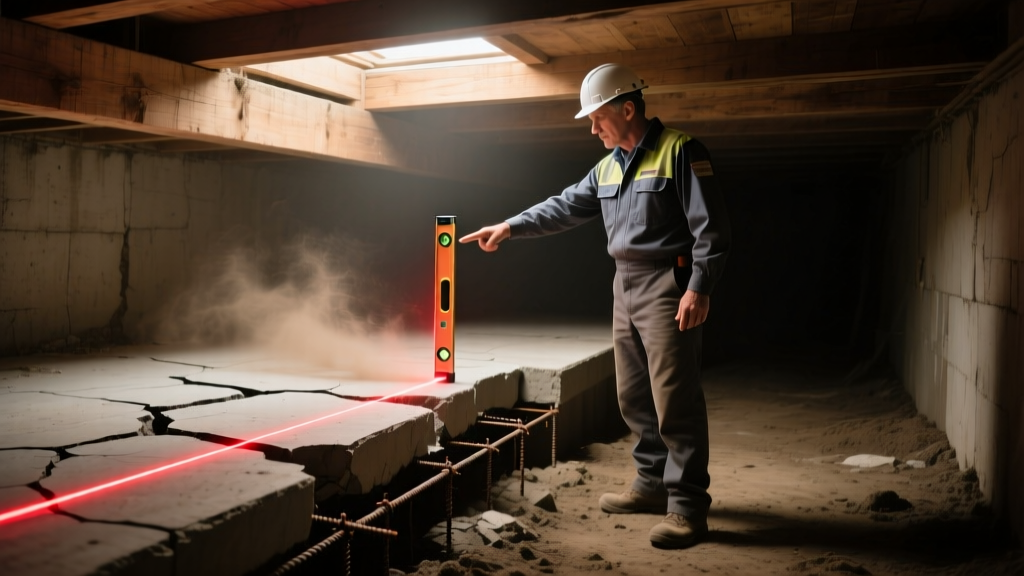
A reputable contractor will always perform a manometer or optical level elevation survey of your entire floor plan before presenting a proposal. If a salesperson recommends underpinning based purely on a visual walk-around without taking precise floor elevation readings, terminate the consultation immediately.
Financing and ROI: Is the Investment Worth It?
A major foundation repair is a capital-intensive project, but it is fundamentally a defensive investment that preserves the asset's marketability. A home with an unrepaired, actively failing foundation is virtually impossible to sell using traditional mortgage financing, as FHA and conventional appraisers will flag the structural deficiency, forcing the sale to cash-only investors at a steep 20% to 40% discount. By executing a professionally engineered repair, you restore the home's eligibility for standard financing and protect your equity. While you will not recoup 100% of the repair cost in a direct dollar-for-dollar increase in appraised value, you eliminate the catastrophic depreciation associated with structural distress, ensuring the property remains a viable, liquid asset in the real estate market.
Written by
Sarah WhitfieldSarah Whitfield is a chartered quantity surveyor (MRICS) and construction cost analyst with 15 years of experience in material pricing, procurement strategy, and project budgeting. She earned her degree in Construction Management from the University of Reading (UK) and has worked on projects ranging from $2M custom homes to $180M mixed-use developments across North America and Europe. Sarah currently leads cost estimating for BuildMat Insight, maintaining a proprietary database of 4,000+ material price points updated quarterly. She is a frequent contributor to RSMeans cost data panels and has presented at the International Cost Engineering Council (ICEC) congress. Based in Denver, CO, Sarah is an avid trail runner and volunteer mentor for Women in Construction.
More from Sarah Whitfield
View all
Wood & Lumber
What Are the Different Types of Wood? A Builder's Guide
Compare structural softwoods, finish hardwoods, and engineered lumber. Analyze Janka ratings, MOE values, and 2026 pricing for construction.
Aug 4, 2026

Walls & Panels
Steel Framing vs Wood Framing: Corrosion and Moisture Defense
Compare steel framing vs wood framing for moisture resistance. Learn about galvanized coatings, condensation risks, and corrosion protection strategies.
Jul 21, 2026

Stone & Masonry
How to Cut Stone Veneer: Wet Saw vs Grinder Comparison
Compare the best tools for cutting stone veneer. We review wet saws, angle grinders, and chop saws to help you achieve clean, chip-free cuts.
Jul 21, 2026