Horizontal Foundation Crack Repair: Material Selection Guide
Compare structural epoxies, carbon fiber straps, and wall anchors for horizontal foundation crack repair. Expert material taxonomy and selection guide.
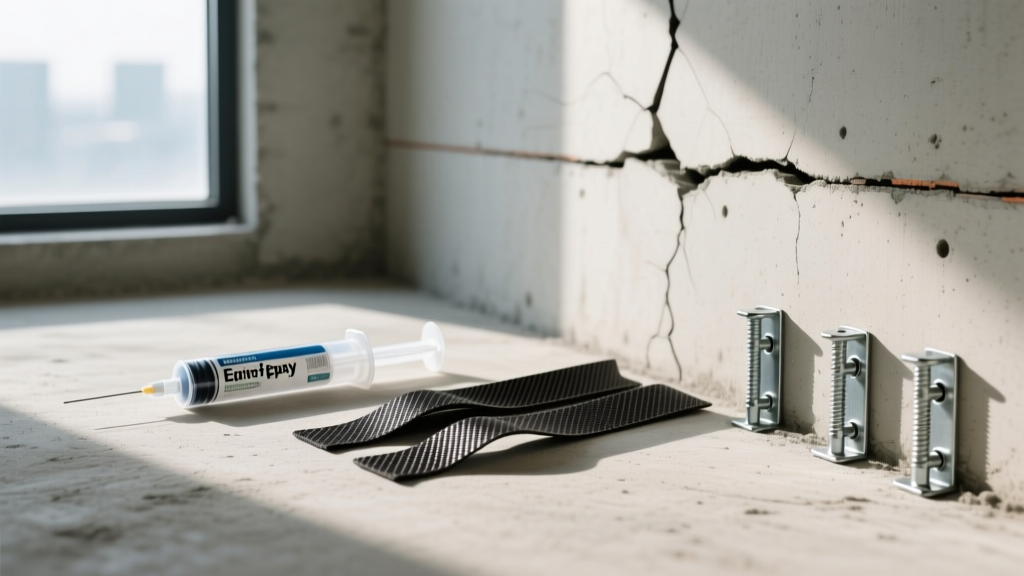
The Physics of Horizontal Cracks and Material Imperatives
Horizontal foundation cracks are universally classified by structural engineers as the most critical failure mode in residential and light commercial foundations. Unlike vertical cracks, which often result from natural concrete shrinkage or minor differential settlement, horizontal cracks are driven by active lateral forces. These forces typically stem from hydrostatic pressure exerted by saturated expansive soils, frost heave, or heavy vehicular surcharge loads near the foundation wall.
When selecting materials for horizontal foundation crack repair, the primary objective is not merely to seal a gap, but to restore the wall's tensile strength and resist ongoing lateral soil pressures that can exceed 2,000 pounds per square foot (psf). Using flexible, non-structural sealants on a horizontal crack is a catastrophic error that will inevitably lead to wall bowing, shear failure, and structural collapse. This guide provides a rigorous material taxonomy to ensure the correct structural intervention is matched to the specific failure mechanism.
Material Taxonomy for Structural Repair
Category 1: High-Modulus Structural Epoxies (The Bonding Agents)
Epoxy injection is the baseline requirement for restoring the monolithic integrity of a cracked concrete or concrete masonry unit (CMU) wall. For horizontal cracks, the epoxy must possess a high modulus of elasticity to prevent flexing under lateral loads.
- Specification Requirement: Always specify epoxies that meet ASTM C881 standards. Specifically, you need Type I (bonding), Grade 1 (low viscosity for deep penetration into hairline to 1/8-inch cracks), and Class B or C (suitable for damp or dry surfaces, operating between 40°F and 100°F).
- Performance Metrics: The cured epoxy must exhibit a minimum tensile strength of 5,000 psi and a compressive strength exceeding 8,000 psi. Products like Simpson Strong-Tie FX-70 or Emseal Emcrete are industry benchmarks.
- Application Limitation: Epoxy restores the concrete's original strength but does not add tensile capacity beyond the original design. If the wall is actively bowing (deflection > 1 inch), epoxy alone is insufficient and must be paired with Category 2 or 3 materials.
Category 2: Carbon Fiber and Kevlar Reinforcement (The Tensile Armor)
When a horizontal crack is accompanied by wall deflection or bowing, carbon fiber reinforcement systems (CFRS) are the modern standard for internal bracing. Carbon fiber boasts a tensile strength up to 10 times greater than steel at a fraction of the weight.
- Strap vs. Grid Systems: For horizontal cracks in CMU block walls, vertical carbon fiber straps (typically 12 inches on center) are used to transfer the lateral load from the wall to the foundation footer and the floor joists above. Woven carbon fiber grids are better suited for poured concrete walls with multiple horizontal cracking planes.
- Modulus of Elasticity: Ensure the selected carbon fiber fabric has a modulus of elasticity of at least 33,000 ksi. Lower-grade materials will stretch too much under hydrostatic pressure, allowing the crack to re-open.
- Anchorage: The critical failure point in carbon fiber repair is the termination. The top of the strap must be mechanically anchored into the rim joist or sill plate using structural epoxy and steel anchor bolts, while the bottom must be embedded into the concrete footer.
Category 3: Helical Tiebacks and Earth Anchors (The External Bracing)
For severe horizontal cracking where interior access is restricted, or where soil pressures exceed the tensile capacity of internal carbon fiber, external earth anchors are required. These systems physically pull the wall back into plumb and lock it in place.
- Helical Tiebacks: Installed horizontally through the wall into the undisturbed soil outside. Brands like Chance or Hubbell manufacture helical anchors that are torque-installed to specific load ratings (e.g., 20,000 lbs to 40,000 lbs ultimate capacity).
- Deadman Anchors: Used in cohesive soils where helical plates cannot achieve sufficient bearing. A concrete or steel deadman is buried in the yard and connected to the interior wall plate via a high-strength steel rod.
Category 4: Polyurethane Foams (The Water Sealers - NON-STRUCTURAL)
It is vital to address a common industry misconception: closed-cell polyurethane foam is strictly a water-sealing material. While excellent for stopping active leaks in vertical or diagonal shrinkage cracks, polyurethane has virtually zero structural tensile strength. Injecting polyurethane into a horizontal crack will stop the water intrusion temporarily, but it will do absolutely nothing to resist the lateral soil pressure causing the crack. It must never be used as a standalone repair for horizontal foundation cracks.
Decision Matrix: Matching Material to Crack Severity
Selecting the right material requires a precise diagnosis of the crack's width, the wall's deflection, and the soil profile. Use the following matrix to determine the optimal material stack.
| Crack Width | Wall Deflection (Bowing) | Soil Condition | Required Material Stack |
|---|---|---|---|
| Hairline to 1/16" | None (Plumb) | Well-drained | Low-viscosity structural epoxy injection (ASTM C881 Grade 1) |
| 1/16" to 1/4" | Less than 1/2" | Moderate clay | Medium-viscosity epoxy + Exterior waterproofing membrane |
| 1/4" to 1/2" | 1/2" to 1.5" | Expansive clay / High water table | Epoxy injection + Carbon Fiber Straps (12" O.C.) + Footer anchors |
| > 1/2" | Greater than 1.5" | Severe hydrostatic pressure | Helical Tiebacks / Earth Anchors + Epoxy patching + Carbon Fiber Grid |
2026 Cost Breakdown and Material Pricing
Budgeting for horizontal foundation crack repair requires understanding the distinction between material costs and installed costs. The pricing below reflects current 2026 market rates for professional-grade materials and certified installation.
| Material / System | Unit of Measure | Material Cost Only | Fully Installed Cost |
|---|---|---|---|
| Structural Epoxy Injection | Per linear foot | $8 - $15 | $25 - $45 |
| Carbon Fiber Straps (Standard) | Per 8-foot strap | $120 - $180 | $450 - $750 |
| Carbon Fiber Grid System | Per square foot | $25 - $40 | $85 - $130 |
| Helical Tieback Anchor | Per anchor (installed) | $250 - $400 | $600 - $950 |
| Steel I-Beam Brace (Interior) | Per beam | $150 - $250 | $800 - $1,200 |
Never use silicone, polyurethane caulk, or hydraulic cement as a primary repair for horizontal cracks. Hydraulic cement expands as it cures, which can exert internal outward pressure on the already compromised concrete block, accelerating spalling and crack propagation. Flexible caulks will simply tear when the wall shifts under seasonal hydrostatic loads.
Surface Preparation Protocols for Maximum Adhesion
The most expensive carbon fiber or epoxy system will fail if the substrate preparation is inadequate. Horizontal cracks in CMU walls are often filled with efflorescence (calcium carbonate deposits) and degraded mortar, which act as bond-breakers.
- Mechanical Routing: Use a diamond-tipped crack router with a V-shaped bit to open the crack to a minimum width of 1/2 inch and a depth of 1 inch. This removes degraded material and creates a mechanical key for the epoxy.
- Efflorescence Removal: Wire brushing is insufficient. Use a needle scaler or a 3,000 PSI pressure washer with a specialized masonry cleaning tip to blast out salt deposits from the crack interior.
- Acid Etching (If Required): For heavily carbonated concrete surfaces, a 10% muriatic acid wash followed by a thorough freshwater rinse and 48-hour drying period is necessary to open the pores for epoxy penetration.
- Port Installation: For epoxy injection, surface ports must be bonded using a fast-setting paste epoxy. The spacing of the ports should be exactly 1.5 times the wall thickness (e.g., 12 inches apart for an 8-inch thick wall) to ensure the epoxy flow fronts meet perfectly inside the crack.
Authoritative Standards and Code Compliance
When specifying materials for horizontal foundation crack repair, always verify that the manufacturer provides an ICC-ES (International Code Council Evaluation Service) report. This report validates that the proprietary material system has been independently tested and meets the structural requirements of the International Building Code (IBC).
Furthermore, repair designs should align with the guidelines established by the American Concrete Institute. Specifically, ACI Committee 224 provides the definitive framework for the causes, evaluation, and repair of cracks in concrete structures, detailing the exact modulus and viscosity requirements for injectable resins based on crack width and structural demand.
By adhering to this material taxonomy and strictly avoiding non-structural shortcuts, property owners and contractors can ensure that horizontal foundation cracks are permanently stabilized, preserving the structural integrity of the building for decades.