Foundation Stabilization Material Taxonomy & Selection
Compare polyurethane foam, helical piers, and carbon fiber for foundation stabilization. Expert material taxonomy and selection framework for contractors.
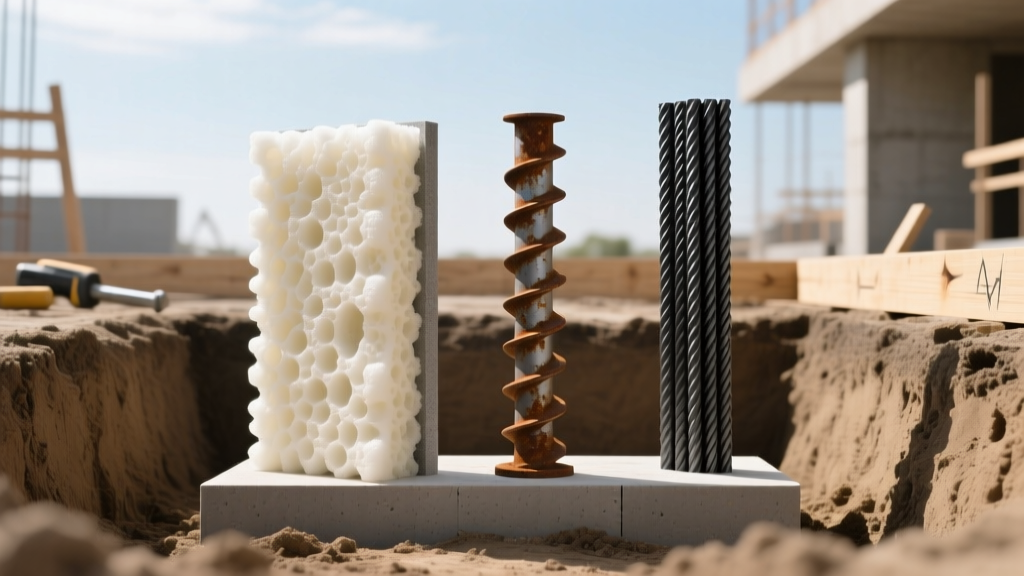
The Core Taxonomy of Foundation Stabilization Materials
Effective foundation stabilization requires moving beyond reactive patching to engineered load transfer and soil modification. Selecting the correct material hinges on understanding the specific failure mechanism—whether it is differential settlement, shear cracking, or soil voiding. The modern material taxonomy for foundation stabilization divides into three primary categories: Deep Load Transfer, Soil Modification, and Structural Reinforcement.
Category 1: Deep Load Transfer (Piers and Piles)
When surface soils lack adequate bearing capacity, loads must be transferred to a stable stratum or bedrock. Steel push piers (e.g., Foundation Supportworks systems) utilize the structure's own weight to drive steel pipe sections hydraulically to refusal. Helical piers (e.g., Chance/Hubbell systems) are mechanically torqued into the ground, making them ideal for lighter loads or new construction where the structure cannot provide the necessary reaction force for push piers. Both systems typically offer ultimate load capacities ranging from 50,000 lbs to over 100,000 lbs per pier.
Category 2: Soil Modification & Void Filling (Foams and Grouts)
For slab-on-grade foundations experiencing uniform settlement or voiding due to washouts, deep piers are often overkill. High-density polyurethane foams and cementitious slurry grouts are injected directly beneath the slab. These materials densify loose soils, fill subterranean voids, and provide immediate slab lifting through controlled expansion pressure.
Category 3: Structural Reinforcement (Carbon Fiber and Epoxy)
Once the foundation is stabilized and re-leveled, the concrete itself often requires structural reinforcement to restore tensile strength. Carbon fiber straps (e.g., Fortress Stabilization 12K carbon grids) and structural epoxy resins (e.g., Sika Sikadur) are applied to basement walls and grade beams to resist hydrostatic pressure and prevent future flexural or shear cracking.
Material Selection Matrix: Matching Failure Modes to Solutions
Choosing the right stabilization material requires diagnosing the exact failure mode. The matrix below provides a rapid-reference framework for structural engineers and foundation repair contractors.
| Failure Mode | Primary Material | Secondary Material | Contraindications |
|---|---|---|---|
| Differential Settlement (Deep) | Steel Push Piers | Carbon Fiber Straps | Lightweight structures (use helical instead) |
| Slab Voiding / Washouts | Polyurethane Foam (2.0 - 3.5 lb/ft³) | Cementitious Grout | High water tables without drainage |
| Expansive Soil Heave | Helical Piers (with void form) | Polyurethane Moisture Barrier | Rigid grout injection (will crack) |
| Basement Wall Bowing | Carbon Fiber Straps (130k PSI) | Steel I-Beams | Epoxy alone (insufficient tensile strength) |
| Grade Beam Shear Cracking | Structural Epoxy Injection | External Post-Tensioning | Polyurethane foam (lacks structural bond) |
Deep Dive: Polyurethane vs. Cementitious Slurry for Slab Lifting
The debate between high-density polyurethane foam and traditional mudjacking (cementitious slurry) is central to modern slab stabilization. Understanding the chemical and physical properties of each is critical for long-term success.
High-Density Polyurethane Foam
Two-part polyurethane resins (such as Alchemy-Spetec AP Lift 430) react upon mixing, expanding up to 20 times their liquid volume. The material cures in roughly 15 seconds, forming a rigid, closed-cell structure with a compressive strength of 40 to 60 PSI and a density of 3.5 to 4.5 lb/ft³.
Advantage: The injection holes are only 5/8-inch in diameter, minimizing cosmetic damage. The closed-cell structure is completely impervious to water, meaning it will not wash away or degrade in wet soils.
Cementitious Slurry (Mudjacking)
Traditional slurry consists of topsoil, sand, and Portland cement, weighing upwards of 100 lb/ft³. It requires 1.5-inch to 2-inch injection holes and takes 24 to 48 hours to fully cure.
Advantage: The material cost is significantly lower than polyurethane, making it viable for large-scale municipal or highway slab lifting where cosmetic hole size is irrelevant. However, the heavy weight adds immense dead load to already compromised subgrades, and the material is highly susceptible to erosion if water infiltrates the sub-base.
Pricing & ROI: 2026 Contractor Benchmarks
Accurate estimating requires separating material costs from labor and equipment mobilization. The following benchmarks reflect current national averages for residential and light-commercial stabilization.
| Stabilization Method | Unit of Measure | Average Installed Cost | Material Cost Factor |
|---|---|---|---|
| Steel Push Piers | Per Pier (avg 25ft depth) | $1,600 - $2,400 | 35% of total |
| Helical Piers | Per Pier (avg 20ft depth) | $1,900 - $2,800 | 40% of total |
| Polyurethane Slab Lift | Per Square Foot | $7.00 - $14.00 | 60% of total |
| Cementitious Mudjacking | Per Square Foot | $4.00 - $8.00 | 20% of total |
| Carbon Fiber Straps | Per Strap (4-inch x 10ft) | $850 - $1,300 | 25% of total |
Diagnostic Decision Tree for Stabilization
Before specifying a material, contractors must execute a rigorous diagnostic sequence to avoid misapplication. Follow this step-by-step framework:
- Soil Boring and Moisture Mapping: Extract soil samples at 5-foot intervals down to the bearing stratum. Test for plasticity index (PI). If the PI exceeds 35 (highly expansive clay), deep piers bypassing the active zone are mandatory; foam injection will only provide temporary relief.
- Load Calculation: Calculate the total dead and live load of the failing section. Divide by the required factor of safety (typically 2.0). If the required capacity per linear foot exceeds 10,000 lbs, specify steel push piers over helical piers.
- Crack Pattern Analysis: Map the foundation cracks. Stair-step cracking in masonry indicates differential settlement (requires piers). Horizontal cracking in poured concrete basement walls indicates lateral earth pressure (requires carbon fiber or steel I-beams).
- Hydrological Assessment: Identify water intrusion paths. If sub-slab water flow is active, polyurethane foam must be used instead of cementitious grout to prevent material washout before curing.
Authoritative Standards & Code Compliance
All foundation stabilization materials and installations must comply with local building codes and industry standards. The design and installation of deep foundation elements like piers are heavily governed by the Geo-Institute of the American Society of Civil Engineers (ASCE), which provides rigorous guidelines on load testing and soil-structure interaction. Furthermore, when utilizing structural epoxies and carbon fiber for concrete reinforcement, contractors must adhere to the guidelines established by the American Concrete Institute (ACI), specifically ACI 440 for fiber-reinforced polymer (FRP) systems and ACI 224 for crack repair. Ensuring your material selections align with these institutional frameworks not only guarantees structural integrity but also protects against liability in post-repair inspections.