2026 Foundation Settling Repair Cost: Regional Guide
Compare 2026 foundation settling repair costs by region. Analyze how expansive clay, frost heave, and karst soils dictate pier and slabjacking prices.

The Mechanics of Settling: Why Geography Dictates Price
Foundation settling is not a uniform structural failure; it is a localized reaction to subsurface hydrology and soil mechanics. A stair-step crack in a Dallas masonry wall stems from entirely different geotechnical forces than a sloping floor in a Minneapolis ranch home. Consequently, the foundation settling repair cost fluctuates wildly based on regional soil composition, frost line depths, and municipal permitting requirements. According to data mapped via the USDA Web Soil Survey, over 25% of U.S. residential structures are built on expansive soils that shift volumetrically with moisture changes, driving the highest concentration of heavy-duty underpinning costs in the South and Midwest.
Understanding your specific regional hazard is the first step in decoding contractor estimates. A contractor in Florida dealing with karst topography will deploy entirely different equipment—and bill at a different rate—than a contractor in Ohio addressing frost heave.
2026 Regional Cost Matrix: Soil Types & Repair Methods
| Region | Dominant Soil / Hazard | Primary Failure Mode | Standard Repair Method | Avg 2026 Project Cost |
|---|---|---|---|---|
| South & Southeast | Expansive Clay (Smectite) | Seasonal shrink/swell cycles | Steel Push Piers | $18,000 - $45,000 |
| Midwest & Northeast | Silt, Loam, Frost-Susceptible | Frost heave and freeze-thaw | Polyurethane Slabjacking | $3,500 - $12,000 |
| Southeast (FL/TN) | Karst / Limestone Bedrock | Sinkhole activity & voids | Deep Helical Piers | $22,000 - $55,000+ |
| West & Southwest | Arid / Desiccated Clay | Drought-induced soil shrinkage | Helical Piers & Root Barriers | $15,000 - $35,000 |
Deep Dive: Regional Settling Profiles & Pricing
South & Southeast: Expansive Clay and High Pier Counts
States like Texas, Oklahoma, and Louisiana are dominated by Blackland Prairie soils and red clays rich in smectite and montmorillonite minerals. These clays act like sponges, expanding significantly during wet seasons and shrinking during droughts. This constant volumetric change snaps shallow concrete footings.
The Repair Reality: Surface-level fixes fail here. Contractors must bypass the active clay zone and drive steel push piers down to load-bearing strata or bedrock, which in areas like the Dallas-Fort Worth metroplex can be 20 to 45 feet deep. In 2026, installed push piers cost between $1,800 and $3,200 per pier. Because settling often affects an entire elevation of a home, jobs routinely require 12 to 20 piers, pushing total costs into the $25,000–$45,000 range.
Midwest & Northeast: Frost Heave and Freeze-Thaw Cycles
In states like Minnesota, Ohio, and New York, the primary enemy is water saturation combined with freezing temperatures. When poorly drained silt or loam soils freeze, they expand upward (frost heave), lifting foundation footings unevenly. When the ice melts, the soil loses bearing capacity, and the foundation drops.
The Repair Reality: Deep underpinning is rarely necessary unless the frost line was improperly calculated during original construction (e.g., footings poured at 30 inches instead of the required 42+ inches). The standard 2026 protocol involves correcting exterior drainage and utilizing closed-cell polyurethane foam slabjacking. High-density structural foam (typically 3.0 to 4.0 lb/ft³ density) is injected beneath the slab to fill voids and lift the concrete. Pricing averages $12 to $28 per square foot, making localized repairs highly cost-effective compared to Southern pier jobs.
West & Southwest: Drought Shrinkage and Seismic Variables
California, Arizona, and Colorado face unique challenges. Prolonged droughts cause deep soil desiccation, pulling moisture away from foundation perimeters and causing the soil to pull away from the footing. Additionally, California's seismic codes require specialized structural connections.
The Repair Reality: Contractors often utilize helical piers, which are mechanically screwed into the ground rather than hydraulically pushed. Helical piers are ideal for arid regions where the soil lacks the density required to provide hydraulic driving resistance for push piers. Furthermore, repairs in California often require concurrent seismic retrofitting (bolting sill plates to footings), adding $3,000 to $8,000 to the baseline foundation settling repair cost.
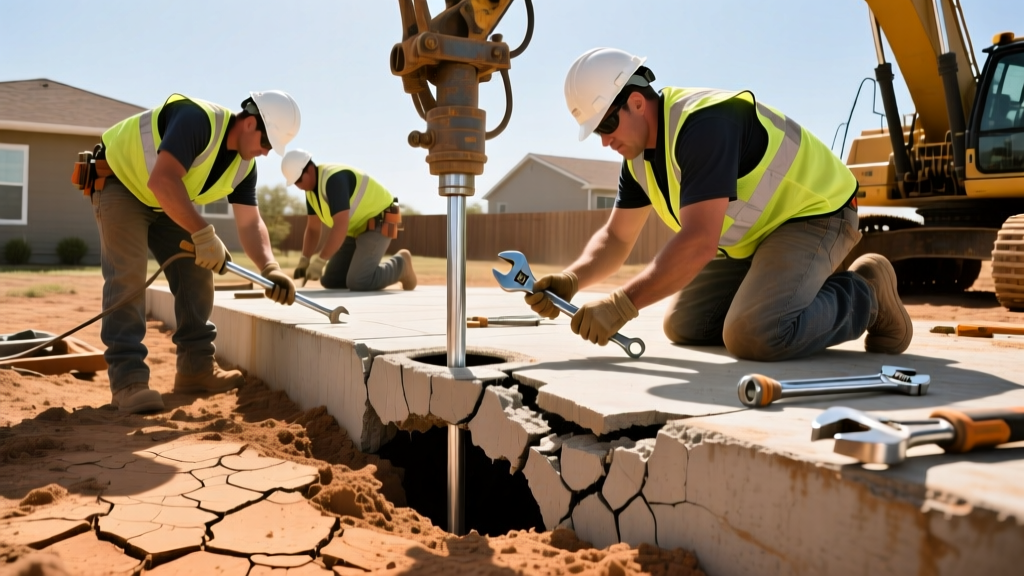
Method-Specific Unit Pricing (2026 Baselines)
Material & Installation Unit Costs
- Steel Push Piers (Eccentric/Concentric): $1,800 – $3,200 per pier. Includes hydraulic driving, steel brackets, and manifold syncing. Depth dictates final price.
- Helical Piers (Round Shaft / Square Shaft): $1,500 – $2,800 per pier. Torque-to-capacity verification ensures exact load-bearing metrics. Preferred for lighter loads or karst voids.
- Polyurethane Foam Jacking (Deep Injection): $12 – $28 per sq. ft. Cures in 15 minutes, impervious to water washout, and requires 5/8-inch drill holes.
- Traditional Mudjacking (Cement Slurry): $5 – $10 per sq. ft. Declining in use due to heavy weight (120+ lbs/ft³) which can exacerbate settling in weak soils.
Hidden Regional Costs: Engineering, Permits, and Access
The foundation settling repair cost quoted by a contractor rarely includes the prerequisite geotechnical and municipal requirements. Budget for the following regional variables:
Budget Overrun Triggers
- Geotechnical Engineering Report ($1,500 - $3,500): Mandatory in many Texas and California municipalities before a permit is issued. Requires soil boring logs to determine the exact depth of the load-bearing strata.
- Structural Engineer Stamp ($800 - $1,500): Required to design the pier placement plan and bracket load calculations.
- Landscaping & Hardscape Demolition ($2,000 - $6,000): If a concrete patio, HVAC unit, or mature tree root system blocks access to the foundation footing, contractors will charge for removal and will not include replacement in their scope of work.
- Karst Void Grouting ($5,000 - $15,000+): In Florida and Tennessee, if a helical pier encounters a subterranean limestone void, structural compaction grouting must be pumped into the void before the pier can achieve torque refusal.
Decision Framework: Matching Symptoms to Solutions
Use this diagnostic framework to verify if your contractor is proposing the correct regional solution. Misdiagnosing the soil mechanic leads to catastrophic repair failures.
- Symptom: Doors sticking on the second floor; exterior brick stair-step cracks; interior drywall tears at window headers.
Diagnosis: Differential settlement (one side of the house is dropping).
Required Action: Deep foundation underpinning (Push or Helical Piers). Slabjacking will not fix structural footing failure. - Symptom: Interior floor sloping toward the center of the room; cracks in floor tiles; no exterior masonry damage.
Diagnosis: Slab settlement or sub-grade erosion (common in post-tension slabs or plumbing leak washouts).
Required Action: Polyurethane deep-injection slabjacking to fill voids and re-level the interior grade beam. - Symptom: Foundation cracks that open in the winter and close tightly in the summer.
Diagnosis: Frost heave or seasonal clay swell.
Required Action: Do not install rigid piers immediately. Consult a geotechnical engineer to implement moisture-control systems (root barriers, French drains, or automated soaker hoses) to stabilize the soil's moisture content before locking the foundation in place.
For comprehensive guidelines on mitigating foundation hazards related to extreme weather and soil instability, refer to the FEMA Building Science resource library, which provides critical data on frost-protected shallow foundations and expansive soil mitigation strategies. Accurate diagnosis paired with region-specific repair methodologies is the only way to ensure long-term structural stability and justify the investment in your property's foundation.
Written by
David NakamuraDavid Nakamura is a licensed architect (AIA) and construction technology writer focused on sustainable building methods, mass timber engineering, and high-performance building envelopes. He holds a Master of Architecture from the University of Washington and is a certified Passive House Consultant (CPHC). David spent eight years at the Seattle firm Mithun, where he led the design of three LEED Platinum projects, before founding his own practice specializing in net-zero residential design. He serves on the editorial advisory board of GreenBuilder Magazine and has authored peer-reviewed papers on cross-laminated timber (CLT) connections for the Journal of Structural Engineering. In his spare time, David teaches woodworking at Pratt Fine Arts Center and kayaks the Puget Sound.
More from David Nakamura
View all
Construction Cost
Labor Cost to Build a Deck Per Sq Ft: 2026 Installation Guide
Discover the exact labor cost to build a deck per sq ft in 2026. This installation guide breaks down contractor rates, complexity factors, and hidden fees.
Aug 4, 2026

Construction Cost
How Much Does It Cost to Build a 3 Bedroom House? Financing Guide
Learn exactly how much it costs to build a 3 bedroom house and explore 2026 financing options, construction loan types, and budget frameworks for your build.
Aug 4, 2026

Construction Cost
Cost to Build a Tennis Court: 2026 Guide
How much does it cost to build a tennis court in 2026? Breakdowns for asphalt, concrete, and synthetic surfaces plus fencing and lighting.
Jul 30, 2026