How Much Can Foundation Repair Cost? 2026 Type Comparison
Discover how much foundation repair can cost in 2026. Compare pricing for piering, slabjacking, carbon fiber, and crack injection to budget accurately.

The True Cost Spectrum of Foundation Remediation
When homeowners ask how much can foundation repair cost, the answer spans a massive spectrum based on the failure mechanism, soil composition, and structural load. In 2026, minor cosmetic crack sealing starts around $400, while severe structural underpinning for a sprawling single-family home can exceed $45,000. The Foundation Performance Association (FPA) emphasizes that accurate pricing requires matching the specific symptom to the correct engineered solution. Applying a superficial fix to a deep-seated soil consolidation issue will only delay inevitable structural failure.
This guide breaks down the exact costs, material specifications, and engineering applications for the primary foundation repair types, providing a practical framework to evaluate contractor estimates.
Deep Underpinning: Push Piers vs. Helical Piers
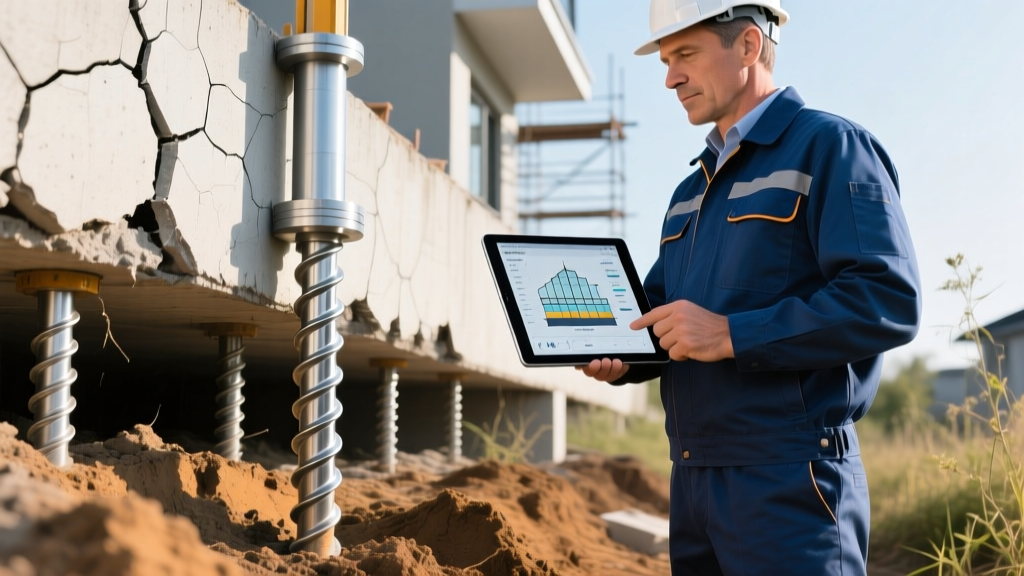
When a foundation settles due to unstable, compressible, or expansive soil layers, contractors must bypass the weak soil and transfer the structural load to bedrock or a stable load-bearing stratum. This is achieved through deep underpinning.
Push Piers (Resistance Piers)
Push piers are steel pipe sections driven hydraulically into the ground using the actual weight of the structure as resistance. They are ideal for heavy, multi-story masonry or concrete structures. Installation requires excavating a 3x3 foot working pit at each pier location. The typical cost ranges from $1,600 to $2,600 per pier, with most homes requiring 15 to 25 piers for a single settling wall. Push piers must be driven to 'refusal' (bedrock) or a specified friction depth, often 25 to 45 feet deep.
Helical Piers
Helical piers feature steel shafts with circular bearing plates (helices) and are mechanically screwed into the soil. Unlike push piers, they do not rely on the structure's weight for installation, making them mandatory for lighter structures like single-story wood-frame homes, porches, or garage slabs. Contractors verify load capacity in real-time by monitoring hydraulic motor torque; for example, 5,500 ft-lbs of installation torque typically correlates to a safe working load of 40,000 lbs. Helical piers cost between $1,900 and $3,200 per pier due to the higher material cost of the forged helices and specialized torque motors.
| Feature | Push Piers | Helical Piers |
|---|---|---|
| Cost Per Pier (2026) | $1,600 - $2,600 | $1,900 - $3,200 |
| Best Application | Heavy structures (2+ stories, brick) | Light structures, new construction, porches |
| Installation Method | Hydraulic ram (uses structure weight) | Rotary torque motor (screwed into soil) |
| Load Verification | Hydraulic pressure gauge | Torque-to-capacity correlation |
| ASTM Testing Standard | ASTM D1143 (Static Load) | AC358 (Acceptance Criteria) |
Slab Lifting Technologies: Mudjacking vs. Polyurethane
For sunken concrete slabs (driveways, patios, interior slab-on-grade floors) where the structural integrity of the concrete itself remains intact, slab lifting is the most cost-effective remedy. The goal is to fill the void beneath the slab and hydraulically raise it to its original grade.
Traditional Mudjacking
Mudjacking involves pumping a cementitious slurry (a mix of topsoil, sand, cement, and water) beneath the slab through 2-inch diameter drill holes. The slurry weighs approximately 100 lbs per cubic foot. While effective, the heavy material can cause further subsidence in highly compressible clay soils. Mudjacking costs $4 to $7 per square foot. The primary drawback is the large drill holes and the 24-to-48-hour curing time before the slab can bear heavy loads.
Closed-Cell Polyurethane Foam
Polyurethane foam injection uses a two-part resin that expands up to 30 times its liquid volume upon mixing beneath the slab. The cured foam is incredibly lightweight (2.5 to 4.0 lbs per cubic foot) and completely hydrophobic, meaning it will not wash away or degrade during heavy rain events. Installation requires only 5/8-inch drill holes, and the slab can be driven on just 15 minutes after injection. Due to the specialized chemical resins and equipment, polyurethane lifting costs $8 to $14 per square foot.
Basement Wall Stabilization: Carbon Fiber vs. Steel I-Beams
Lateral soil pressure, often exacerbated by hydrostatic buildup and frost heave, causes poured concrete and CMU (cinder block) basement walls to bow inward. The American Concrete Institute (ACI) provides strict guidelines on reinforcing masonry against lateral loads. The repair type depends entirely on the degree of deflection.
- Carbon Fiber Straps ($800 - $1,300 per strap): Ideal for walls that have bowed less than 2 inches. These straps utilize aerospace-grade carbon and Kevlar weaves, offering tensile strengths exceeding 10,000 lbs. They are epoxied directly to the wall, creating a zero-clearance profile that allows homeowners to finish the basement directly over the straps.
- Steel I-Beam Bracing ($1,600 - $2,400 per beam): Required for walls deflected more than 2 inches or walls with severe horizontal shearing. Steel beams are anchored into the basement floor slab and bolted to the floor joists above. They can be mechanically tightened over time to slowly push the wall back toward plumb, a feat carbon fiber cannot achieve.
Decision Framework: Matching the Symptom to the Repair
Diagnosing the correct repair type prevents overspending on unnecessary interventions. Use this framework to align your visual symptoms with the appropriate engineering solution:
- Symptom: Stair-step cracking in exterior brick veneer or CMU walls, accompanied by sticking doors on the first floor.
Cause: Differential settlement of the perimeter footing.
Solution: Deep underpinning (Push or Helical Piers) at the settling corner. - Symptom: Interior slab floor sloping toward the center of the room, with no cracking in the perimeter drywall.
Cause: Subgrade soil erosion or consolidation beneath the interior slab.
Solution: Polyurethane foam slab lifting. - Symptom: Horizontal cracking midway up a basement wall, with white efflorescence (mineral deposits) leaking through.
Cause: Hydrostatic pressure and lateral soil loading.
Solution: Carbon fiber straps (if deflection is under 2 inches) plus exterior French drain installation to relieve water pressure.
Hidden Variables That Inflate 2026 Repair Quotes
The per-pier or per-square-foot metrics rarely tell the whole story. When budgeting, homeowners must account for auxiliary costs that contractors often list as 'exclusions' in their initial proposals:
- Geotechnical Soil Reports: In regions with highly expansive clays or karst topography, structural engineers may require a soil boring analysis before designing a piering system. Expect to pay $1,800 to $3,500 for a licensed geotechnical engineer to drill test bores and provide a bearing capacity report.
- Landscaping and Hardscape Restoration: Piering requires heavy machinery and excavation along the foundation perimeter. Replacing destroyed concrete walkways, irrigation lines, and mature shrubbery can add $2,000 to $8,000 to the total project cost.
- Interior Flooring Removal: If interior slab lifting or interior piering is required, the contractor will not remove hardwood, tile, or carpet. Hiring a flooring specialist to pull and reinstall finishes adds $3 to $9 per square foot.
Crack Injection: Epoxy vs. Polyurethane
Not all foundation cracks indicate structural failure. Shrinkage cracks that occur during the initial 28-day concrete curing process are common. However, they must be sealed to prevent water intrusion and rebar corrosion.
Epoxy Injection ($450 - $850 per crack): Epoxy is a structural adhesive. Once cured, it is stronger than the concrete itself, effectively welding the crack back together. It is strictly used for dry, non-leaking structural cracks. If water is present during application, the epoxy will fail to bond.
Polyurethane Injection ($350 - $650 per crack): Polyurethane is a flexible, hydrophilic resin that expands upon contact with water. It is the mandatory choice for active, leaking cracks. While it does not restore the structural tensile strength of the wall, it creates a permanent, watertight seal that flexes with minor seasonal thermal expansion. For comprehensive grading and drainage standards, refer to guidelines published by the American Society of Home Inspectors (ASHI) regarding exterior water management.
Frequently Asked Questions
Does homeowner's insurance cover foundation repair?
Standard HO-3 policies explicitly exclude foundation damage caused by soil expansion, contraction, settling, or water seepage. Insurance will only cover foundation repairs if the damage was the direct result of a covered peril, such as a sudden plumbing leak beneath the slab or a vehicle striking the foundation. Always review your policy's 'earth movement' exclusion clause.
How long does a typical piering installation take?
A standard 20-pier exterior underpinning project takes 7 to 12 working days. This includes 2 days for permit acquisition and utility marking (811), 4 to 6 days for excavation and hydraulic driving, and 1 to 2 days for site cleanup and concrete patching of the working pits.
Can I sell my house with an unrepaired foundation issue?
Legally, yes, but you must disclose the known defect in most states. Practically, unrepaired structural issues will cause conventional mortgage lenders to deny the loan after the appraiser flags the condition. You will likely be forced to sell to cash buyers or investors at a 20% to 40% discount below market value to account for their repair risk.
Written by
David NakamuraDavid Nakamura is a licensed architect (AIA) and construction technology writer focused on sustainable building methods, mass timber engineering, and high-performance building envelopes. He holds a Master of Architecture from the University of Washington and is a certified Passive House Consultant (CPHC). David spent eight years at the Seattle firm Mithun, where he led the design of three LEED Platinum projects, before founding his own practice specializing in net-zero residential design. He serves on the editorial advisory board of GreenBuilder Magazine and has authored peer-reviewed papers on cross-laminated timber (CLT) connections for the Journal of Structural Engineering. In his spare time, David teaches woodworking at Pratt Fine Arts Center and kayaks the Puget Sound.
More from David Nakamura
View all
Construction Cost
Labor Cost to Build a Deck Per Sq Ft: 2026 Installation Guide
Discover the exact labor cost to build a deck per sq ft in 2026. This installation guide breaks down contractor rates, complexity factors, and hidden fees.
Aug 4, 2026

Construction Cost
How Much Does It Cost to Build a 3 Bedroom House? Financing Guide
Learn exactly how much it costs to build a 3 bedroom house and explore 2026 financing options, construction loan types, and budget frameworks for your build.
Aug 4, 2026

Construction Cost
Cost to Build a Tennis Court: 2026 Guide
How much does it cost to build a tennis court in 2026? Breakdowns for asphalt, concrete, and synthetic surfaces plus fencing and lighting.
Jul 30, 2026