Garage Foundation Repair Cost: Price Guide by Damage Type
Discover the true garage foundation repair cost. Compare 2026 pricing for polyurethane foam, helical piers, and epoxy by specific damage types.

The True Cost of Ignoring Garage Foundation Settlement
Garage foundations endure a uniquely punishing environment compared to the rest of your home's footprint. Unlike climate-controlled living spaces, a garage slab must support dynamic point-loads from 4,000 to 6,000-pound vehicles, resist chemical degradation from road salts and motor oil, and combat aggressive water runoff channeled directly from the driveway apron. When the subgrade fails, the resulting settlement compromises the structural integrity of the stem walls, binds the overhead garage door tracks, and creates pathways for hydrostatic water intrusion.
Understanding the exact garage foundation repair cost requires moving beyond national averages and diagnosing the specific failure mode. A sunken center slab requires a vastly different remediation strategy—and budget—than a failing perimeter footing. According to the Portland Cement Association, untreated concrete cracking allows moisture to reach the steel rebar, accelerating spalling and reducing the slab's load-bearing capacity by up to 40% within five years.
Over 60% of garage slab settlements originate at the driveway apron. If your driveway slopes toward the garage and lacks a functioning trench drain, thousands of gallons of annual rainfall will pool at the threshold, eroding the uncompacted fill dirt beneath the slab edge. Repairing the interior slab without addressing the exterior grading and apron drainage guarantees a repeat failure within 24 months.
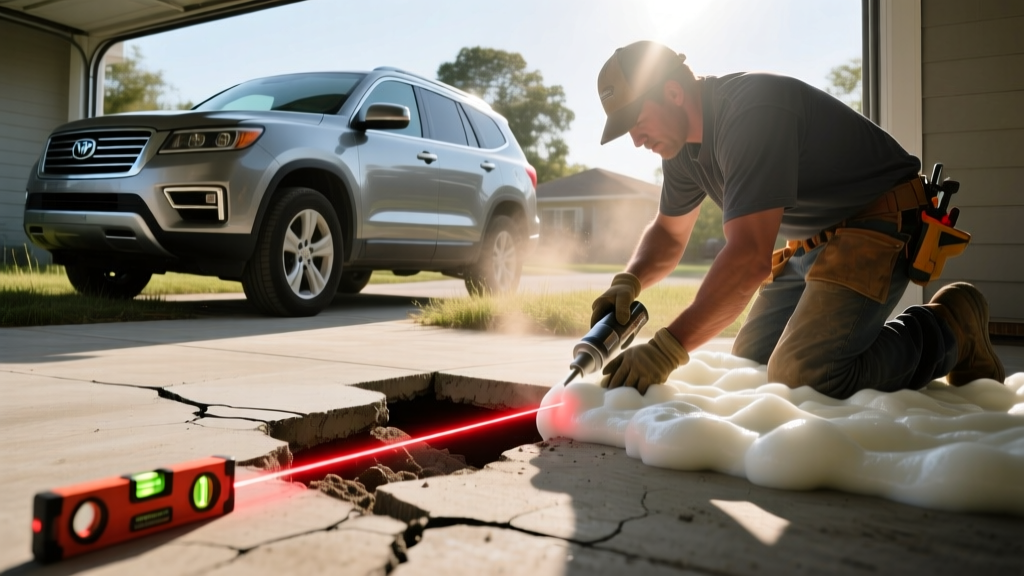
Garage Foundation Repair Cost Matrix by Repair Method
The following matrix breaks down 2026 market rates for professional remediation, categorized by the specific structural intervention required. Prices reflect fully burdened contractor rates, including engineering permits and soil testing.
| Repair Method | Best Application | Average Cost Range | Expected Lifespan |
|---|---|---|---|
| Polyurethane Foam Injection | Void filling, slab lifting, water sealing | $10 - $25 per sq. ft. | 100+ years |
| Mudjacking (Slabjacking) | Minor slab leveling, exterior aprons | $3 - $8 per sq. ft. | 5 - 10 years |
| Helical Piers | Stem wall failure, light structural loads | $1,500 - $2,800 per pier | 100+ years |
| Steel Push Piers | Deep load-bearing strata, heavy settlement | $1,200 - $2,200 per pier | 100+ years |
| Carbon Fiber Straps | Bowing stem walls, horizontal cracking | $800 - $1,500 per strap | Permanent |
| Epoxy Crack Injection | Non-structural shrinkage cracks | $500 - $1,200 per project | Permanent |
Slabjacking: Mud vs. Polyurethane Chemistry
When a garage slab sinks uniformly or develops a localized void beneath the vehicle parking zone, slabjacking is the primary intervention. However, the material choice dictates the long-term viability of the repair. Traditional mudjacking utilizes a slurry of topsoil, sand, and cement. This mixture weighs over 110 pounds per cubic foot, adding massive dead load to an already failing subgrade. Furthermore, mudjacking requires drilling 2-inch diameter holes through your garage floor, which can compromise the slab's tensile strength.
Conversely, two-part high-density polyurethane foam expands to 2.5 times its liquid volume and cures at a lightweight 2.5 to 4 lbs per cubic foot. It requires only 5/8-inch injection ports, cures in 15 minutes (allowing you to park your vehicle on the slab the same day), and is entirely impervious to water washout. While the upfront garage foundation repair cost for polyurethane is higher, the elimination of repeat washout failures makes it the superior economic choice for garage environments.
Deep Foundation Piers for Severe Perimeter Settlement
If the damage extends beyond the floating slab and affects the structural stem walls—evidenced by diagonal cracking radiating from the garage door corners or binding of the overhead door tracks—slabjacking will not suffice. The entire footing is likely dropping due to inadequate depth or expansive soil failure. According to research published by the Building Science Corporation, expansive clays with a high plasticity index (PI > 25) can exert upward swelling pressures exceeding 15,000 pounds per square foot, easily snapping shallow concrete footings.
In these scenarios, structural engineers specify underpinning. Steel push piers are driven hydraulically through the unstable soil until they refusal on load-bearing bedrock or dense strata, typically 20 to 40 feet deep. Helical piers, which feature screw-like bearing plates, are torqued into the ground and are preferred when the structure cannot provide the downward force required to push a steel pier.
Diagnosing the Damage: Symptom-to-Solution Decision Tree
Use this diagnostic framework to identify your specific failure mode before soliciting contractor bids. This prevents contractors from upselling unnecessary deep underpinning for simple surface voids.
- Symptom: Center of the slab is sinking; hollow sound when tapped with a hammer.
Cause: Subgrade washout from plumbing leaks or poor exterior drainage.
Required Fix: Polyurethane foam injection to fill voids and lift the slab. - Symptom: Diagonal cracks originating from the top corners of the garage door opening.
Cause: Corner footing settlement or steel lintel deflection over the door span.
Required Fix: Helical pier underpinning at the corners, followed by masonry crack stitching. - Symptom: Horizontal cracking and inward bowing of the concrete block stem wall.
Cause: Lateral hydrostatic pressure from saturated exterior backfill.
Required Fix: Carbon fiber strap reinforcement paired with an exterior French drain system. - Symptom: Fine, map-like crazing on the surface with no vertical displacement.
Cause: Plastic shrinkage during the original concrete curing process.
Required Fix: Cosmetic concrete resurfacing or penetrating silane-siloxane sealer.
Hidden Variables That Spike Your Final Invoice
The initial quote for garage foundation repair rarely accounts for site-specific complications. Be prepared for the following hidden variables that routinely increase final project costs by 15% to 30%:
1. Sub-Slab Plumbing Leaks
If your garage houses a water heater or utility sink, a slow leak in the copper or PEX supply line will saturate the subgrade, turning clay into mud. Contractors will halt lifting operations until a licensed plumber performs a hydrostatic pressure test and repairs the leak. Expect to add $400 to $1,200 for leak detection and sub-slab pipe rerouting.
2. Tree Root Intrusion
Species like Oak, Willow, and Silver Maple possess aggressive, shallow root systems that seek out the moisture differential beneath your garage slab. Roots can exert enough turgor pressure to fracture concrete. If a structural engineer identifies root intrusion, you must budget for root barrier installation ($20 - $35 per linear foot) or selective tree removal before underpinning can begin.
3. Hazardous Material Abatement
Garages built prior to 1980 frequently feature asbestos-containing floor tiles or lead-based paint on the stem walls. If polyurethane injection or epoxy grinding is required, state regulations mandate professional abatement, adding $1,500 to $3,000 to the project baseline.
"Never authorize a foundation repair contract based solely on a contractor's visual inspection. Always require a geotechnical soil report and an independent structural engineer's assessment. The Environmental Protection Agency (EPA) notes that unresolved moisture dynamics will destroy any mechanical repair within a single freeze-thaw cycle."
DIY vs. Professional Remediation: Where to Draw the Line
While the internet is saturated with DIY foundation repair kits, the structural stakes of a garage—which often supports a second-story living space or a heavy roof truss system—require strict boundaries.
Safe for DIY
- Applying silane-siloxane penetrating sealers to prevent future water ingress.
- Injecting low-viscosity epoxy into non-structural, dormant shrinkage cracks using gravity-feed kits.
- Regrading the exterior soil to ensure a 5% slope away from the garage stem wall.
- Installing exterior downspout extensions and trench drains.
Strictly Professional
- Operating high-pressure polyurethane injection rigs (risk of slab blowout or chemical burns).
- Hydraulic driving of steel push piers (requires engineering load calculations).
- Mudjacking heavy cementitious slurries (requires specialized pumps and precise volume control).
- Installing carbon fiber straps (requires structural epoxy saturation and precise tensioning).
Frequently Asked Questions
Does homeowners insurance cover garage foundation repair?
Standard HO-3 policies explicitly exclude "earth movement," meaning settlement caused by expansive soils, drought, or poor compaction is entirely your financial responsibility. However, if the settlement was directly caused by a sudden, covered peril—such as a burst municipal water main undermining your property or a vehicle striking the structural columns—you may have a valid claim. Always document the timeline of the damage relative to the triggering event.
How long must I wait to park my car after polyurethane foam lifting?
High-density structural polyurethane reaches 90% of its ultimate compressive strength within 15 minutes of injection. You can safely park a standard 5,000-pound SUV or truck on the repaired garage slab immediately after the contractor removes the injection ports and patches the holes with hydraulic cement.
Can I use self-leveling concrete compound instead of slabjacking?
Self-leveling compounds are strictly cosmetic interior floor finishes designed to correct minor surface undulations (typically less than 1/2 inch). They possess no structural load-bearing capacity and will immediately crack and crumble under the dynamic point-loads of vehicle tires if applied over an active, unsupported void. True settlement must be addressed from the subgrade up.
Written by
Elena RodriguezElena Rodriguez is a civil engineer and technical writer specializing in concrete technology, masonry systems, and ASTM/ACI compliance. She earned her B.S. in Civil Engineering from Texas A&M University and spent a decade at a materials testing laboratory, performing over 2,000 concrete compressive strength tests and masonry prism evaluations. Elena is an ACI-certified Field Testing Technician (Grade I) and a member of ASTM Committee C12 on Natural Building Stone. She currently consults on forensic engineering cases involving concrete failures and moisture intrusion. Based in San Antonio, TX, Elena is a proud member of the Society of Women Engineers (SWE) and coaches her daughter's FIRST Robotics team.
More from Elena Rodriguez
View all
Walls & Panels
Cost Analysis: Light Gauge Steel Framing Advantages and Disadvantages
Evaluate light gauge steel framing advantages and disadvantages through a strict cost analysis lens, comparing material, labor, and lifecycle expenses.
Aug 4, 2026

Walls & Panels
Gypsum Board Types: Exact Specifications, Thickness & Dimensions
Compare standard, Type X, and moisture-resistant gypsum board types. Get exact specifications, thicknesses, dimensions, and ASTM standards for your project.
Aug 4, 2026

Fire Resistance
Best Fire-Resistant Outdoor Decking Materials: 2026 Buyer Guide
Discover the best fire-resistant outdoor decking materials for 2026. Compare Class A PVC, aluminum, and hardwood options for WUI compliance and safety.
Aug 4, 2026