Top Waterproofing Brands for a Finished Basement: 2026 Product Guide
Compare top 2026 waterproofing brands like Tremco, CETCO, and Schluter for your finished basement. Get product specs, costs, and failure mode insights.
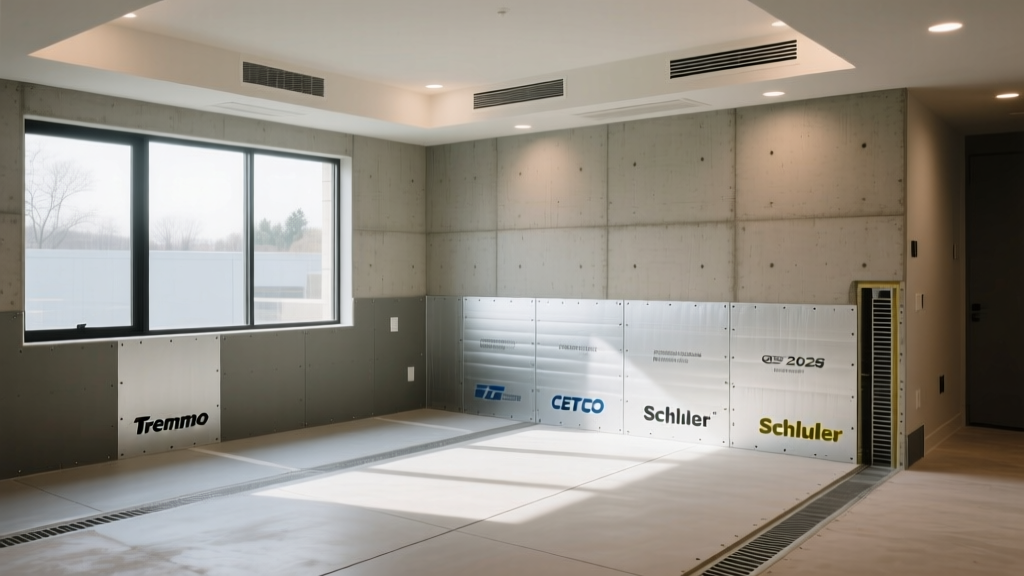
The Hydrostatic Reality of Below-Grade Spaces
Transforming a subterranean concrete box into a livable finished basement requires more than just framing and drywall. It demands a rigorous, multi-layered moisture management strategy. Concrete is inherently porous; it acts like a rigid sponge, drawing groundwater through capillary action while simultaneously allowing soil gases and vapor to migrate inward. When hydrostatic pressure builds against the foundation wall, even micro-fractures become pathways for liquid water.
For a finished basement to survive decades without mold growth, structural degradation, or indoor air quality issues, builders must rely on specialized product lines designed specifically for below-grade environments. This guide deep-dives into the leading 2026 waterproofing, drainage, and insulation systems from Tremco, CETCO, Schluter, and Owens Corning, providing exact specifications, material costs, and assembly frameworks.
The 2024/2026 International Residential Code (IRC) updates to Section R406 now mandate continuous exterior insulation and stricter capillary break requirements for all habitable below-grade spaces in Climate Zones 4 and higher. Damp-proofing (asphalt spray) is no longer sufficient; true waterproofing membranes are required for finished basements in these zones.
Exterior Waterproofing Deep-Dive: Tremco vs. CETCO
The first line of defense for any finished basement is the exterior membrane. This layer must withstand backfill abrasion, soil chemicals, and constant hydrostatic pressure. Two dominant product lines lead the commercial and high-end residential markets.
Tremco Paraseal GM
Tremco’s Paraseal GM is a self-adhering, composite waterproofing membrane consisting of a 60-mil high-density polyethylene (HDPE) sheet laminated to 120 mils of rubberized asphalt. The HDPE layer provides exceptional puncture resistance during backfilling, while the rubberized asphalt self-seals around concrete form tie holes and minor substrate cracks.
- Application: Requires a Tremco-approved primer on the concrete substrate. The membrane is rolled on, and seams are overlapped by 3 inches and sealed with Paraseal Lap Adhesive.
- Cost: $2.80 to $3.50 per square foot (material only).
- Best For: Sites with high water tables and rocky backfill where puncture resistance is critical.
CETCO Volclay Bentonite Panels
CETCO’s Volclay system takes a different approach, utilizing sodium bentonite clay encased in corrugated cardboard or geotextile layers. When exposed to moisture, the bentonite swells up to 15 times its dry volume, forming a dense, impermeable gel that actively seeks out and seals cracks in the concrete substrate.
- Application: Panels are mechanically fastened or adhered to the foundation wall. Unlike liquid or peel-and-stick membranes, Volclay does not require a perfectly smooth substrate, making it ideal for CMU (cinder block) walls.
- Cost: $3.20 to $4.10 per square foot.
- Best For: CMU foundations, blind-side waterproofing (property line walls), and sites where the membrane will be exposed to delayed hydration.
Interior Moisture Management: Schluter Systems
Even with perfect exterior waterproofing, interior moisture management is critical in a finished basement, particularly if the design includes a bathroom, kitchenette, or laundry area. Standard paper-faced gypsum board and wood framing are highly susceptible to the ambient humidity and occasional condensation inherent to below-grade spaces.
Schluter-Kerdi-Board for Below-Grade Wet Areas
While traditionally used in shower enclosures, Schluter-Kerdi-Board is increasingly specified by high-performance builders for entire basement bathroom assemblies. Kerdi-Board is an extruded polystyrene (XPS) foam panel with a waterproof, fleece-webbed surface on both sides.
By replacing standard cement board and drywall in basement wet zones with 1/2-inch Kerdi-Board, you eliminate the organic food source (paper and wood) that mold requires. The panels are cut with a standard utility knife, attached to metal framing with Schluter screws and washers, and seams are sealed with Kerdi-Band and Kerdi-Coll adhesive. This creates a continuous, vapor-tight envelope that prevents interior moisture from migrating into the wall cavity and condensing on the cold concrete.
Thermal & Vapor Control: Owens Corning FOAMULAR NGX
Insulating a finished basement requires materials that will not absorb moisture or lose their R-value when exposed to high humidity. Fiberglass batts are strictly prohibited in below-grade wall assemblies due to their tendency to trap moisture and sag.
For 2026, the industry standard is Owens Corning FOAMULAR NGX (Next Generation Extrusion). This XPS (extruded polystyrene) rigid foam board utilizes a new HFO (hydrofluoroolefin) blowing agent, which drops the Global Warming Potential (GWP) to less than 1, complying with the latest EPA AIM Act regulations while maintaining an R-value of 5 per inch.
According to Building Science Corporation's BSI-011 guidelines, the optimal basement wall assembly places the rigid XPS insulation directly against the interior concrete, sealed with spray foam at the edges. The wood or metal framing is then built 1 inch away from the foam, creating an air gap that allows any incidental moisture to drain downward to the interior footing drain, completely bypassing the stud cavity.
2026 Material Cost & Performance Matrix
| Brand / Product Line | System Type | Material Cost (per sq. ft.) | Primary Advantage | Limitation / Edge Case |
|---|---|---|---|---|
| Tremco Paraseal GM | Exterior HDPE/Asphalt Membrane | $2.80 - $3.50 | Superior puncture resistance; self-sealing | Requires smooth, primed concrete substrate |
| CETCO Volclay | Exterior Bentonite Clay Panel | $3.20 - $4.10 | Active self-healing; works on rough CMU | Requires hydration to activate; poor in high-salt soils |
| Schluter Kerdi-Board | Interior Waterproof Wall Panel | $4.50 - $5.20 (1/2' panel) | Zero organic material; mold-proof; lightweight | Higher material cost than cement board |
| OC FOAMULAR NGX | Interior/Exterior XPS Insulation | $1.10 - $1.40 (per 1' R-5) | Moisture impermeable; 2026 EPA compliant | Must be protected from UV and thermal ignition |
| B-Dry BrightWall | Interior Drainage Wall Panel | $6.00 - $8.00 (installed) | Channels active leaks to sump pump | Aesthetic is industrial; usually requires a finish wall over it |
Critical Failure Modes in Finished Basement Assemblies
Even when using premium product lines, incorrect installation sequencing can lead to catastrophic moisture failure. Avoid these three common edge-case mistakes:
1. The Interior Polyethylene Vapor Trap
Historically, builders placed a 6-mil polyethylene sheet between the basement studs and the drywall to act as a vapor retarder. In a below-grade space, the concrete wall is cooler than the interior air. During summer months, warm, humid interior air migrates outward, hits the cold concrete (or the cold side of the XPS insulation), and condenses. If an interior poly barrier is present, this condensation is trapped inside the wall cavity, saturating the fiberglass and wood. Solution: Never use an interior vapor barrier in a basement. Rely on the XPS foam itself as the vapor control layer, and use a Class III (vapor-permeable) latex paint on the interior drywall.
2. Omission of the Capillary Break
Water can wick upward through the concrete footing and into the foundation wall, bypassing exterior waterproofing that stops at the grade line. Solution: Install a capillary break, such as Tremco’s Polyurethane Caulk or a specialized sill sealer membrane, between the concrete footing and the poured foundation wall before the concrete cures.
3. Unsealed Penetrations
HVAC lines, plumbing stacks, and electrical conduits penetrating the basement rim joist or concrete wall act as direct highways for soil gases (including radon) and bulk water. Solution: Use Tremco’s TremCork or specialized EPDM pipe seals (like those from Oatey) to create an airtight, watertight seal at every penetration point.
Frequently Asked Questions
Can I use spray foam directly against interior basement concrete?
Closed-cell spray polyurethane foam (ccSPF) can be applied directly to interior concrete and acts as both insulation and a vapor retarder (at 2 inches thick). However, it is expensive ($2.50+ per board foot) and makes future inspections of the concrete wall impossible. If a hairline crack develops and leaks, the water will travel behind the foam and pool at the base plate. Rigid XPS boards sealed with canned spray foam at the edges remain the preferred, serviceable method.
Do I need an interior French drain if my exterior waterproofing is flawless?
Yes. The EPA's moisture control guidelines recommend a redundant approach. Exterior membranes can be damaged during backfill or degrade over 50 years. An interior perimeter drain system (like a Form-A-Drain or traditional gravel-and-pipe setup) tied to a sump pump with a battery backup provides a critical fail-safe, ensuring that any water breaching the exterior envelope is captured before it reaches the finished floor.
What is the best flooring underlayment for a finished basement?
Avoid organic underlayments like cork or standard foam. Use a dimpled, high-density polyethylene subfloor system like Dricore or Schluter-Ditra. These products create a 1/4-inch air gap between the concrete slab and the finished flooring, allowing incidental moisture to evaporate laterally and preventing the floor covering from trapping vapor against the slab.