Diagnosing Warning Signs and Average Foundation Repair Cost Texas 2025 vs 2026
Learn to diagnose structural warning signs in expansive clay and analyze the average foundation repair cost Texas 2025 vs 2026 for slab and pier systems.

The Geotechnical Reality: Expansive Clay and Moisture Deficits
Texas foundation failures are rarely the result of poor initial construction; they are predominantly driven by the state's aggressive geotechnical profile. Much of the state, particularly the Dallas-Fort Worth metroplex, San Antonio, and Austin, sits atop the Blackland Prairie and Eagle Ford shale formations. These soils are rich in montmorillonite, a highly reactive clay mineral with a Plasticity Index (PI) frequently exceeding 40. When moisture is introduced, this clay expands with immense hydrostatic pressure; during the relentless Texas summer droughts, it shrinks and pulls away from the foundation base, creating voids that lead to differential settlement.
According to the American Society of Civil Engineers (ASCE), expansive soils cause more financial damage to property owners annually than earthquakes, floods, and tornadoes combined. Diagnosing the specific vector of movement—whether it is edge lift, center heave, or uniform settlement—is the mandatory first step before any underpinning contractor can provide an accurate stabilization plan.
Diagnostic Matrix: Mapping Symptoms to Structural Severity
Homeowners often misinterpret cosmetic drywall cracking as catastrophic structural failure, or conversely, ignore severe masonry fracturing. Use the diagnostic matrix below to triage your property's warning signs before requesting repair estimates.
| Warning Sign | Typical Location | Severity Level | Underlying Mechanism |
|---|---|---|---|
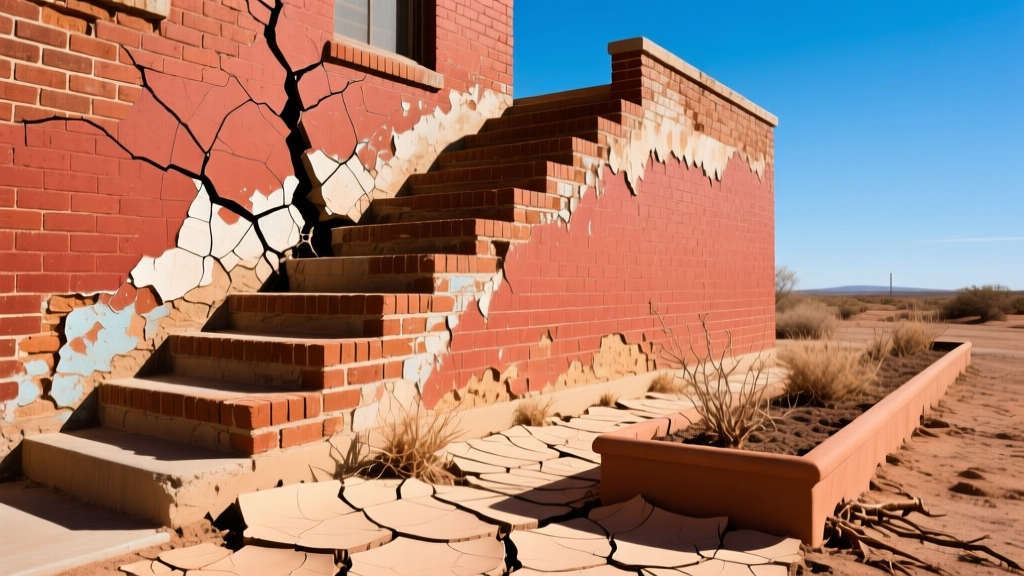
| Stair-step cracking in brick veneer | Exterior walls, near corners or window lintels | High (Structural) | Differential settlement; the rigid masonry cannot flex with the shifting grade beam. |
| Diagonal drywall cracks | Originating from the top corners of interior door frames | Moderate to High | Frame distortion due to slab twisting or localized pier failure beneath load-bearing walls. |
| Frieze board separation | Exterior trim where the siding meets the soffit | Moderate | Slab edge lift; the perimeter of the foundation is heaving upward while the interior remains static. |
| Doors binding on the strike plate | Interior hollow-core or solid wood doors | Low to Moderate | Minor seasonal moisture fluctuation or localized joist deflection (in pier-and-beam systems). |
| Horizontal cracks in basement/block walls | Below-grade retaining walls (rare in TX, common in panhandle) | Critical (Imminent Failure) | Lateral soil pressure exceeding the tensile strength of the unreinforced masonry. |
Breaking Down the Average Foundation Repair Cost Texas 2025 vs 2026
When evaluating the average foundation repair cost Texas 2025, historical industry data indicated a median project spend of approximately $7,200 for standard perimeter stabilization. However, as we navigate 2026, market realities have shifted. Supply chain fluctuations in structural steel, increased diesel costs for hydraulic drilling rigs, and a shortage of specialized geotechnical labor have pushed the true average for comprehensive perimeter stabilization closer to $9,500 - $14,000 for an average-sized single-family home (requiring 15 to 22 piers).
Contractors frequently advertise low 'per-pier' costs to win bids. A contractor quoting $600 per pier for pressed concrete may seem cheaper than one quoting $1,800 for steel push piers. However, the cheaper method may require 30 piers to achieve the same load-bearing strata that 15 steel piers can reach. Always evaluate the total project cost and the depth to refusal, not just the unit price.
2026 Cost Estimates by Repair Method
| Underpinning Method | Cost Per Pier (2026) | Average Total Job (15-20 Piers) | Best Application |
|---|---|---|---|
| Pressed Concrete Piers | $850 - $1,300 | $12,750 - $26,000 | Shallow bedrock areas (e.g., Austin hill country), lighter structural loads. |
| Steel Push Piers | $1,600 - $2,400 | $24,000 - $48,000 | Deep stabilization (25-50 ft) to reach the Austin Chalk formation or stable load-bearing strata. |
| Helical Piers | $1,800 - $2,800 | $27,000 - $56,000 | New construction, tie-downs for uplift resistance, or areas with high water tables where concrete cures poorly. |
| Slabjacking / Mudjacking | $4 - $8 per sq. ft. | $2,000 - $6,000 | Non-structural interior slab settlement (e.g., garage floors, patios). NOT for perimeter grade beams. |
Method Matchmaking: Selecting the Right Underpinning System
The Foundation Performance Association (FPA), a Texas-based consortium of structural engineers, emphasizes that the repair method must match the soil profile and the structural load. Blindly installing pressed concrete piers in deep, highly plastic clay without reaching a stable stratum guarantees future failure.
- Pressed Concrete Piers: These rely on hydraulic pressure to push pre-cast concrete cylinders into the ground. They are highly effective in areas where bedrock or a highly compacted clay layer is within 12 to 18 feet of the surface. In deep-soil regions like Fort Worth, they often fail to reach 'refusal' (the point where the pier can support 2x the design load without further sinking).
- Steel Push Piers: Utilizing high-strength steel tubing driven hydraulically through the unstable clay until they hit bedrock or a verified load-bearing stratum. In the DFW metroplex, this often requires driving piers 30 to 45 feet deep. They offer the highest factor of safety for heavy masonry veneer homes.
- Helical Piers: Screwed into the ground like a giant wood screw. They are ideal for situations where the foundation cannot bear the weight required to 'push' a pier down, or for stabilizing lightweight additions and porches.
Mandatory Pre-Repair Triage: Plumbing and Drainage
No reputable structural engineer will approve a foundation lift without first verifying the integrity of the under-slab plumbing. When a slab settles, it frequently shears the cast-iron or PVC waste lines buried beneath it. If a contractor lifts your foundation without repairing a sub-slab leak, the newly introduced water will wash away the supporting soil, causing the foundation to collapse again within months.
The Hydrostatic Test Requirement: Before any piers are installed, mandate a hydrostatic plumbing test (average cost: $350 - $500). An independent plumber will plug the main sewer line and fill the system with water to check for drops in pressure. If a leak is detected, it must be excavated and repaired via tunneling or pipe-bursting prior to foundation stabilization.
Furthermore, underpinning only addresses the symptoms of moisture imbalance. To protect your investment, you must correct the site drainage. The Texas A&M AgriLife Extension recommends maintaining a positive grade away from the foundation of at least 5% (a 6-inch drop over the first 10 feet). Additionally, installing High-Density Polyethylene (HDPE) root barriers at a depth of 24 inches between the foundation and large vegetation (like Live Oaks or Pecan trees) is critical to prevent root systems from extracting localized moisture and inducing differential settlement.
Evaluating Contractor Warranties: Read the Fine Print
The Texas foundation repair industry is largely unregulated, leading to a proliferation of misleading 'Lifetime Warranties.' When reviewing your contract, distinguish between a contractor's proprietary warranty and a third-party backed warranty.
Warranty Red Flags vs. Green Lights
- Red Flag: 'Lifetime' warranties that require annual paid inspections by the original contractor to remain valid. If the contractor goes out of business, the warranty vanishes.
- Red Flag: Warranties that void coverage if 'minor' drainage issues occur or if trees are planted within 20 feet of the home.
- Green Light: Third-party insured warranties (e.g., backed by an independent trust or insurance provider) that transfer automatically to the next homeowner upon sale.
- Green Light: A repair plan stamped and sealed by an independent, licensed Texas Professional Engineer (P.E.), rather than a plan drawn up by the contractor's in-house sales team.
Diagnosing foundation failure in Texas requires an understanding of local soil mechanics, a rigorous approach to plumbing and drainage triage, and a clear-eyed view of 2026 material costs. By matching the specific warning signs to the correct underpinning technology, homeowners can secure their structural assets against the relentless expansion and contraction of Texas clay.
Written by
David NakamuraDavid Nakamura is a licensed architect (AIA) and construction technology writer focused on sustainable building methods, mass timber engineering, and high-performance building envelopes. He holds a Master of Architecture from the University of Washington and is a certified Passive House Consultant (CPHC). David spent eight years at the Seattle firm Mithun, where he led the design of three LEED Platinum projects, before founding his own practice specializing in net-zero residential design. He serves on the editorial advisory board of GreenBuilder Magazine and has authored peer-reviewed papers on cross-laminated timber (CLT) connections for the Journal of Structural Engineering. In his spare time, David teaches woodworking at Pratt Fine Arts Center and kayaks the Puget Sound.
More from David Nakamura
View all
Construction Cost
Labor Cost to Build a Deck Per Sq Ft: 2026 Installation Guide
Discover the exact labor cost to build a deck per sq ft in 2026. This installation guide breaks down contractor rates, complexity factors, and hidden fees.
Aug 4, 2026

Construction Cost
How Much Does It Cost to Build a 3 Bedroom House? Financing Guide
Learn exactly how much it costs to build a 3 bedroom house and explore 2026 financing options, construction loan types, and budget frameworks for your build.
Aug 4, 2026

Construction Cost
Cost to Build a Tennis Court: 2026 Guide
How much does it cost to build a tennis court in 2026? Breakdowns for asphalt, concrete, and synthetic surfaces plus fencing and lighting.
Jul 30, 2026