3 Tab Roof Shingles Durability: Lifespan, Failure Modes, and ROI
Analyze the true lifespan and durability of 3 tab roof shingles. Discover failure modes, wind ratings, climate impacts, and long-term ROI data.
The Engineering Reality of 3-Tab Asphalt Shingles
When evaluating roofing materials, 3 tab roof shingles represent the baseline of asphalt roofing technology. Unlike architectural (dimensional) shingles, which feature multiple laminated layers to create a contoured profile, 3-tab shingles are manufactured from a single layer of asphalt-saturated fiberglass mat. The characteristic 'three-tab' appearance is achieved by cutting two 5-inch slots into the lower edge of a 12-inch by 36-inch strip.
This single-ply construction dictates their physical limitations. With an average weight of just 195 to 235 pounds per square (100 square feet), they possess roughly 20% less asphalt and fiberglass reinforcement than standard architectural shingles. This reduced mass directly correlates to lower thermal inertia, reduced impact resistance, and a fundamentally shorter functional lifespan. According to the Asphalt Roofing Manufacturers Association (ARMA), while 3-tab shingles meet minimum building code requirements for weather resistance, their single-layer geometry makes them inherently more susceptible to environmental stressors.
Lifespan Expectancy vs. Climate Zones
Manufacturers typically stamp 3 tab roof shingles with 20-year or 25-year prorated warranties. However, real-world functional lifespan rarely matches the warranty period. The actual time to failure is heavily dictated by regional climate mechanics, specifically UV exposure, thermal cycling amplitude, and wind loads.
Data Highlight: Functional Lifespan by Region
Field data indicates that 3-tab shingles reach the end of their functional life (defined by widespread granule loss, sealant failure, or thermal cracking) well before their warranty expires in extreme climates.
- Sun Belt (AZ, TX, FL): 10 to 14 years (UV degradation and thermal shock dominate)
- Pacific Northwest (WA, OR): 15 to 18 years (Algae growth and moisture retention dominate)
- Northeast/Midwest (NY, IL): 14 to 17 years (Freeze-thaw cycling and ice damming dominate)
- Mild Coastal (CA, NC): 18 to 22 years (Optimal conditions for maximum lifespan)
Primary Failure Modes and Degradation Mechanics
Understanding why 3 tab roof shingles fail requires examining the specific mechanical and chemical breakdown processes that occur on the roof deck.
Wind Uplift and the 60 MPH Threshold
Standard 3-tab shingles are typically rated for ASTM D3161 Class D wind resistance, which equates to 60 MPH sustained winds. The vulnerability lies in the sealant strip. A 3-tab shingle relies on a single, narrow band of factory-applied asphalt sealant to bond the 12-inch tab to the shingle below. When wind creates negative pressure (uplift) on the roof plane, the 12-inch tab acts as a lever. If the sealant bond breaks, the tab flutters, fatiguing the fiberglass mat at the cutout until it tears. In contrast, modern architectural shingles utilize wider, multiple sealant strips and heavier mats to achieve ASTM D7158 Class H ratings (130 MPH), as outlined in the IBHS FORTIFIED Roof standards for high-wind mitigation.
Thermal Splitting and Volatile Loss
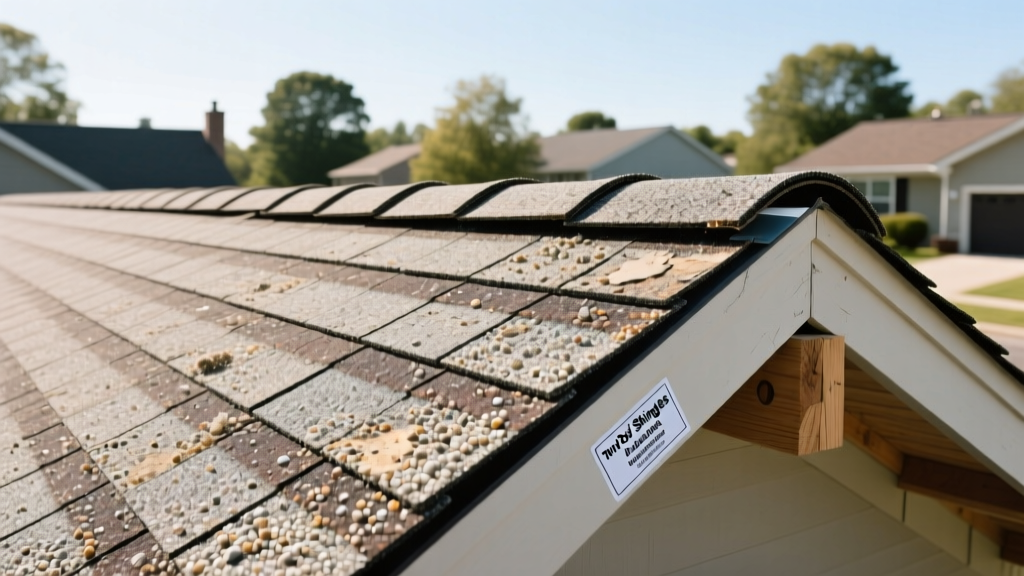
Asphalt shingles contain volatile organic compounds (VOCs) that keep the material pliable. In poorly ventilated attics, roof deck temperatures can exceed 150°F in the summer. This extreme heat bakes the 3-tab shingle, accelerating the evaporation of volatiles. As the shingle loses its plasticity, it becomes brittle. Because the single-layer mat lacks the dimensional buffering of laminated shingles, the daily expansion and contraction cause 'thermal splitting'—hairline cracks that radiate from the cutouts and eventually propagate through the entire shingle.
3-Tab vs. Architectural: The Weight and Wind Matrix
To contextualize the durability of 3 tab roof shingles, it is necessary to compare their physical specifications against standard architectural alternatives (such as GAF Timberline HDZ or Owens Corning Duration).
| Specification | Standard 3-Tab Shingle | Architectural Shingle |
|---|---|---|
| Weight per Square | 195 - 235 lbs | 240 - 300+ lbs |
| Wind Rating (ASTM) | Class D (60 MPH) | Class H (130 MPH) |
| Sealant Strips | Single, narrow band | Multiple / Wide bands |
| Impact Resistance | Rarely Class 4 rated | Often Class 4 (UL 2218) |
| Material Cost (per sq ft) | $1.00 - $1.40 | $1.50 - $2.25 |
Financial Analysis: The True Cost of a 3-Tab Roof
The primary driver for specifying 3 tab roof shingles is upfront cost savings. Material costs average $1.20 per square foot, compared to $1.85 for mid-grade architectural shingles. On a 2,000-square-foot roof, this yields a material savings of roughly $1,300. However, a lifecycle cost analysis reveals a different financial picture.
Assuming a 3-tab roof requires replacement at year 16, and an architectural roof at year 26, a 50-year ownership period requires three 3-tab roofs but only two architectural roofs. When factoring in the rising costs of tear-off, dumpster disposal (which averages $400 to $600 per roof), and labor inflation, the 50-year net present value of the 3-tab system is often 15% to 22% higher than the architectural system. The initial savings are entirely consumed by the third installation cycle.
Installation Variables That Destroy Warranties
The durability of 3 tab roof shingles is hyper-sensitive to installation errors. Because the shingle is thin and lacks a secondary laminated layer to hide imperfections, minor installation flaws lead to rapid failure.
- Nail Placement Tolerance: The nailing line on a 3-tab shingle is exceptionally narrow (typically a 3/4-inch zone). Nails driven too high (above the sealant strip) will not penetrate the underlying shingle, eliminating the wind-uplift bond. Nails driven too low will be exposed to the weather and cause leaks.
- Fastener Count: While 4 nails per shingle is the code minimum in low-wind zones, upgrading to 6 nails per shingle is critical for durability. However, 6-nail patterns on 3-tab shingles require precise alignment to avoid hitting the cutouts, which weakens the tab structure.
- Underlayment Requirements: Using a standard #15 asphalt felt underlayment with 3-tab shingles accelerates degradation if the roof deck retains moisture. Synthetic underlayment is highly recommended to prevent the felt from wrinkling and telegraphing through the thin 3-tab profile.
Final Verdict: When to Specify 3-Tab Shingles
Despite their limitations in lifespan and wind resistance, 3 tab roof shingles remain a viable product for specific, targeted applications. They should not be used on primary residences in high-wind corridors (coastal regions, Tornado Alley) or areas with extreme temperature swings.
They are, however, the optimal choice for unheated outbuildings, detached garages, agricultural structures, and low-budget property flips where the 30-year lifecycle cost is irrelevant to the current owner. If specifying 3-tab shingles for a residential application, mandate a 6-nail fastening pattern, synthetic underlayment, and verify that the roof geometry includes adequate ridge and soffit ventilation to mitigate thermal splitting.