Fabric Roof Material Repair: Maintenance and Patching Guide
Expert guide to fabric roof material repair. Learn diagnostic frameworks, PVC and PTFE patching protocols, and 2026 maintenance costs.

Diagnostic Framework: Identifying Membrane Failures
Tensile architecture relies on precise biaxial tension to maintain structural integrity. When a fabric roof material system fails, it is rarely due to random chance; failures follow predictable mechanical and chemical pathways. Facility managers and roofing contractors must accurately diagnose the root cause before attempting any field repairs, as applying the wrong thermal or chemical treatment can compromise the entire tension matrix.
| Visual Symptom | Root Cause | Primary Material Affected | Severity Level |
|---|---|---|---|
| Chalking or white powdery residue | UV degradation of topcoat; plasticizer migration | PVC-PES (Polyester) | Moderate |
| Micro-tears radiating from cable nodes | Stress concentration; differential settlement | PTFE-Fiberglass, PVC | Critical |
| Loss of pneumatic pressure in cushions | Puncture, valve failure, or perimeter seal leak | ETFE Foil | High |
| Brown/black spotting near drainage valleys | Biological growth (algae/fungi) trapping moisture | All Membranes | Low |
Material-Specific Repair Protocols
The term 'fabric roof material' encompasses three distinct chemical families, each requiring radically different repair methodologies. According to the Advanced Textiles Association, misidentifying the membrane polymer is the leading cause of catastrophic repair failures in commercial tensile structures.
PVC-Coated Polyester (The Industry Workhorse)
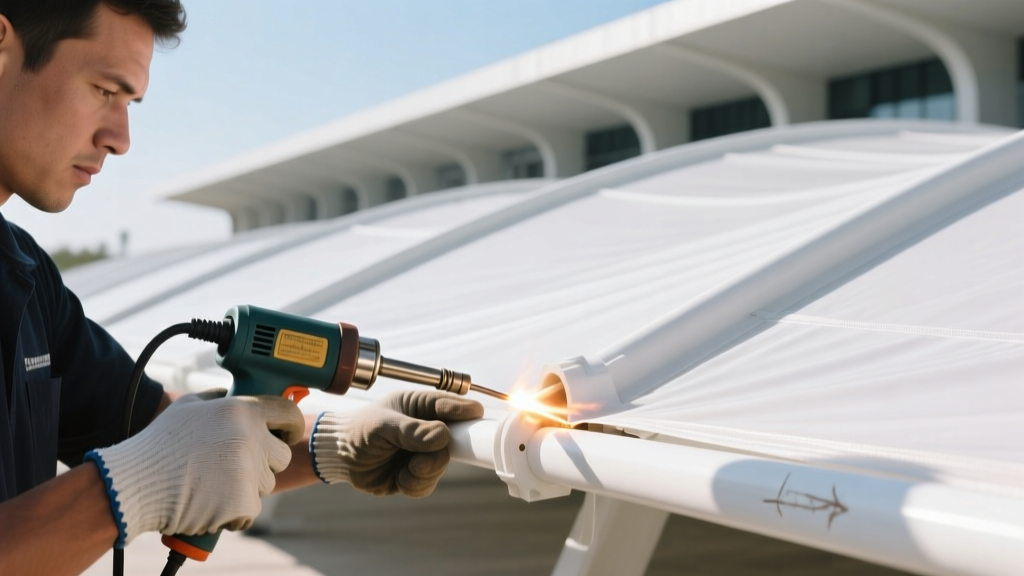
PVC membranes, such as those utilizing PVDF topcoats (e.g., Serge Ferrari Précontraint), are highly field-repairable. The primary failure mode in older PVC roofs is plasticizer loss, leading to embrittlement. For tears under 6 inches, high-frequency (HF) welding or hot air welding with a compatible PVC patch is the standard protocol. Solvent-based cements are only acceptable for temporary emergency seals, as they degrade the PVDF topcoat over time.
PTFE-Coated Fiberglass (The Premium Standard)
PTFE (Polytetrafluoroethylene) is chemically inert and virtually immune to UV degradation, boasting lifespans exceeding 35 years. However, its repairability is notoriously difficult. PTFE requires sintering temperatures above 320°C (608°F) to fuse. Field welding at these temperatures risks igniting the fiberglass substrate or burning the technician. Consequently, PTFE repairs are typically limited to specialized high-temperature adhesive tapes (like Chemoplast PTFE tape) for minor punctures, or complete panel replacement for structural tears near the perimeter cables.
ETFE Foil Systems (The Pneumatic Approach)
ETFE is not a woven fabric but an extruded fluoropolymer film used in multi-layer pneumatic cushions. As noted by Vector Foiltec, the primary maintenance task for ETFE is monitoring the air supply units (ASUs). A drop in cushion pressure (typically maintained between 200 and 600 Pascals) indicates a leak. Punctures in ETFE are repaired using specialized ETFE tape or by hot-air welding a secondary foil patch, provided the ambient temperature is strictly controlled between 280°C and 310°C.
Step-by-Step Field Patching Procedure for PVC Membranes
For standard PVC-PES tensile roofs, follow this precise thermal welding procedure to ensure a watertight, structurally sound bond.
- Surface Preparation: Clean a 12-inch radius around the tear using isopropyl alcohol (IPA) or a manufacturer-approved fluorinated solvent. Never use acetone or MEK, as these will strip the PVDF protective topcoat.
- Patch Fabrication: Cut a patch from matching PVC membrane stock. The patch must overlap the tear by a minimum of 2 inches on all sides. Critical: Round all corners of the patch with a 1-inch radius to prevent edge-peeling under wind shear.
- Thermal Application: Using a variable-temperature hot air welder, set the nozzle temperature to 350°C–380°C (662°F–716°F). Maintain a consistent nozzle speed of 2 to 3 inches per second.
- Pressure Bonding: Immediately follow the heat nozzle with a 2-inch silicone pressure roller, applying 15–20 lbs of downward force to squeeze out air pockets and ensure molecular cross-linking.
- Seam Testing: After the patch cools to ambient temperature (approx. 15 minutes), perform a peel test on the edges using a blunt spatula. If the patch lifts, the heat was insufficient; if the base membrane distorts, the heat was too high.
Preventative Maintenance & Cleaning Regimens
Proactive maintenance extends the lifecycle of a fabric roof material by 10 to 15 years. The self-cleaning properties of PVDF and PTFE topcoats rely on rain to wash away dirt; however, low-slope areas and drainage valleys require manual intervention.
| Maintenance Task | Frequency | Approved Agents / Tools | Strict Prohibitions |
|---|---|---|---|
| Routine Debris Removal | Bi-annual (Spring/Fall) | Soft-bristle brooms, leaf blowers | Metal rakes, pressure washers >1200 PSI |
| Biological Stain Treatment | As needed (typically Year 3+) | Diluted sodium hypochlorite (max 5%), soft sponges | Abrasive scrub pads, ammonia-based cleaners |
| Cable & Node Inspection | Annual | Torque wrenches, ultrasonic thickness gauges | Oiling or greasing stainless steel nodes |
| ETFE Cushion Pressure Check | Monthly (Automated via ASU) | Digital manometers, soap solution for leak tracing | Over-pressurizing >800 Pa to 'stretch out' wrinkles |
2026 Cost Analysis: Repair vs. Full Panel Replacement
Budgeting for tensile membrane upkeep requires an understanding of specialized labor rates. General commercial roofers rarely possess the certification for structural fabric welding. As of 2026, certified tensile membrane technicians command premium rates due to the niche expertise required.
| Service / Material | Estimated 2026 Cost Range | Notes & Variables |
|---|---|---|
| PVC Field Patching (Labor + Material) | $18 – $32 per sq. ft. | Highly dependent on roof pitch and scaffolding requirements. |
| PTFE Panel Replacement | $65 – $110 per sq. ft. | Includes crane rental and specialized rigging for pre-tensioning. |
| ETFE Cushion Leak Repair | $45 – $75 per linear ft. | Assumes accessible via BMU (Building Maintenance Unit). |
| Specialized Membrane Cleaning | $0.85 – $1.50 per sq. ft. | Price drops significantly for large-scale stadium roofs (>50,000 sq ft). |
| Certified Tensile Welder Labor Rate | $140 – $195 per hour | Travel and per diem usually billed extra for remote sites. |
Expert FAQ on Tensile Membrane Upkeep
Q: Can I use a standard EPDM or TPO patch kit on a PVC fabric roof?
A: Absolutely not. EPDM and TPO rely on entirely different chemical cross-linking and adhesives. Applying a rubberized patch to a PVC membrane will fail within weeks due to thermal expansion mismatches and chemical incompatibility with the PVDF topcoat.
Q: How do we address ponding water on a tensile fabric roof?
A: Ponding on a tensile structure indicates a loss of pre-tension or structural settlement, not a membrane failure. You cannot simply 'add a drain' to a fabric roof. The solution requires a structural engineer to recalculate the tension matrix and physically re-stress the perimeter cables using hydraulic jacks to restore the designed hyperbolic paraboloid curvature.
Q: What is the expected lifespan of a repaired PVC seam compared to a factory weld?
A: A properly executed field weld using matched materials and correct thermal parameters achieves roughly 85% to 90% of the sheer strength of a factory HF weld. While slightly weaker, it is more than sufficient to handle standard wind uplift loads, provided the patch edges are properly rounded and sealed.
Written by
Priya KapoorPriya Kapoor is a real estate market analyst and construction economics researcher with expertise in housing affordability, development feasibility, and infrastructure investment. She holds a Master of Regional Planning from Cornell University and previously worked as a senior analyst at CBRE's Investment Properties group, where she modeled returns for $4B in mixed-use development pipelines. Priya now runs an independent research practice advising developers, municipalities, and REITs on construction cost forecasting and market timing. She publishes the quarterly "BuildMat Market Pulse" report tracking material price indices across 12 commodity categories. Based in Austin, TX, Priya serves on the board of Habitat for Humanity Austin and is a marathon runner.
More from Priya Kapoor
View all
Construction Cost
Cost to Build a 1600 Sq Ft Home in 2026: Full Breakdown
Accurate 2026 cost to build a 1600 sq ft home—material, labor, and regional pricing breakdowns included. Plan your budget with real-time estimates.
Aug 11, 2026

Wood & Lumber
Name the Types of Wood for Pressure Treatment and Preservation
Learn how to name the types of wood best suited for pressure treatment. Compare species treatability, chemical retention levels, and 2026 preservation costs.
Aug 4, 2026

Stone & Masonry
Stone Veneer Suppliers Lindenhurst: 2026 Cost Analysis
Analyze 2026 stone veneer costs in Lindenhurst, NY. Compare local supplier pricing, delivery fees, and Suffolk County installation labor rates.
Aug 4, 2026