Copper Roof Applications: When to Install & When to Avoid
Discover if a copper roof fits your project. We analyze application scenarios, environmental patina timelines, alloy specs, and 2026 ROI metrics.
The Application-Fit Matrix: Where Copper Thrives and Fails
Copper is frequently romanticized as the ultimate premium roofing material, boasting a functional lifespan that routinely exceeds 100 years. However, treating copper as a universal solution leads to severe aesthetic and structural compromises. Application-fit analysis requires evaluating environmental variables, structural geometry, and long-term maintenance expectations. Below is a scenario-matching matrix to determine if copper aligns with your specific project parameters.
| Project Scenario | Fit Rating | Technical Rationale |
|---|---|---|
| Historic Restoration & Landmarks | Excellent | Authentic period aesthetics; allows for custom ornamental forming, domes, and complex cupolas. |
| Coastal / Marine Environments | Good (Conditional) | Highly resistant to salt spray degradation, but mandates 316 stainless steel fasteners and 20oz minimum thickness to resist wind-driven abrasion. |
| Heavy Pine Forest / Wooded Lots | Poor | Trapped organic debris (pine needles) holds localized moisture, causing uneven patina development and accelerating micro-pitting. |
| Modern Low-Slope Commercial | Moderate | Superior waterproofing via soldered flat-lock seams, but high initial capital expenditure limits ROI unless the institutional holding period exceeds 50 years. |
| Agricultural / Livestock Facilities | Poor | Ammonia and acidic vapors from animal waste aggressively attack copper alloys, leading to premature chemical degradation. |
Technical Specifications for Scenario Matching
Specifying copper requires precise alloy and thickness selection. The industry standard for architectural roofing is UNS C11000 (Electrolytic Tough Pitch, or ETP copper), which offers 99.9% purity and optimal malleability for seam forming. Avoid plumbing-grade UNS C12200 (Deoxidized High Phosphorus), as the phosphorus content alters the patina formation and welding characteristics.
Gauge and Weight Selection
- 16 oz (0.0216 inches): Strictly reserved for flashings, fascias, and interior architectural accents. Too thin for primary roof fields due to thermal oil-canning.
- 20 oz (0.027 inches): The baseline standard for residential and commercial roof fields. Provides sufficient rigidity for double-lock standing seams while remaining workable for field seaming.
- 24 oz (0.0323 inches): Mandated for extreme wind-load zones, heavy snow regions, or complex ornamental geometries where structural rigidity is paramount.
Copper is highly noble on the galvanic series. Direct contact with aluminum, galvanized steel, or untreated carbon steel will cause rapid, catastrophic corrosion of the lesser metal. You must exclusively use copper, brass, or 304/316 stainless steel fasteners and cleats. Furthermore, modern pressure-treated lumber (like ACQ or CA-C) contains highly corrosive copper-azole compounds that will destroy copper flashing. Always isolate copper from treated wood using heavy rosin paper, EPDM slip sheets, or specialized isolation membranes.
Environmental Variables: Patina Chemistry and Timelines
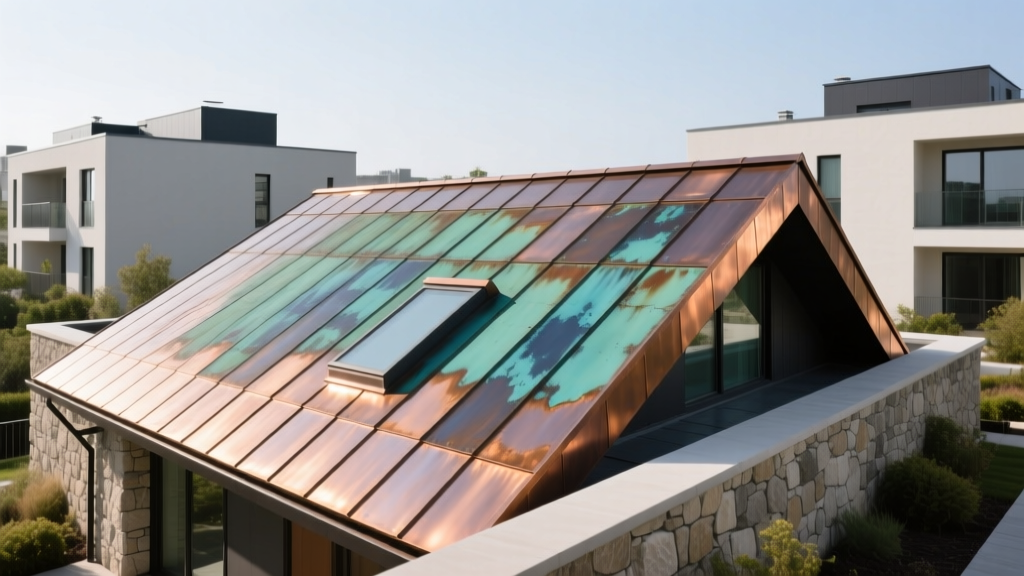
The defining characteristic of a copper roof is its evolving patina—a protective layer of copper sulfate and copper carbonate that halts further corrosion. Understanding patina timelines is crucial for client expectation management. According to the Copper Development Association's Architectural Design Handbook, the rate of patina formation is directly tied to environmental moisture and airborne sulfates.
The Patina Progression Timeline
- Phase 1: Bright Metallic to Iridescent (0–12 Months): Initial oxidation creates a salmon-pink or iridescent sheen. Highly reflective; requires UV glare management in dense urban settings.
- Phase 2: Oxide Layer / Russet Brown (1–5 Years): Cuprite and tenorite compounds form, shifting the color to a deep statuary brown. This stage is stable in arid climates.
- Phase 3: Basic Copper Sulfate / Verdigris (10–30+ Years): The iconic green patina. Requires consistent moisture and atmospheric sulfur to develop.
- Coastal/Marine: High humidity and salt accelerate the green patina to 7–12 years. (Note: Chlorides do not form patina; they rely on atmospheric sulfates, but moisture drives the reaction).
- Industrial Urban: Higher sulfur dioxide levels accelerate verdigris formation to 10–15 years.
- Arid Desert: Lack of precipitation frequently stalls the chemical reaction indefinitely, leaving the roof in a permanent russet/brown state.
Architectural Detailing: Flat-Lock vs. Standing Seam
Matching the seam profile to the roof pitch is a non-negotiable aspect of copper application. The Sheet Metal and Air Conditioning Contractors' National Association (SMACNA) provides strict guidelines for architectural sheet metal detailing that must be followed to prevent capillary water intrusion.
Double-Lock Standing Seam
Best suited for pitches of 3:12 or greater. Panels are formed with continuous cleats, allowing the copper to expand and contract independently of the fasteners. The double-lock mechanical fold eliminates the need for solder, relying on gravity and capillary breaks for waterproofing. This is the dominant profile for modern residential and steep-slope commercial applications.
Flat-Lock Soldered Seams
Required for low-slope applications ranging from 1/4:12 to 2:12. Panels are interlocked and permanently joined using 50/50 tin-lead solder (or lead-free silver/tin alternatives for LEED compliance). Flat-lock systems require rigid continuous decking (like plywood or tongue-and-groove) and a rosin-paper slip sheet to prevent the copper from bonding to the substrate, which would restrict thermal movement and cause tearing.
Thermal Movement and Expansion Engineering
Copper possesses a high coefficient of thermal expansion: 0.0000094 in/in/°F. To contextualize this, a 20-foot continuous copper panel will expand or contract approximately 1/8 of an inch for every 100°F change in ambient temperature. In regions with extreme seasonal swings, this movement can exceed 1/4 inch.
If panels are rigidly pinned or if continuous cleats are omitted, this thermal energy will manifest as severe oil-canning (buckling), fastener back-out, or seam tearing. All copper roofing systems must utilize sliding clips or continuous T-cleats that allow the metal to float over the substrate. Never use fixed-face fastening on long copper runs.
Cost vs. Lifespan ROI Analysis (2026 Metrics)
Evaluating copper requires shifting from initial capital expenditure to lifecycle cost analysis. In 2026, the material cost for 20oz UNS C11000 copper sheets ranges from $14.00 to $22.00 per square foot, depending on market volatility and alloy surcharges. Fully installed, including specialized labor, underlayment, and custom flashings, expect to pay between $35.00 and $55.00 per square foot.
| Material | Installed Cost (per sq ft) | Expected Lifespan | 100-Year Replacement Cycles |
|---|---|---|---|
| Architectural Asphalt | $8.50 - $14.00 | 20 - 25 Years | 4 to 5 Replacements |
| Galvalume Standing Seam | $18.00 - $26.00 | 40 - 60 Years | 1 to 2 Replacements |
| Zinc (Titanium Zinc) | $28.00 - $40.00 | 80 - 100 Years | 0 to 1 Replacement |
| 20oz Copper (UNS C11000) | $35.00 - $55.00 | 100+ Years | 0 Replacements |
While the upfront premium for copper is 30% to 50% higher than zinc or Galvalume, its salvage value at the end of its life cycle is significant. Scrap copper routinely recoups 15% to 25% of the original material cost, a financial offset not present with steel or asphalt.
Final Verdict: Is Your Project a Match?
A copper roof is an exceptional engineering choice for projects demanding multi-generational longevity, complex ornamental detailing, or historical accuracy. It is highly recommended for institutional buildings, coastal luxury estates, and architectural features like cupolas and mansards where material costs represent a small fraction of the overall structural budget.
Conversely, avoid copper for tight-budget commercial builds, heavily shaded wooded lots where debris accumulation is inevitable, or agricultural structures with high ammonia output. If your scenario aligns with the environmental and structural prerequisites outlined above, specifying 20oz UNS C11000 with proper thermal isolation detailing will yield a roof system that outlasts the building it protects.