BUR Roofing Material Installation: Step-by-Step Commercial Guide
Master hot-mopped BUR roofing material installation with our step-by-step guide covering bitumen temperatures, ply sheet overlaps, and surfacing.

Built-Up Roofing (BUR) System Architecture
Built-Up Roofing (BUR) remains one of the most durable and time-tested commercial low-slope roofing systems available. Unlike single-ply membranes, a BUR system relies on alternating layers of bitumen and reinforcing ply sheets to create a continuous, monolithic waterproofing barrier. According to the National Roofing Contractors Association (NRCA), the redundancy of multiple plies provides superior puncture resistance and long-term weathering performance.
A standard commercial BUR system consists of three primary components:
- Base Sheet: The foundational layer, either mechanically fastened or adhered to the roof deck or insulation.
- Interply Bitumen & Ply Sheets: Alternating layers of hot-mopped asphalt (ASTM D312) or coal tar pitch (ASTM D450) and reinforcing felts (typically Type IV fiberglass conforming to ASTM D2178).
- Surfacing: A flood coat of bitumen embedded with aggregate (gravel or slag) or a mineral-surfaced cap sheet to protect the underlying bitumen from UV degradation and physical damage.
Pre-Installation Deck Preparation & Priming
Proper substrate preparation dictates the lifespan of a BUR system. Moisture trapped beneath the membrane will inevitably vaporize under solar heat, causing interply blisters and adhesion failure.
Moisture and Surface Tolerances
Concrete decks must cure for a minimum of 28 days and be visibly dry. For wood decks, moisture content must not exceed 20% as measured by a pin-type moisture meter. Steel decks must be free of rust, welding slag, and oil. All deck joints, gaps, and penetrations must be sealed or fitted with cant strips to prevent sharp 90-degree bends in the base sheet.
Primer Application
When adhering the base sheet directly to concrete or wood, apply an ASTM D41-compliant asphalt primer. Use a mechanical sprayer or heavy-nap roller to achieve a uniform coverage rate of 0.5 gallons per 100 square feet. Allow the primer to dry completely (typically 2 to 4 hours, depending on ambient humidity) until it is tacky but does not transfer to a touch.
Step-by-Step Hot-Mop BUR Installation Process
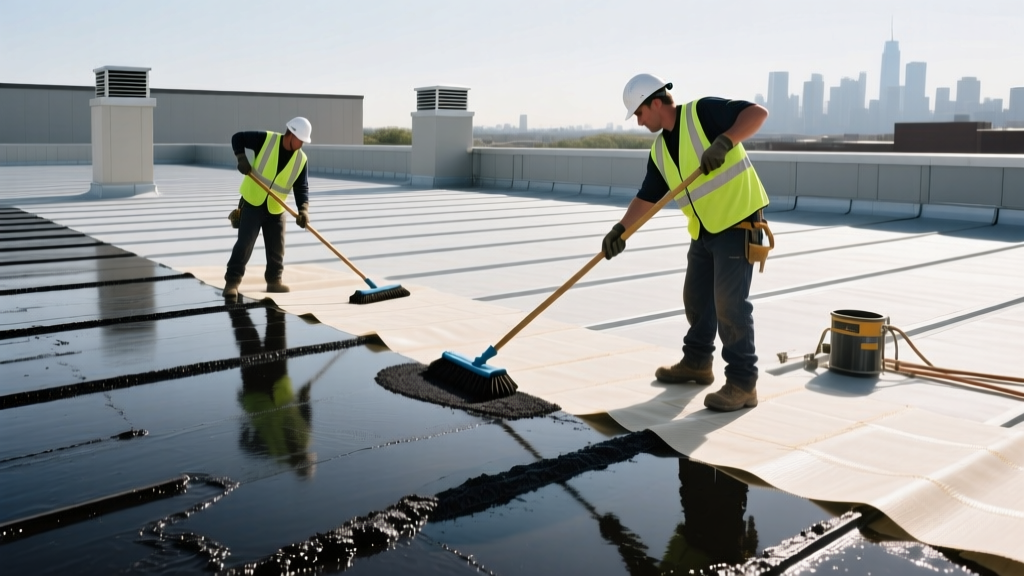
Hot-mopping requires precise temperature control and coordinated crew movement. The bitumen must be applied at the correct viscosity to ensure complete saturation of the ply sheets without creating voids or excessive buildup.
- Base Sheet Installation: Roll out the base sheet and secure it according to the deck type. For wood decks, use annular ring-shank nails with 1-inch caps, spaced 12 inches on center in the field and 6 inches on center at laps. For concrete, fully adhere using hot bitumen or cold-process adhesive.
- Bitumen Heating: Heat the asphalt or coal tar in a properly calibrated rooftop or ground-level kettle. Maintain the temperature within the manufacturer's specified Equiviscous Temperature (EVT) range.
- First Interply Mopping: Using a long-handled roofing mop, apply a continuous, uniform layer of hot bitumen over the base sheet, extending slightly beyond the width of the incoming ply sheet.
- Ply Sheet Embedding & Brooming: Immediately roll the Type IV fiberglass ply sheet into the hot bitumen. Crew members must follow closely with heavy push-brooms, vigorously brooming the sheet from the center outward to eliminate air pockets and ensure 100% contact.
- Staggering and Overlapping: Maintain minimum 2-inch side laps and 4-inch end laps. Stagger end laps of successive plies by at least 3 feet to prevent continuous seams that could compromise the membrane's integrity.
- Successive Plies: Repeat the mopping, embedding, and brooming process for the required number of plies (typically 3 or 4 plies for standard commercial applications).
Interply Mopping Rates & Temperature Specifications
Applying the correct amount of bitumen is critical. Starved moppings lead to dry spots and delamination, while excessive mopping causes bitumen to bleed through the ply sheets, creating brittle ridges.
| Material Type | EVT Range | Max Kettle Temp | Interply Mopping Rate | Flood Coat Rate |
|---|---|---|---|---|
| Type III Asphalt | 400°F ± 25°F | 450°F | 20 - 25 lbs / 100 sq ft | 55 - 60 lbs / 100 sq ft |
| Type IV Asphalt | 425°F ± 25°F | 475°F | 20 - 25 lbs / 100 sq ft | 55 - 60 lbs / 100 sq ft |
| Coal Tar Pitch | 380°F ± 20°F | 430°F | 25 - 30 lbs / 100 sq ft | 60 - 65 lbs / 100 sq ft |
Flashing, Edge Details, and Surfacing
The field of the roof is only as strong as its terminations. All perimeter edges, parapets, and penetrations require specialized detailing.
Base Flashing Integration
Extend the base sheet and ply sheets up vertical surfaces (parapets or curbs) a minimum of 8 inches above the roof surface. Secure the top edge with a continuous metal termination bar, fastened 6 inches on center, and seal the top edge with a two-part polyurethane sealant. Apply a 2-ply reinforcing layer over the termination bar, embedded in hot bitumen.
Aggregate Surfacing Application
For aggregate-surfaced systems, the final step is the flood coat. Apply the flood coat bitumen at the rates specified in the table above. Immediately broadcast the aggregate (gravel or slag) into the hot bitumen. The Asphalt Roofing Manufacturers Association (ARMA) mandates that aggregate must be applied while the bitumen is still hot and fluid to ensure proper embedding. Target an application rate of 400 to 500 lbs per 100 square feet for gravel, or 300 to 400 lbs for slag. Sweep away any loose, unembedded aggregate the following day to prevent drain clogging.
Common Installation Failures & Troubleshooting
Even with high-quality BUR roofing material, improper installation techniques lead to specific, predictable failure modes. Recognizing these early allows for immediate remediation.
- Interply Blisters: Caused by moisture trapped between plies or inadequate brooming that leaves voids. Fix: Cut an 'X' into the blister, dry the void with a torch, inject hot bitumen, and patch with a 2-ply overlay extending 6 inches beyond the cut.
- Fishmouths (Wrinkles): Occur when ply sheets are not pulled taut during embedding, creating open laps that allow water ingress. Fix: Slit the fishmouth, press it flat, mop with hot bitumen, and cover with a 4-inch wide strip of reinforcing felt.
- Ridging at Deck Joints: Linear cracks or ridges directly over insulation or deck joints caused by structural movement. Fix: Install a 12-inch wide slip sheet (unmopped base sheet) centered over the joint before applying the main BUR plies to allow independent movement.
- Bare Spots in Flood Coat: Areas where aggregate failed to embed, leaving bitumen exposed to UV rays. Fix: Reheat the area with a torch or hot mop, re-apply bitumen, and immediately embed new aggregate.
Frequently Asked Questions: BUR Material Nuances
Can BUR be installed over existing wet insulation?
No. Installing BUR over wet insulation guarantees system failure. The heat from the sun will vaporize the trapped moisture, creating massive blisters that will rupture the membrane. Always perform a core cut test to verify the moisture status of the existing substrate before overlaying a new BUR system.
Is coal tar pitch still used in modern BUR installations?
Yes, though its use has declined due to environmental and safety regulations regarding VOC emissions and handling. However, coal tar pitch remains unmatched for its self-healing properties and resistance to standing water and chemical pollutants, making it the preferred choice for specific industrial applications and dead-flat roofs with poor drainage.
What is the expected lifespan of a properly installed 4-ply BUR system?
When installed to NRCA specifications and maintained with periodic inspections, a 4-ply asphalt BUR system with an aggregate surface reliably delivers 20 to 30 years of service life. Coal tar systems frequently exceed 30 years due to the material's inherent resistance to oxidation and water absorption.
Written by
Marcus ChenMarcus Chen is a licensed structural engineer (PE) and building materials analyst with over 12 years of experience across residential, commercial, and industrial construction. He holds a Master of Science in Civil Engineering from UC Berkeley and spent six years at Thornton Tomasetti before transitioning to independent consulting and technical writing. Marcus specializes in material selection for seismic-prone regions, concrete reinforcement strategies, and lifecycle cost analysis. His work has been cited by the American Concrete Institute (ACI) and the Structural Engineers Association of California (SEAOC). When he is not on a job site or at his desk, you will find him hiking the Sierra Nevada or restoring a 1920s craftsman bungalow in Oakland, CA.
More from Marcus Chen
View all
Construction Cost
How Much Did the Eiffel Tower Cost to Build?
How much did the Eiffel Tower cost to build in 1889? We adjust for inflation and compare its budget to modern skyscraper construction.
Aug 4, 2026

Fire Resistance
What Is a Fire Resistant Material? Testing & Certification Guide
Discover what is a fire resistant material through ASTM and UL testing. Learn how fire ratings, certifications, and assemblies work in construction.
Aug 4, 2026

Construction Cost
How Much Did the Burj Khalifa Cost to Build?
How much did the Burj Khalifa cost to build? We break down the $1.5B project and extract 5 money-saving strategies for your next build.
Jul 30, 2026