Selecting Types of Roofing Materials Flat Roof by Climate
Discover the best types of roofing materials flat roof systems require for hot, cold, coastal, and rainy climates. Expert specs and 2026 costs.

The Climate-Material Matrix: Why One Size Fails
Flat and low-slope roofs (defined as having a pitch of 3:12 or less) do not shed water via gravity like steep-slope systems; they manage it through continuous membranes and internal drains. Because water evacuation is slower, the membrane is subjected to prolonged environmental stress. When evaluating the types of roofing materials flat roof systems can accommodate, selecting a membrane based solely on upfront cost is a critical error. A material that performs flawlessly in the arid heat of Arizona will suffer catastrophic seam failure in the freeze-thaw cycles of Michigan.
The primary failure modes for flat roofs are heavily dictated by regional climate: ultraviolet (UV) degradation and thermal shock in hot zones; membrane brittleness and ice damming in cold zones; and wind uplift and chemical corrosion in coastal areas. This guide breaks down the exact material specifications, thickness requirements, and 2026 installed costs for flat roofs across four distinct climate profiles.
Hot & Arid Climates: Defeating UV and Thermal Shock
In regions with intense solar radiation and high diurnal temperature swings (e.g., the US Southwest, Middle East), the roof surface can experience temperature fluctuations of 50°F to 70°F within a 12-hour period. This causes severe thermal expansion and contraction, leading to membrane fatigue and seam splitting.
Optimal Material: 80-Mil TPO (Thermoplastic Polyolefin)
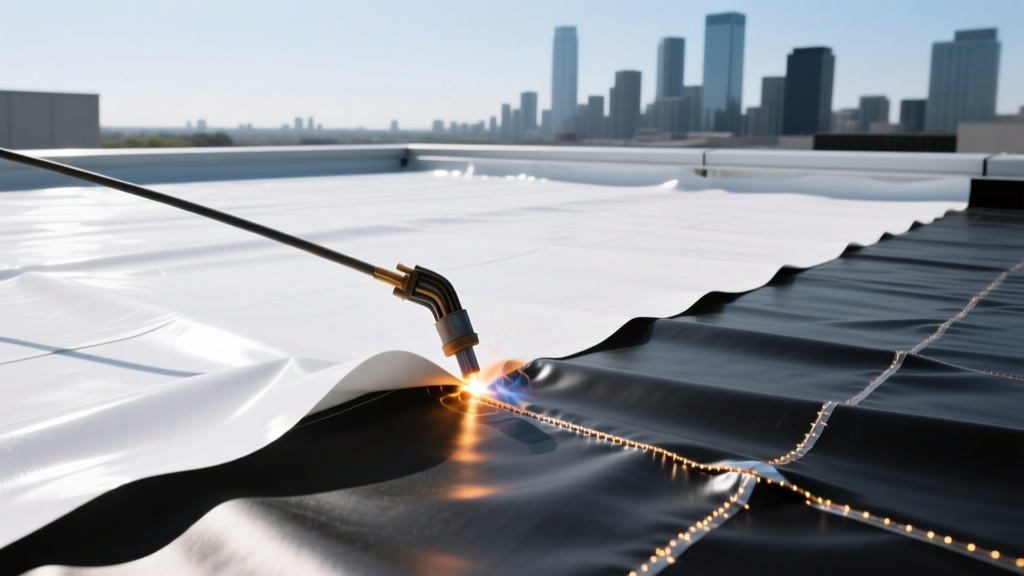
While 60-mil TPO is the industry baseline, arid climates demand 80-mil or 90-mil membranes to resist UV-induced plasticizer migration and top-ply erosion. White TPO reflects up to 85% of solar radiation, significantly reducing the thermal shock applied to the seams. According to the Department of Energy Cool Roofs Guide, highly reflective white membranes can reduce peak cooling demand by 10% to 15%.
- Recommended Product: GAF EverGuard Extreme TPO or Carlisle Sure-Weld 80-mil.
- Seam Technology: Hot-air welding at 1,100°F to 1,300°F. In high heat, welders must adjust speed to prevent scorching the top ply.
- Failure Mode to Avoid: Using mechanically attached TPO in high-wind desert corridors without adequate edge securement, leading to billowing and fastener back-out.
Cold & Snow-Heavy Zones: Surviving Freeze-Thaw Cycles
In northern climates, flat roofs must endure heavy snow loads, prolonged sub-zero temperatures, and the mechanical stress of ice expansion. The membrane must remain pliable at -40°F to prevent cracking when the building structure shifts under snow weight.
Optimal Material: SBS Modified Bitumen & Black EPDM
Styrene-Butadiene-Styrene (SBS) modified bitumen incorporates synthetic rubber into the asphalt matrix, granting it exceptional elasticity in freezing temperatures. Alternatively, 60-mil black EPDM (Ethylene Propylene Diene Monomer) is highly effective. The black color absorbs solar heat, promoting passive snow melt and reducing the formation of ice dams at parapet walls.
- Recommended Product: Mule-Hide SBS Mod-Bit (Torch-Down or Cold-Adhesive) or Firestone UltraPly EPDM.
- Seam Technology: For EPDM, use 3-inch double-sided butyl seam tape with a primer (e.g., Firestone QuickPrime Plus). Liquid adhesives fail in sub-zero application temperatures.
- Installed Cost (2026): $5.50 to $9.50 per square foot.
Coastal & Hurricane-Prone Regions: Wind Uplift and Salt
Coastal environments subject flat roofs to driving rain, salt spray, and extreme wind uplift events. The membrane must resist chemical degradation from salt and maintain structural integrity when subjected to negative wind pressure (uplift).
Optimal Material: Fully Adhered PVC (Polyvinyl Chloride)
PVC membranes are inherently resistant to salt, chemicals, and animal fats (making them ideal for coastal restaurants with grease vents). More importantly, PVC is typically installed using a fully adhered method, bonding the membrane directly to the substrate with low-VOC adhesives. This eliminates the wind-getting points found in mechanically fastened systems, allowing the roof to achieve FM 1-90 or higher wind uplift ratings required in hurricane zones.
- Recommended Product: Sarnafil G 410 (Fleece-backed) or Johns Manville PVC.
- Thickness Spec: Minimum 60-mil, though 80-mil is recommended for debris impact resistance during storms.
- Seam Technology: Solvent welding or hot-air welding, creating a monolithic, watertight bond that is stronger than the membrane itself.
PVC membranes utilize a scrim reinforcement (usually polyester) that provides high tensile strength. The Single-Ply Roofing Industry (SPRI) mandates specific edge metal securement standards (ANSI/SPRI ES-1) which must be strictly enforced in coastal zones to prevent perimeter peeling during cyclonic events.
Temperate & High-Rainfall Areas: Moisture and Biological Growth
Regions like the Pacific Northwest or the UK experience frequent, light rainfall and high humidity. The primary threats are ponding water, algae, and moss growth, which can degrade certain membranes and block internal drains.
Optimal Material: Liquid-Applied Polyurethane or EPDM
For complex flat roofs with numerous penetrations (HVAC units, pipes, skylights), liquid-applied polyurethane systems provide a seamless, monolithic barrier that eliminates the risk of seam leaks under constant moisture. For large, open roof areas, EPDM remains a cost-effective, highly water-resistant choice that naturally inhibits biological growth better than some asphalt-based systems.
Climate-Specific Flat Roof Cost & Lifespan Matrix
The following table outlines the 2026 market averages for commercial and residential flat roof systems, factoring in material, labor, and baseline insulation.
| Material Type | Best Suited Climate | Required Thickness | 2026 Installed Cost (per sq. ft.) | Expected Lifespan |
|---|---|---|---|---|
| TPO (White) | Hot, Arid, High UV | 80-mil to 90-mil | $5.50 - $8.50 | 20 - 25 Years |
| EPDM (Black) | Cold, Snow-Heavy | 60-mil | $5.00 - $9.00 | 25 - 30 Years |
| SBS Mod-Bit | Cold, High Thermal Shift | Two-Ply System | $6.50 - $10.50 | 15 - 20 Years |
| PVC (Fleece-Back) | Coastal, Hurricane Zones | 60-mil to 80-mil | $8.00 - $13.00 | 20 - 30 Years |
| Liquid Polyurethane | Wet, High-Rainfall | 60-mil (Dry Mil) | $7.50 - $12.50 | 15 - 20 Years |
Code Compliance and Insulation Requirements
The membrane is only half the system. The National Roofing Contractors Association (NRCA) emphasizes that proper insulation and slope are critical to membrane longevity. Under the 2024 and 2026 IECC (International Energy Conservation Code) updates, commercial flat roofs in most US climate zones require continuous insulation (ci) values between R-30 and R-38.
Designing for Drainage
Flat roofs are never truly flat. Building codes require a minimum design slope of 1/4 inch per foot (2%) to positive drains. If the structural deck is level, contractors must install tapered polyisocyanurate insulation. This system uses varying thicknesses of polyiso boards to create a slope, directing water to drains or scuppers while simultaneously providing the required R-value (polyiso offers approximately R-5.6 to R-6.0 per inch). Failure to specify tapered insulation in high-rainfall climates guarantees ponding water, which will void the warranty of almost all single-ply membrane manufacturers.
Expert Verdict: Making Your Final Selection
Do not default to the cheapest bid. A 60-mil TPO roof in Phoenix will crack within a decade, while an 80-mil PVC roof in Minnesota is an unnecessary expense when black EPDM would perform better thermally. Match the membrane chemistry to the specific environmental stressors of your zip code, enforce strict adherence to manufacturer-approved fastening patterns, and ensure your insulation strategy meets current IECC mandates. By treating the roof as a climate-specific thermal and hydrological barrier rather than a generic covering, you will secure a system that reliably protects the asset for decades.
Written by
Elena RodriguezElena Rodriguez is a civil engineer and technical writer specializing in concrete technology, masonry systems, and ASTM/ACI compliance. She earned her B.S. in Civil Engineering from Texas A&M University and spent a decade at a materials testing laboratory, performing over 2,000 concrete compressive strength tests and masonry prism evaluations. Elena is an ACI-certified Field Testing Technician (Grade I) and a member of ASTM Committee C12 on Natural Building Stone. She currently consults on forensic engineering cases involving concrete failures and moisture intrusion. Based in San Antonio, TX, Elena is a proud member of the Society of Women Engineers (SWE) and coaches her daughter's FIRST Robotics team.
More from Elena Rodriguez
View all
Walls & Panels
Cost Analysis: Light Gauge Steel Framing Advantages and Disadvantages
Evaluate light gauge steel framing advantages and disadvantages through a strict cost analysis lens, comparing material, labor, and lifecycle expenses.
Aug 4, 2026

Walls & Panels
Gypsum Board Types: Exact Specifications, Thickness & Dimensions
Compare standard, Type X, and moisture-resistant gypsum board types. Get exact specifications, thicknesses, dimensions, and ASTM standards for your project.
Aug 4, 2026

Fire Resistance
Best Fire-Resistant Outdoor Decking Materials: 2026 Buyer Guide
Discover the best fire-resistant outdoor decking materials for 2026. Compare Class A PVC, aluminum, and hardwood options for WUI compliance and safety.
Aug 4, 2026