Car Vinyl Roof Material vs. Architectural PVC: A Deep Comparison
Compare car vinyl roof material with architectural PVC membranes. Learn the differences in thickness, UV resistance, and best applications for RVs and sheds.

The Material Divide: Automotive vs. Architectural Vinyl
Contractors, RV restorers, and custom outbuilding designers frequently encounter a critical sourcing error: confusing automotive-grade vinyl with architectural thermoplastic membranes. While both are fundamentally polyvinyl chloride (PVC) based, a car vinyl roof material is engineered for complex compound curves, aesthetic gloss, and aerodynamic drag reduction. Architectural PVC, conversely, is engineered for hydrostatic head pressure, puncture resistance, and long-term UV degradation on flat planes. Using the wrong material for a teardrop camper, shed, or vintage vehicle restoration guarantees premature failure. This guide deconstructs the chemical, structural, and installation differences between these two material classes to ensure you specify the correct product for your 2026 projects.
Deconstructing Car Vinyl Roof Material
When sourcing car vinyl roof material, you are generally looking at one of two distinct sub-categories, each with vastly different physical properties:
1. Cast and Calendered Wrap Films
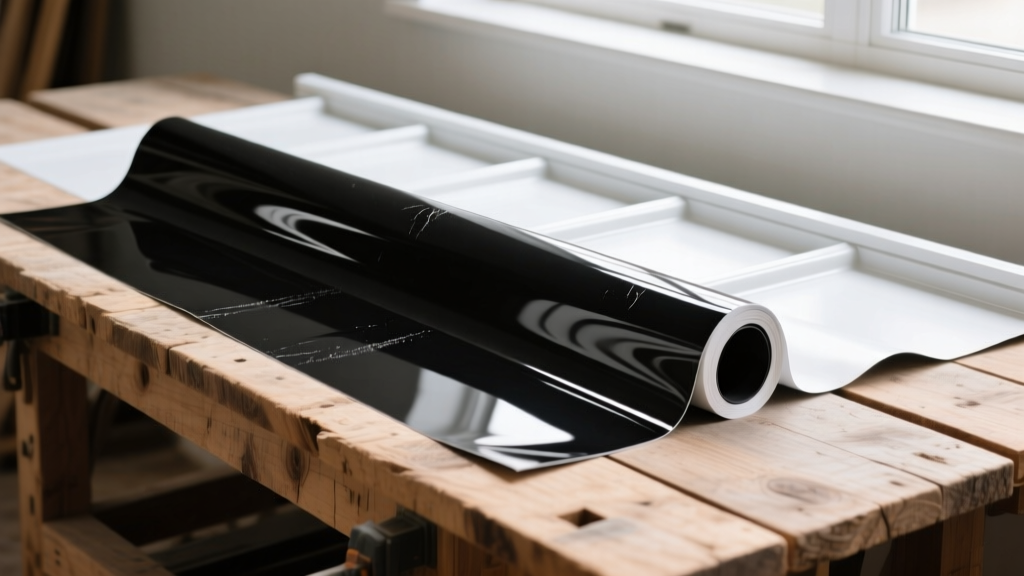
Products like 3M Scotchcal or Avery Dennison Supreme Wrapping Cast are designed for vehicle exteriors. These films are exceptionally thin, typically measuring between 2.0 and 3.5 mils. They rely on aggressive, pressure-sensitive acrylic adhesives designed to bond to clear-coated automotive paint. They possess zero puncture resistance and lack a reinforcement scrim. Applying wrap vinyl to a flat wooden shed roof or an RV deck will result in immediate tearing under foot traffic and rapid UV embrittlement.
2. Convertible Top and Marine Composites
Heavy-duty automotive vinyl, such as Haartz Stayfast or Sonnendeck, is a multi-ply composite. These materials feature a PVC outer layer bonded to a cotton, poly-cotton, or polyester backing fabric. They measure between 30 and 40 mils thick. The backing provides dimensional stability and allows the material to be stretched and stapled or glued to complex wooden or metal bow frames. While highly durable for convertible tops and marine Bimini tops, these materials are not designed for heat-welded seams, making them unsuitable for large, watertight architectural envelopes.
Architectural PVC and TPO Membranes Explained
Architectural single-ply membranes, such as Sika Sarnafil G 410 or FiberTite, are engineered specifically for low-slope and flat roofing. Unlike car vinyl roof material, architectural PVC incorporates an internal polyester reinforcement scrim. This scrim provides immense tensile strength, allowing the membrane to withstand wind uplift pressures and thermal shock without tearing. Thickness ranges from 45 to 80 mils. Furthermore, architectural membranes are formulated with high levels of titanium dioxide (TiO2) and specialized UV stabilizers to reflect solar radiation and prevent plasticizer migration over a 20- to 30-year lifespan.
Technical Comparison Matrix
| Property | Automotive Wrap Vinyl | Automotive Convertible Vinyl (e.g., Haartz) | Architectural PVC Membrane (e.g., Sarnafil) |
|---|---|---|---|
| Thickness | 2.0 - 3.5 mils | 30 - 40 mils (composite) | 45 - 80 mils (reinforced) |
| Internal Scrim | None | Cotton / Poly-blend backing | Polyester reinforcement scrim |
| Seam Method | Overlap / Pressure-sensitive | Stitching, stapling, contact cement | Hot-air welding (solvent or thermal) |
| UV Stabilization | Low (3-5 year exterior life) | Medium (formulated for flex, not static UV) | High (TiO2 loaded, 20+ year life) |
| Puncture Resistance | Negligible | Moderate (backing dependent) | High (ASTM D5602 compliant) |
| Primary Adhesive | Acrylic pressure-sensitive | Solvent-based contact cement | Mechanical, ballast, or low-VOC bonding |
Real-World Failure Modes and Edge Cases
Understanding how these materials fail in the wrong environment is critical for avoiding costly callbacks and structural water damage.
Car vinyl roof material relies on liquid plasticizers to maintain flexibility across the compound curves of a vehicle. When laid flat on an architectural roof and exposed to sustained, high-angle UV radiation, these plasticizers rapidly migrate to the surface. This results in 'chalking,' severe shrinkage, and cold-cracking within 18 to 24 months. Architectural PVC uses polymeric plasticizers that are chemically bound to resist this migration.
The Thermal Expansion Trap
Automotive vinyls are designed to be installed under tension and heat-stretched to fit vehicle contours. If you attempt to use a heavy-duty automotive vinyl to cover a 10x10 foot shed roof, the material's coefficient of thermal expansion (CTE) will cause massive issues. Without the internal polyester scrim found in architectural PVC, the automotive vinyl will expand in the summer heat, creating bubbles and fishmouths. When winter arrives, the material will contract and pull away from the perimeter flashing, breaking the adhesive bond.
Seam Integrity and Hydrostatic Pressure
Architectural PVC seams are fused together using hot-air welders (like the Leister Triac), creating a monolithic, chemically bonded seam that is actually stronger than the membrane itself. Car vinyl roof material cannot be hot-air welded; the lack of specific thermoplastic elastomers in the wrap layer means heat will simply burn through the film. Relying on liquid sealants or contact cements for seams on a flat roof will inevitably lead to leaks under ponding water.
Application Decision Framework
Use this framework to select the correct material based on your specific project parameters.
Scenario A: Vintage Auto Restoration or Convertible Top
- Material: Haartz Stayfast or Crown Texture automotive vinyl.
- Why: You need a material that can be stretched over bows, stitched, and glued with 3M Super Trim Adhesive (08090). Architectural PVC is too rigid and cannot be stitched without compromising waterproofing.
Scenario B: Custom Teardrop Camper or Overland Trailer Roof
- Material: EPDM rubber or specialized RV TPO (e.g., Dicor RP-RV-101).
- Why: While some DIYers attempt to use car vinyl roof material for small campers, the constant vibration and flexing of a trailer will cause rigid architectural PVC to crack at the fasteners, while automotive wrap vinyl will puncture from tree branches. RV-specific TPO offers the perfect middle ground of flexibility and puncture resistance.
Scenario C: Flat Shed Roof, Garage, or Outbuilding
- Material: 45-mil or 60-mil Architectural PVC or TPO.
- Why: You require hot-air welded seams, high puncture resistance for hail and debris, and a 20-year weathering warranty. According to the National Roofing Contractors Association (NRCA), thermoplastic single-ply membranes remain the premier choice for low-slope commercial and residential outbuildings due to their superior seam strength and reflectivity.
2026 Cost Breakdown and Sourcing Guide
Pricing for specialty polymers has stabilized in 2026 following the supply chain adjustments of the early 2020s. However, sourcing channels remain highly segregated.
| Material Type | Average Material Cost (Per Sq. Ft.) | Primary Sourcing Channel |
|---|---|---|
| Automotive Wrap Vinyl (Cast) | $2.50 - $4.50 | Sign supply distributors, auto body suppliers |
| Convertible Top Vinyl (Haartz) | $18.00 - $32.00 | Automotive upholstery wholesalers, marine canvas suppliers |
| Architectural PVC (45-60 mil) | $3.50 - $6.50 | Commercial roofing distributors (e.g., ABC Supply, Beacon) |
If you are installing automotive convertible vinyl to a substrate, never use standard architectural bonding adhesives. You must use a solvent-based contact cement designed for automotive weatherstripping and canvas, such as those specified by 3M's automotive division. Conversely, never use automotive contact cement to adhere architectural PVC to insulation boards; the solvents will melt the PVC membrane and destroy the foam insulation.
Final Specification Guidelines
The search for 'car vinyl roof material' often stems from a misunderstanding of polymer engineering. If your project involves a vehicle, a marine vessel, or a highly contoured, tensioned frame, specify a multi-ply automotive canvas or cast wrap film. If your project involves a flat or low-slope structure requiring watertight, welded seams and long-term UV resistance, you must pivot to architectural PVC or TPO membranes. Cross-pollinating these materials will result in catastrophic adhesion failure, plasticizer loss, and immediate water intrusion. Always match the material's chemical formulation to the structural and environmental demands of the specific application.
Written by
David NakamuraDavid Nakamura is a licensed architect (AIA) and construction technology writer focused on sustainable building methods, mass timber engineering, and high-performance building envelopes. He holds a Master of Architecture from the University of Washington and is a certified Passive House Consultant (CPHC). David spent eight years at the Seattle firm Mithun, where he led the design of three LEED Platinum projects, before founding his own practice specializing in net-zero residential design. He serves on the editorial advisory board of GreenBuilder Magazine and has authored peer-reviewed papers on cross-laminated timber (CLT) connections for the Journal of Structural Engineering. In his spare time, David teaches woodworking at Pratt Fine Arts Center and kayaks the Puget Sound.
More from David Nakamura
View all
Construction Cost
Labor Cost to Build a Deck Per Sq Ft: 2026 Installation Guide
Discover the exact labor cost to build a deck per sq ft in 2026. This installation guide breaks down contractor rates, complexity factors, and hidden fees.
Aug 4, 2026

Construction Cost
How Much Does It Cost to Build a 3 Bedroom House? Financing Guide
Learn exactly how much it costs to build a 3 bedroom house and explore 2026 financing options, construction loan types, and budget frameworks for your build.
Aug 4, 2026

Construction Cost
Cost to Build a Tennis Court: 2026 Guide
How much does it cost to build a tennis court in 2026? Breakdowns for asphalt, concrete, and synthetic surfaces plus fencing and lighting.
Jul 30, 2026