Flat Roof Materials Types: 2026 Complete Guide & Cost Breakdown
Compare flat roof materials types including EPDM, TPO, PVC, and Mod-Bit. Get 2026 pricing, lifespan data, and failure modes for low-slope systems.

The Low-Slope Reality: Pitch and Water Management
In commercial and residential architecture, the term "flat roof" is a misnomer. These structures are technically "low-slope" roofs, typically engineered with a minimum pitch of 1/4:12 (a quarter-inch of vertical drop per horizontal foot). The selection of flat roof materials types is not merely about waterproofing; it is about managing thermal expansion, UV degradation, chemical exposure, and structural deflection that leads to ponding water. Choosing the wrong membrane for a specific building use can result in catastrophic seam failures within five years, while the correct specification yields a 25-to-30-year lifecycle.
Flat Roof Materials Types: 2026 Cost & Performance Matrix
The roofing market has shifted heavily toward single-ply thermoplastics, though asphaltic systems remain vital for specific high-traffic applications. Below is the current pricing and performance data for 2026.
| Material Type | Avg. Installed Cost (per sq. ft.) | Expected Lifespan | Puncture Resistance | Best Application |
|---|---|---|---|---|
| TPO (60-mil) | $6.50 - $9.50 | 20 - 25 Years | Moderate | Warehouses, retail, standard commercial |
| PVC (60-mil) | $8.50 - $13.00 | 25 - 30+ Years | Moderate-High | Restaurants, chemical plants, grease vents |
| EPDM (60-mil) | $5.50 - $8.50 | 25 - 30 Years | High | Cold climates, residential low-slope, ballasted |
| Modified Bitumen (SBS) | $6.00 - $9.50 | 15 - 20 Years | Very High | High foot traffic, balconies, heavy HVAC use |
| Built-Up Roofing (BUR) | $7.00 - $11.00 | 20 - 30 Years | Extreme | Institutional buildings, redundant ply needs |
Single-Ply Membranes: The Market Dominators
Single-ply membranes account for the vast majority of new low-slope installations due to their lightweight nature, ease of installation, and reflective properties. According to the Environmental Protection Agency (EPA), highly reflective single-ply membranes can reduce peak cooling demand by 10-15%, a critical factor in modern energy code compliance.
TPO (Thermoplastic Polyolefin)
TPO is the current market leader for commercial flat roofs. Modern TPO formulations (post-2015) have largely resolved the premature cracking and seam degradation issues that plagued early-generation products. Premium membranes like Carlisle Sure-Weld or GAF EverGuard utilize a polyester-reinforced scrim sandwiched between TPO layers, providing dimensional stability and high wind-uplift resistance.
- Seam Technology: Hot-air welded. The seam becomes a monolithic bond stronger than the membrane itself.
- Failure Mode: In mechanically attached systems, thermal cycling can cause fasteners to "back out" and puncture the membrane from underneath if not properly seated.
- Specification Tip: Always specify 60-mil or 80-mil thickness for commercial applications. 45-mil is highly susceptible to hail damage and should only be used on temporary or low-budget residential porches.
PVC (Polyvinyl Chloride)
PVC membranes, such as Sarnafil or Johns Manville, are the gold standard for chemical resistance. Unlike TPO, PVC is highly resistant to animal fats, vegetable oils, and industrial chemicals. If a building houses a commercial kitchen with grease-laden exhaust vents, TPO will degrade and soften upon contact with the grease, leading to catastrophic leaks. PVC is mandatory in these environments.
EPDM (Ethylene Propylene Diene Monomer)
Often referred to as "rubber roofing," EPDM is a thermoset membrane. It excels in extreme cold and handles ponding water better than almost any other material. While black EPDM is traditional, white EPDM is increasingly used to meet Department of Energy (DOE) cool roof standards without the plasticizer migration risks of PVC.
- Seam Technology: Seams are joined using liquid adhesives or double-sided butyl tape. This is the system's weakest point.
- Failure Mode: EPDM naturally shrinks over its lifespan (up to 2-3% over 20 years). If not installed with adequate slack at the edges, this shrinkage will pull the membrane off parapet walls and roof penetrations.
Asphaltic Systems: Built-Up and Modified Bitumen
While single-plies dominate new construction, asphaltic systems remain highly relevant for retrofit and high-abuse environments.
Modified Bitumen (Mod-Bit)
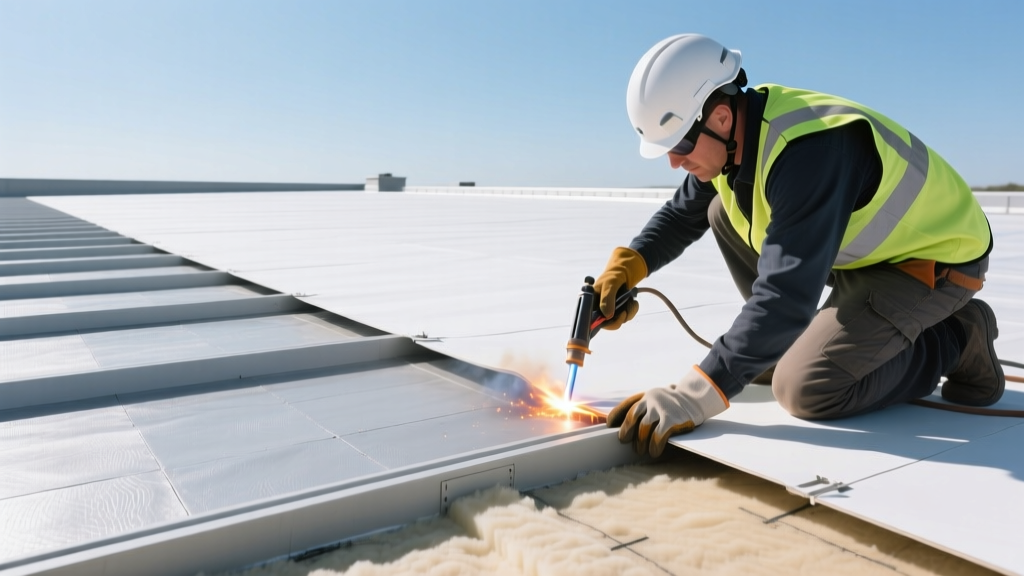
Mod-Bit is essentially an evolution of the traditional BUR, rolled out in sheets. SBS (Styrene-Butadiene-Styrene) modified bitumen offers rubber-like elasticity and is typically torch-applied or cold-adhered. It is incredibly thick (often 160+ mils across two plies), making it highly resistant to punctures from dropped tools, heavy foot traffic, and rooftop debris. It is the preferred choice for residential flat roofs, balconies, and roofs requiring frequent HVAC maintenance access.
The 2026 Specification Decision Framework
Use this logic tree to determine the optimal material for your specific building profile:
- Are there commercial kitchen exhaust vents or chemical processing on the roof?
- Yes: Specify 60-mil PVC or KEE (Ketone Ethylene Ester) membrane.
- No: Proceed to step 2.
- Will the roof experience heavy, daily foot traffic (e.g., maintenance crews, rooftop patios)?
- Yes: Specify 2-ply SBS Modified Bitumen, or a fully adhered TPO/PVC system with dedicated walkway pads.
- No: Proceed to step 3.
- Is the primary goal lifecycle cost-efficiency and solar reflectivity for a large footprint (warehouse/big box)?
- Yes: Specify 60-mil or 80-mil mechanically attached TPO.
- No: Proceed to step 4.
- Is the building in a northern climate with extreme temperature swings and potential for ice damming on low slopes?
- Yes: Specify fully adhered 60-mil EPDM.
Insulation, Tapering, and IECC Code Compliance
The membrane is only half the system. Under the 2024 and 2026 International Energy Conservation Code (IECC) updates, continuous above-deck insulation requirements have surged, often demanding R-30 to R-40 values depending on the climate zone. Polyisocyanurate (Polyiso) is the standard, offering roughly R-6.5 per inch.
Furthermore, structural deflection often creates "birdbaths" (ponding water) on flat roofs. While most membrane manufacturers warrant against ponding water, they require it to dissipate within 48 hours. To guarantee this, specify a tapered insulation system. By laying Polyiso boards in a graduated slope (e.g., 1/8" per foot taper), you create positive drainage toward interior scuppers or drains, entirely independent of the structural deck's pitch.
Common Edge-Case Failures and Warranty Traps
Another frequent failure occurs at roof drains. Using standard membrane flashing around a drain pipe is a recipe for leaks. Always specify cast-iron or heavy-duty PVC drain flanges with a built-in clamping ring that mechanically secures the membrane to the drain body, paired with a secondary overflow scupper set two inches above the primary drain to prevent structural collapse from water weight in the event of a clog.
Written by
Marcus ChenMarcus Chen is a licensed structural engineer (PE) and building materials analyst with over 12 years of experience across residential, commercial, and industrial construction. He holds a Master of Science in Civil Engineering from UC Berkeley and spent six years at Thornton Tomasetti before transitioning to independent consulting and technical writing. Marcus specializes in material selection for seismic-prone regions, concrete reinforcement strategies, and lifecycle cost analysis. His work has been cited by the American Concrete Institute (ACI) and the Structural Engineers Association of California (SEAOC). When he is not on a job site or at his desk, you will find him hiking the Sierra Nevada or restoring a 1920s craftsman bungalow in Oakland, CA.
More from Marcus Chen
View all
Construction Cost
How Much Did the Eiffel Tower Cost to Build?
How much did the Eiffel Tower cost to build in 1889? We adjust for inflation and compare its budget to modern skyscraper construction.
Aug 4, 2026

Fire Resistance
What Is a Fire Resistant Material? Testing & Certification Guide
Discover what is a fire resistant material through ASTM and UL testing. Learn how fire ratings, certifications, and assemblies work in construction.
Aug 4, 2026

Construction Cost
How Much Did the Burj Khalifa Cost to Build?
How much did the Burj Khalifa cost to build? We break down the $1.5B project and extract 5 money-saving strategies for your next build.
Jul 30, 2026