Flat Roof Materials Barnstable: 2026 Cost Breakdown
Detailed 2026 cost breakdown for flat roof materials in Barnstable, MA. Compare EPDM, TPO, and Mod-Bit pricing, labor premiums, and coastal codes.

The Cape Cod Climate Tax: Why Barnstable Roofing Costs Differ
Installing a flat roof in Barnstable, Massachusetts, requires navigating a unique intersection of coastal weather extremes and strict local building codes. Unlike inland projects, flat roof systems on Cape Cod must withstand nor'easter wind uplifts, salt-air degradation, and heavy winter snow loads. Consequently, the cost to install flat roof materials in Barnstable runs 15% to 25% higher than the national average, driven by specialized material requirements, elevated labor rates, and strict adherence to the Massachusetts Stretch Energy Code.
Ballasted roofing systems—where river stone holds the membrane down—are largely prohibited or highly discouraged in Barnstable's coastal wind zones. High-velocity gusts can turn loose ballast into dangerous projectiles. Therefore, contractors must utilize fully adhered or mechanically fastened systems rated for FM 1-90 or higher wind uplift resistance. This requirement fundamentally shifts the material and labor cost structure.
2026 Material & Labor Cost Matrix
The following table outlines the current installed cost ranges for the three primary flat roof materials used in Barnstable residential and light-commercial applications. Costs are calculated per square foot (100 square feet = 1 roofing square) and include tear-off of one existing layer, standard polyiso insulation, and fully adhered installation.
| Material Type | Material Cost (per sq. ft.) | Labor & Overhead (per sq. ft.) | Total Installed Cost | Expected Lifespan |
|---|---|---|---|---|
| 60-Mil Reinforced EPDM | $4.50 - $6.00 | $8.50 - $11.00 | $13.00 - $17.00 | 20 - 25 Years |
| 60-Mil / 80-Mil TPO | $5.00 - $7.50 | $9.00 - $12.50 | $14.00 - $20.00 | 20 - 30 Years |
| SBS Modified Bitumen (2-Ply) | $4.00 - $6.50 | $9.50 - $13.00 | $13.50 - $19.50 | 15 - 20 Years |
Material Deep Dive: Performance vs. Price on the Cape
EPDM (Ethylene Propylene Diene Monomer)
Often referred to as "rubber roofing," EPDM is a staple in New England. However, standard 45-mil non-reinforced EPDM is insufficient for Barnstable's freeze-thaw cycles. Local experts mandate 60-mil reinforced EPDM (such as Holcim RubberGard or Carlisle SecuGard), which features an internal polyester scrim that prevents tearing during thermal contraction in sub-zero temperatures.
- Pros: Excellent resistance to UV degradation and salt spray; highly flexible in extreme cold; seamless up to 50 feet in width, minimizing field seams.
- Cons: Black membranes absorb heat, increasing cooling costs in summer unless a white reflective coating is applied (adding $2.00 - $3.00 per sq. ft.); vulnerable to punctures from sharp debris.
TPO (Thermoplastic Polyolefin)
TPO has become the dominant commercial flat roof material due to its heat-welded seams, which create a monolithic surface impervious to the driving rain of coastal storms. For Barnstable properties, 60-mil or 80-mil TPO (like GAF EverGuard or Carlisle Sure-Weld) is the standard.
- Pros: Highly reflective white surface reduces summer cooling loads by up to 20%; heat-welded seams are significantly stronger than EPDM's taped or glued seams, offering superior wind-uplift resistance.
- Cons: Earlier generations of TPO suffered from premature cracking in cold weather; ensure you purchase current-generation membranes with advanced polymer formulations.
SBS Modified Bitumen
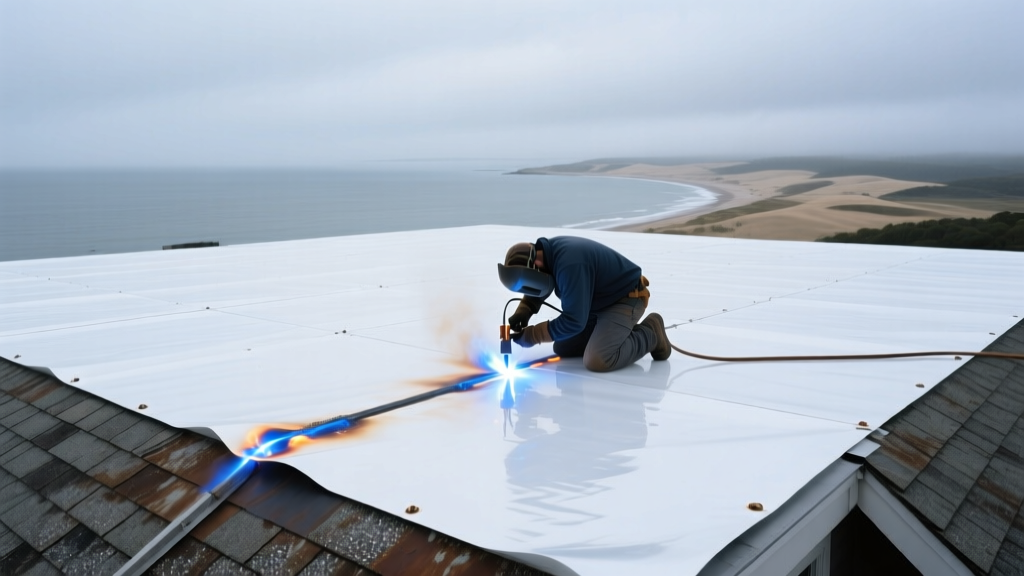
Modified bitumen combines asphalt with rubber polymers. For Cape Cod winters, SBS (Styrene-Butadiene-Styrene) is strictly preferred over APP (Atactic Polypropylene) because SBS remains highly flexible at low temperatures, whereas APP becomes brittle. Installation typically involves torching or cold-adhesive application over a base sheet.
- Pros: Exceptional puncture resistance, making it ideal for flat roofs with high foot traffic (e.g., HVAC maintenance, rooftop decks); multi-ply system provides redundant waterproofing layers.
- Cons: Torch-down application poses a fire risk on older Barnstable homes with wood decking; requires highly certified labor, driving up the installation premium.
Hidden Costs in Barnstable Flat Roof Installations
Budgeting solely for the membrane will result in severe cost overruns. The following variables frequently impact flat roof projects in the Barnstable area:
1. Insulation and the MA Stretch Energy Code
The Massachusetts Building Code and local Stretch Energy Codes mandate rigorous thermal resistance for flat roofs. To meet the required R-30 to R-38 continuous insulation values, contractors must install multiple layers of polyisocyanurate (polyiso) boards. Upgrading from standard R-25 to code-compliant R-38 adds approximately $1.80 to $2.50 per square foot in material costs alone.
2. Decking Remediation
Many older Cape Cod homes and commercial buildings suffer from concealed wood decking rot due to historical micro-leaks. Once the old membrane is torn off, replacing compromised CDX plywood or tongue-and-groove planking costs between $4.00 and $7.50 per square foot. It is standard practice to include a 15% contingency fund specifically for decking replacement.
3. Logistical Premiums
Properties located near Barnstable Harbor, Sandy Neck, or Osterville often face severe logistical constraints. If a crane is required to hoist materials over a multi-story structure or across protected dunes, expect crane rental fees ranging from $1,500 to $3,500 per day. Furthermore, the Cape Cod bridge traffic and seasonal congestion add transit time, which local contractors factor into their labor overhead.
Decision Framework: Which Material Should You Choose?
Selecting the right flat roof material in Barnstable depends on your building's specific use case and structural layout.
- Choose TPO if: You are roofing a commercial building or a residential addition with high summer solar exposure, and you want the lowest long-term energy costs and strongest seam integrity against nor'easters.
- Choose Reinforced EPDM if: You are roofing a complex shape with numerous penetrations (pipes, skylights, HVAC curbs). EPDM's flexibility and availability of pre-fabricated pipe boots make detailing complex penetrations faster and more reliable.
- Choose SBS Mod-Bit if: The roof will experience regular foot traffic for maintenance, or if the roof serves as a base for a rooftop deck or patio. Its multi-ply asphalt construction absorbs impact far better than single-ply membranes.
"In Barnstable, the cheapest bid is usually the most expensive in the long run. A contractor proposing a 45-mil mechanically fastened EPDM system without enhanced perimeter detailing is ignoring the reality of our coastal wind shear. Always specify fully adhered, 60-mil minimum, and verify their FM Global wind uplift ratings."
Final Considerations for 2026
When soliciting bids for flat roof materials in Barnstable, require contractors to itemize membrane thickness, insulation R-values, and fastening methods. Ensure the proposal explicitly states compliance with local coastal wind zones and the current Massachusetts energy code. Investing in a fully adhered, premium-grade system with proper polyiso insulation will protect your property from the harsh Cape Cod elements and deliver a reliable, watertight seal for decades.
Written by
James ThorntonJames Thornton is a construction industry veteran with 25 years of hands-on experience in wood framing, lumber grading, and residential building codes. He started as a framing carpenter in rural Oregon, earned his ICC Residential Building Inspector certification, and eventually became a senior plan reviewer for the City of Portland Bureau of Development Services. James holds a B.S. in Wood Science & Technology from Oregon State University and is a certified lumber grader through the West Coast Lumber Inspection Bureau (WCLIB). He has inspected over 3,000 residential construction sites and authored the city's internal guide on advanced framing techniques (2x6 at 24" O.C.). James lives in Bend, OR, where he builds custom timber-frame cabins and competes in lumberjack sports.
More from James Thornton
View all
Insulation
Best Home Insulation Materials: Complete 2026 Guide
Compare top home insulation materials for 2026. Find R-values, installed costs per square foot, and best uses for fiberglass, spray foam, and mineral wool.
Aug 4, 2026

Sustainable Building
Certify Your Green Building Material for LEED and WELL
Step-by-step guide to certifying a green building material for LEED v5 and WELL v2. Master EPDs, HPDs, and VOC limits for 2026 project specifications.
Aug 4, 2026

Stone & Masonry
Veneer Stacked Stone Panels: Interior Design & Style Showcase
Discover how veneer stacked stone panels transform interiors. Explore modern design profiles, material pairings, and technical installation specs.
Aug 4, 2026