Material-Based Roof Coatings Davidson NC: 2026 Cost Breakdown
Detailed 2026 cost breakdown for material-based roof coatings in Davidson NC. Compare acrylic, silicone, and polyurethane pricing, prep costs, and ROI.

The Davidson NC Climate Factor: Why Material Choice Dictates Cost
Restoring a commercial or residential low-slope roof in Davidson, North Carolina, requires navigating the Piedmont region's specific environmental stressors. Unlike arid climates where basic reflective coatings suffice, Davidson experiences high summer humidity, intense UV radiation (peaking at an index of 9-10 in July), and sudden, heavy thunderstorms that frequently cause temporary ponding water on flat roofs.
When evaluating material-based roof coatings Davidson NC property owners must look beyond the initial price per gallon. A cheaper acrylic coating may fail within three years if subjected to the 48-hour ponding water common after Lake Norman-area summer storms, whereas a premium silicone system will withstand the moisture but requires specific maintenance to retain its solar reflectance. Understanding the exact cost breakdown—including substrate preparation, material specifications, and labor—ensures your 2026 roofing budget aligns with long-term performance.
2026 Cost Breakdown by Coating Material
The following table outlines the current installed costs for the primary material-based roof coatings used in the greater Charlotte and Davidson area. These figures include material, standard labor, and basic equipment mobilization for a standard 10,000 sq. ft. commercial flat roof.
| Coating Material | Material Cost / Sq.Ft. | Labor Cost / Sq.Ft. | Total Installed | Best Application |
|---|---|---|---|---|
| Acrylic Elastomeric | $1.20 - $1.80 | $1.50 - $2.20 | $2.70 - $4.00 | Steep-slope metal, well-drained flat roofs |
| 100% Silicone | $2.50 - $3.80 | $1.80 - $2.50 | $4.30 - $6.30 | Flat roofs with ponding water, EPDM, TPO |
| Polyurethane | $3.50 - $5.00 | $2.20 - $3.00 | $5.70 - $8.00 | High-traffic areas, HVAC walkways, SPF roofs |
| Asphalt-Aluminum | $0.80 - $1.20 | $1.00 - $1.50 | $1.80 - $2.70 | Built-up roofs (BUR), non-reflective needs |
Acrylic Elastomeric Coatings: The Budget-Friendly Reflective Option
Acrylic coatings, such as Henry 587 Dura-Brite or Gaco Acrylic, are water-based, highly reflective, and offer excellent UV resistance. They are the most cost-effective option for metal roofs or low-slope roofs with exceptional drainage. According to data from the Cool Roof Rating Council, high-quality acrylics can reflect up to 85% of solar energy, significantly reducing cooling loads during Davidson's sweltering August months.
The Catch: Acrylics are water-soluble during the curing process and remain somewhat permeable. If your roof has depressions where water ponds for more than 48 hours after a Piedmont thunderstorm, the acrylic will eventually re-emulsify, thin out, and wash away. They are strictly for well-drained substrates.
100% Silicone Roof Coatings: The Ponding Water Solution
For flat commercial roofs in Davidson with existing drainage issues, 100% silicone (like Henry 885 HS Tropi-Cool or GacoRoof 100% Silicone) is the industry standard. Silicone is moisture-cured, meaning it actually relies on ambient humidity to set—a distinct advantage in North Carolina's humid climate. It is entirely impervious to ponding water and will not wash away.
The Catch: Silicone has a high affinity for dirt pickup. Over 3 to 5 years, airborne pollen (abundant in Davidson during spring) and dust will stick to the surface, dropping the solar reflectance from 85% down to 50%. To maintain energy efficiency, the roof must be lightly power-washed every 24 months.
Polyurethane Systems: Maximum Durability for High Traffic
Polyurethane coatings are exceptionally tough and abrasion-resistant. They are typically applied as a base coat with an acrylic or silicone topcoat for UV protection. If your Davidson facility has heavy rooftop foot traffic from HVAC technicians or features outdoor dining spaces, polyurethane is the only material-based coating that will withstand the physical wear without tearing.
Substrate Preparation: The Hidden Costs of Roof Coating
The most common reason material-based roof coatings fail in the Carolinas is inadequate substrate preparation. A coating is only as good as the surface it adheres to. When budgeting for your project, you must account for these mandatory preparatory steps:
- Infrared Moisture Scanning ($0.05 - $0.10 / sq. ft.): Identifies wet insulation beneath the membrane. Wet sections must be cut out and replaced before coating.
- Power Washing & Biological Treatment ($0.15 - $0.25 / sq. ft.): Removes dirt, oxidation, and biological growth (algae/mildew). A mildewcide wash is critical in Davidson's humid environment to prevent organic growth beneath the new coating.
- Substrate-Specific Primers ($0.30 - $0.60 / sq. ft.): TPO and EPDM membranes require specialized primers (like Henry 805 RubberCoat Primer) to break the surface tension and allow the coating to bond chemically. Skipping primer on single-ply membranes guarantees delamination.
- Seam Reinforcement ($1.25 - $1.75 / linear ft.): All membrane seams, flashings, and penetrations must be detailed with a mastic and polyester reinforcing fabric (like Henry 295 RubberSeam Tape or fabric-in-mastic method) before the field coat is applied.
Energy ROI and the Federal Energy Management Program
Applying a highly reflective material-based coating in Davidson NC yields measurable financial returns. The Federal Energy Management Program notes that cool roofs can reduce peak cooling demand by 10% to 15%. For a 10,000 sq. ft. commercial building in the Duke Energy service territory, reducing peak summer demand translates to annual HVAC savings of $1,200 to $2,500, depending on the building's insulation R-value and internal heat generation.
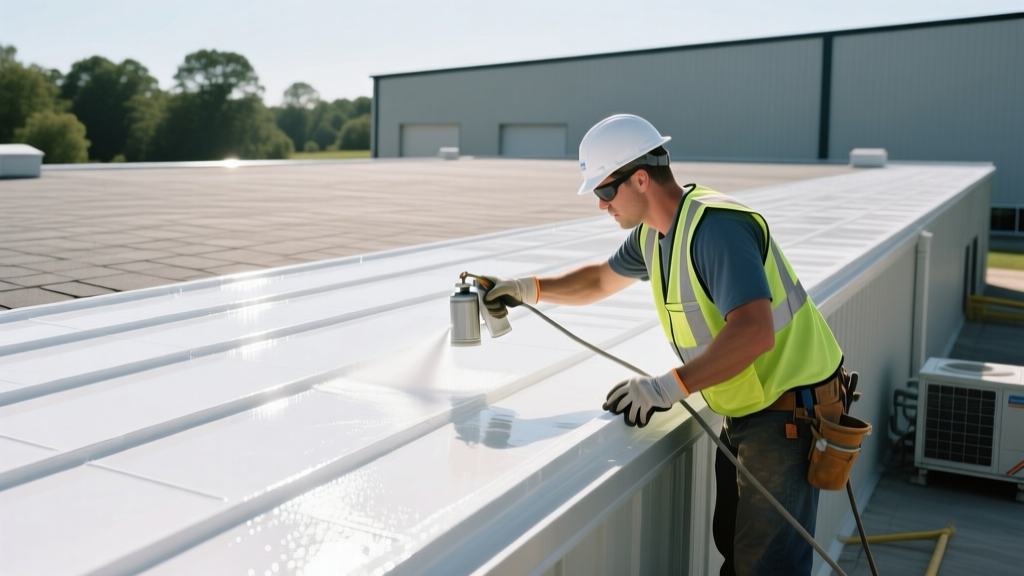
Furthermore, reflective coatings reduce thermal shock. In Davidson, roof surface temperatures can reach 160°F on a 95°F July afternoon, then drop rapidly during evening thunderstorms. This extreme expansion and contraction causes seams to split on EPDM and TPO roofs. A white silicone or acrylic coating keeps the membrane surface temperature below 110°F, drastically slowing the thermal aging of the underlying roof assembly and delaying a full tear-off by 10 to 15 years.
Frequently Asked Questions
Can I apply a roof coating over my existing asphalt shingles?
No. Material-based elastomeric coatings are designed for low-slope or flat roofs (metal, modified bitumen, EPDM, TPO, or built-up roofs). Applying them over residential asphalt shingles will trap moisture in the felt underlayment, void the shingle manufacturer's warranty, and cause premature decking rot. For steep-slope residential roofs in Davidson, replacement or specialized shingle-compatible sealants are required.
How thick does the coating need to be applied?
Most manufacturers require a minimum of 20 to 30 dry mils (which requires roughly 30 to 45 wet mils, as the water or solvent evaporates). This usually equates to two separate coats. Applying it too thin will result in micro-cracking; applying it too thick in a single pass will cause the surface to skin over while the bottom remains uncured, leading to blistering.
Do I need a permit for a roof coating in Davidson, NC?
Generally, the Town of Davidson and Mecklenburg County do not require a building permit for a roof coating if it is considered 'maintenance' and does not involve replacing the underlying roof deck or adding structural weight. However, if the project includes replacing saturated insulation or altering the roof's drainage pathways, a permit will be required. Always verify with the local building codes office before mobilization.
Written by
Priya KapoorPriya Kapoor is a real estate market analyst and construction economics researcher with expertise in housing affordability, development feasibility, and infrastructure investment. She holds a Master of Regional Planning from Cornell University and previously worked as a senior analyst at CBRE's Investment Properties group, where she modeled returns for $4B in mixed-use development pipelines. Priya now runs an independent research practice advising developers, municipalities, and REITs on construction cost forecasting and market timing. She publishes the quarterly "BuildMat Market Pulse" report tracking material price indices across 12 commodity categories. Based in Austin, TX, Priya serves on the board of Habitat for Humanity Austin and is a marathon runner.
More from Priya Kapoor
View all
Construction Cost
Cost to Build a 1600 Sq Ft Home in 2026: Full Breakdown
Accurate 2026 cost to build a 1600 sq ft home—material, labor, and regional pricing breakdowns included. Plan your budget with real-time estimates.
Aug 11, 2026

Wood & Lumber
Name the Types of Wood for Pressure Treatment and Preservation
Learn how to name the types of wood best suited for pressure treatment. Compare species treatability, chemical retention levels, and 2026 preservation costs.
Aug 4, 2026

Stone & Masonry
Stone Veneer Suppliers Lindenhurst: 2026 Cost Analysis
Analyze 2026 stone veneer costs in Lindenhurst, NY. Compare local supplier pricing, delivery fees, and Suffolk County installation labor rates.
Aug 4, 2026