Choosing Roof Flashing Materials: A Pro Selection Guide
Master roof flashing materials selection with our pro framework. Compare copper, aluminum, and steel for cost, climate, and roof compatibility.

Flashing accounts for less than 5% of a total roof system's material cost but is responsible for over 90% of residential and commercial water intrusion claims. Selecting the wrong roof flashing materials guarantees premature system failure, regardless of the primary roofing membrane's quality or warranty. This selection framework eliminates guesswork, aligning metallurgical properties with environmental stressors, substrate compatibility, and long-term lifecycle economics.
The Substrate Compatibility Matrix
The most common error in flashing selection is ignoring the chemical interaction between the primary roof covering and the metal flashing. Runoff, tannins, and alkaline leaching can destroy incompatible metals in under three years.
| Primary Roof Material | Compatible Flashing Metals | Incompatible / High-Risk Metals |
|---|---|---|
| Asphalt Shingles | Galvanized Steel, Aluminum, Copper | None (with proper underlayment separation) |
| Cedar / Redwood Shakes | Copper, Stainless Steel, Lead-Coated | Aluminum, Galvanized (wood tannins and ACQ treatments cause rapid corrosion) |
| Clay / Concrete Tile | Copper, Lead-Coated Copper, 316 SS | Standard Galvanized (alkaline cement runoff degrades zinc coatings) |
| Standing Seam Metal | Match the panel metal exactly | Any dissimilar metal (triggers severe galvanic corrosion) |
| Slate | Copper, Stainless Steel | Aluminum, Galvanized (lifespan mismatch; slate outlasts these metals by decades) |
Material Specifications and Edge Cases
According to the National Roofing Contractors Association (NRCA), material thickness and coating grades are just as critical as the base metal chosen. Below are the exact specifications required for professional-grade installations.
Copper: The Premium Benchmark
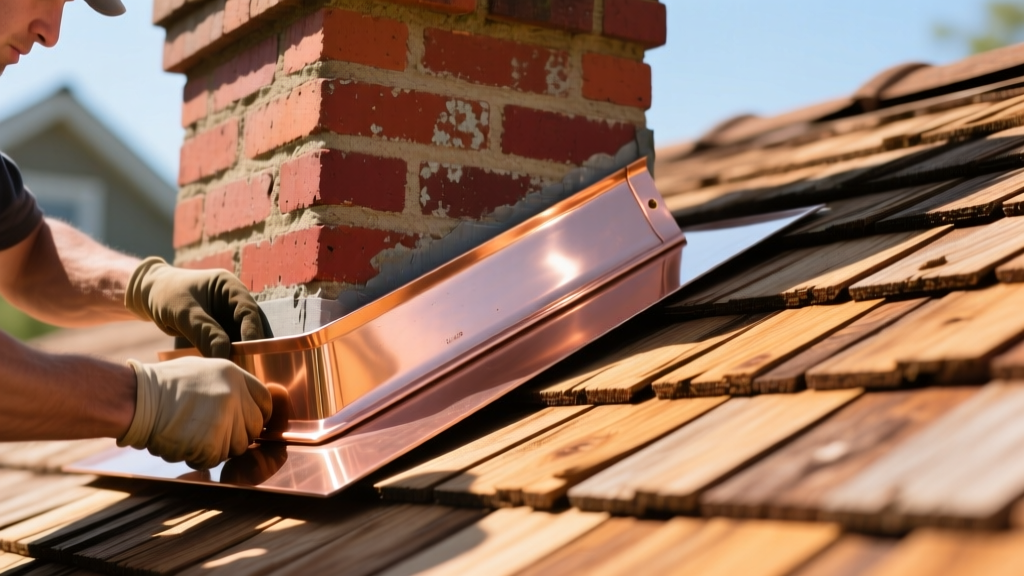
Copper remains the gold standard for longevity and malleability. Specify 16 oz (0.0216-inch) cold-rolled copper for standard step and counter flashing, and upgrade to 20 oz (0.027-inch) for valleys, custom chimney crickets, and high-wear fabrications.
- Material Cost: $14.00 – $22.00 per linear foot.
- Edge Case: Copper oxidation (patina) produces acidic runoff that permanently stains light-colored masonry, stucco, and light asphalt shingles. Mitigation: Apply a clear silicone gutter-sealant to the lower drip edge, or specify lead-coated copper, which drastically limits staining runoff.
Aluminum: The Budget Workhorse
Aluminum is lightweight and cost-effective but requires strict environmental parameters. Minimum thickness should be .019-inch, though .024-inch is heavily recommended for structural rigidity in high-wind zones to prevent edge-lift.
- Material Cost: $3.50 – $6.00 per linear foot.
- Edge Case: Never install aluminum flashing in direct contact with pressure-treated lumber (specifically ACQ or CA-C preservatives) or fresh concrete/mortar. The highly alkaline environment causes rapid pitting and structural failure of the aluminum within 24 to 36 months.
Galvanized Steel: The Middle Ground
For galvanized steel, always specify a G90 coating (0.90 ounces of zinc per square foot) per ASTM A653 standards. Do not accept G60 for exterior roofing applications. Minimum thickness is 26-gauge.
- Material Cost: $4.00 – $8.50 per linear foot.
- Edge Case: Cutting, bending, or welding galvanized steel destroys the sacrificial zinc layer at the stress points. All cut edges and field-modified bends must be immediately treated with a zinc-rich cold galvanizing compound (e.g., ZRC) to prevent edge-creep rust.
Stainless Steel: The Extreme Environment Solution
Type 304 stainless steel is suitable for standard inland applications requiring high tensile strength. However, Type 316 (marine grade, containing molybdenum) is strictly required for structures located within 1,500 feet of saltwater coastlines to resist chloride-induced pitting.
- Material Cost: $9.00 – $15.00 per linear foot.
⚠ Critical Warning: The Galvanic Corrosion Trap
When two dissimilar metals touch in the presence of an electrolyte (rainwater, condensation), the less noble metal (anode) corrodes rapidly to protect the more noble metal (cathode). Never mix copper flashing with aluminum gutters or steel fasteners. If transitioning between dissimilar metals is unavoidable, you must use a physical separation membrane, such as a 40-mil EPDM separator pad or a heavy bituminous tape, to break the electrical path.
Climate-Driven Selection Variables
Environmental stressors dictate metal fatigue and coating degradation rates. Use this regional framework to finalize your material choice:
- Alpine / Heavy Freeze-Thaw Zones: Ice damming causes water to back up under shingles. Softer, highly malleable metals like copper or lead-coated copper are preferred here because they can be tightly formed and soldered to create watertight seals that won't crack under extreme thermal expansion and contraction cycles.
- Coastal / Salt-Spray Environments: Standard galvanized steel will experience white-rust failure in under five years. Type 316 Stainless Steel or heavy-gauge aluminum (if isolated from masonry) are the only viable metal options.
- High-UV / Desert Climates: Thermal expansion is the primary enemy. Aluminum expands at nearly twice the rate of steel. If using aluminum in desert climates, the Sheet Metal and Air Conditioning Contractors' National Association (SMACNA) mandates the use of floating cleats and expansion joints for any continuous run exceeding 20 feet.
Lifecycle ROI and Replacement Economics
Evaluating roof flashing materials strictly on initial material cost is a false economy. The labor cost to expose, remove, and replace failed flashing often exceeds the original installation cost by 400% due to the destruction of surrounding roof coverings and interior drywall repairs.
| Flashing Material | Material Cost (Per LF) | Expected Lifespan | Amortized Cost (Per Year) |
|---|---|---|---|
| Aluminum (.024") | $4.75 | 20 - 30 Years | $0.19 - $0.23 |
| Galvanized Steel (G90) | $6.25 | 25 - 40 Years | $0.15 - $0.25 |
| Type 316 Stainless Steel | $12.00 | 50 - 75+ Years | $0.16 - $0.24 |
| 16oz Copper | $18.00 | 70 - 100+ Years | $0.18 - $0.25 |
Note: When paired with a 50-year slate or tile roof, copper or stainless steel is the only mathematically sound choice, as it prevents the need for a mid-cycle roof tear-off solely to replace degraded flashing.
Code Tolerances and Fastener Mandates
Proper material selection is useless if installation violates building codes. The International Code Council (ICC) outlines strict parameters in the International Residential Code (IRC R905.2.8) for step and valley flashing.
Overlap and Dimensional Minimums
Step flashing must be a minimum of 2 inches wide and overlap the shingle below by at least 2 inches. For valleys, open metal valleys require a minimum 24-inch wide flashing pan, hemmed at the edges to prevent water capillary action from creeping under the adjacent roofing material.
The Fastener Rule
The most frequently violated rule in roofing is fastener compatibility. The fastener must be of the exact same metal, or a nobler metal, than the flashing it secures.
- Copper Flashing: Must use solid copper or 304/316 stainless steel ring-shank nails.
- Aluminum Flashing: Must use aluminum or stainless steel fasteners.
- Galvanized Flashing: Hot-dipped galvanized or stainless steel fasteners are acceptable.
Using a standard electro-galvanized roofing nail to secure a copper step flashing will result in the nail head corroding completely away within a single season, leaving the flashing vulnerable to wind uplift and water intrusion. Always specify minimum 1.5-inch penetration into the structural roof deck, avoiding the OSB/plywood seams where holding power is compromised.
Written by
David NakamuraDavid Nakamura is a licensed architect (AIA) and construction technology writer focused on sustainable building methods, mass timber engineering, and high-performance building envelopes. He holds a Master of Architecture from the University of Washington and is a certified Passive House Consultant (CPHC). David spent eight years at the Seattle firm Mithun, where he led the design of three LEED Platinum projects, before founding his own practice specializing in net-zero residential design. He serves on the editorial advisory board of GreenBuilder Magazine and has authored peer-reviewed papers on cross-laminated timber (CLT) connections for the Journal of Structural Engineering. In his spare time, David teaches woodworking at Pratt Fine Arts Center and kayaks the Puget Sound.
More from David Nakamura
View all
Construction Cost
Labor Cost to Build a Deck Per Sq Ft: 2026 Installation Guide
Discover the exact labor cost to build a deck per sq ft in 2026. This installation guide breaks down contractor rates, complexity factors, and hidden fees.
Aug 4, 2026

Construction Cost
How Much Does It Cost to Build a 3 Bedroom House? Financing Guide
Learn exactly how much it costs to build a 3 bedroom house and explore 2026 financing options, construction loan types, and budget frameworks for your build.
Aug 4, 2026

Construction Cost
Cost to Build a Tennis Court: 2026 Guide
How much does it cost to build a tennis court in 2026? Breakdowns for asphalt, concrete, and synthetic surfaces plus fencing and lighting.
Jul 30, 2026