Progressive Materials Silicone Roof Coating Cost Breakdown 2026
Detailed 2026 cost breakdown for Progressive Materials silicone roof coatings, including material, labor, primer, and prep expenses per square foot.

The True Cost of Progressive Materials Silicone Systems
Restoring a commercial low-slope roof with high-solids silicone has become the dominant alternative to costly tear-offs. Among the premier manufacturers in this space, Progressive Materials (often specified by contractors as ProMaterials) offers high-build, moisture-cure silicone formulations designed to withstand severe UV degradation and ponding water. For facility managers and building owners evaluating a roof restoration project in 2026, understanding the precise financial outlay is critical. The total installed cost for a Progressive Materials silicone roof coating system typically ranges from $4.50 to $7.85 per square foot, depending on substrate condition, warranty length, and regional labor rates.
Unlike acrylics that degrade under constant water exposure, Progressive Materials silicone systems are hydrophobic and chemically inert once cured. However, achieving the manufacturer's specified performance requires strict adherence to mil-thickness requirements and substrate-specific priming protocols. This guide dissects the exact material, labor, and hidden costs associated with specifying Progressive Materials products for commercial flat roofs.
Material Pricing: Progressive Materials Product Lines
Progressive Materials segments its silicone offerings based on viscosity, solids content, and application method. The cost of the coating itself represents roughly 35% to 45% of the total project budget. Below is the 2026 wholesale-to-contractor pricing matrix for the core product lines, measured in standard 5-gallon pails.
| Product Model | Type / Use | Avg. Price (5-Gal Pail) | Coverage Rate (Per Gallon) | Cost Per Square (100 sq ft) |
|---|---|---|---|---|
| PM 3800 | High Solids Silicone (Standard) | $295 - $330 | 12-14 Dry Mils | $145 - $165 (2.5 Gal) |
| PM 3900 | High Build Silicone (Heavy Duty) | $320 - $360 | 14-16 Dry Mils | $160 - $180 (2.5 Gal) |
| PM 2500 | Universal Primer (TPO/EPDM) | $185 - $210 | 300-400 sq ft | $5 - $7 |
| PM 2100 | Bleed-Blocking Primer (Mod-Bit) | $220 - $250 | 250-300 sq ft | $8 - $10 |
| ProFabric | Polyester Reinforcing Mesh | $85 - $110 (Roll) | Linear Footage | $0.45 - $0.65 / lin. ft. |
Labor, Preparation, and Equipment Expenses
The longevity of a silicone coating is entirely dependent on the preparation phase. Progressive Materials mandates specific surface profiles and moisture limits before application. Labor and preparation generally account for 50% to 60% of the total project cost, ranging from $2.50 to $4.50 per square foot.
1. Surface Preparation and Power Washing
Silicone will not adhere to dirt, biological growth, or chalky oxidation. Contractors must use high-pressure power washing (minimum 3,000 PSI) to remove debris and open the pores of the existing membrane. For heavily soiled roofs, a trisodium phosphate (TSP) or specialized roof cleaner is required. Power washing costs average $0.15 to $0.25 per square foot. If the roof has severe biological staining, chemical treatment adds $0.10 per square foot.
2. Seam and Fastener Reinforcement
All seams, penetrations, and fastener heads must be reinforced. The standard protocol involves embedding ProFabric polyester mesh into a base coat of silicone or specialized mastic. This labor-intensive process is priced per linear foot for seams and per unit for penetrations (HVAC curbs, pipes, drains). Expect to pay $0.85 to $1.50 per linear foot for seam reinforcement and $15 to $25 per penetration detail.
3. Application Method: Spraying vs. Rolling
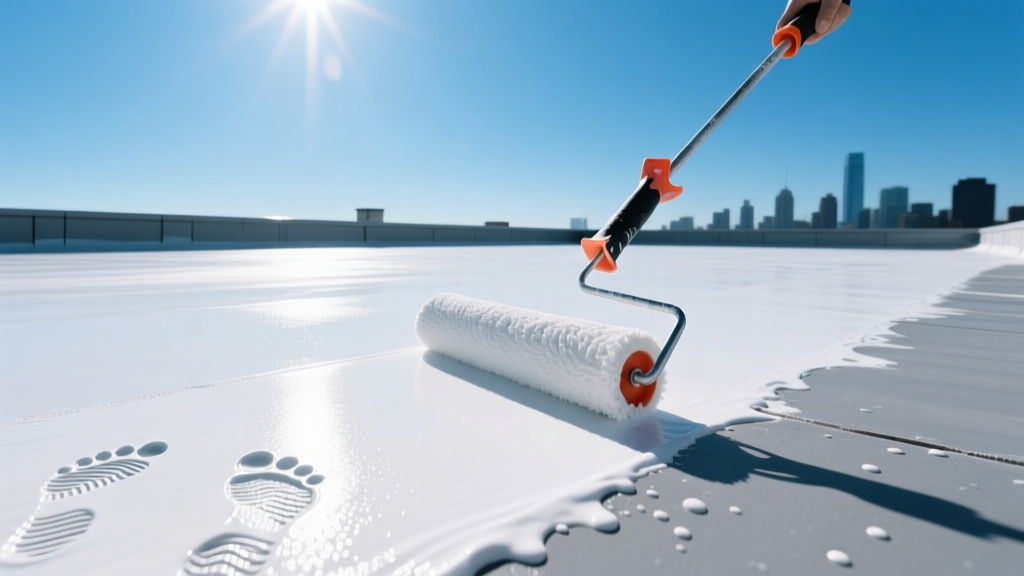
Progressive Materials high-solids silicones are incredibly viscous. While they can be rolled, commercial applications heavily favor airless sprayers for speed and uniform mil-thickness. Contractors typically use heavy-duty hydraulic airless sprayers, such as the Graco GH-833 or Titan MX-833, equipped with 0.031 to 0.035-inch tip sizes. Spraying reduces labor time by 40% compared to rolling, bringing the application labor cost down to $1.25 to $1.85 per square foot. Roller application, often required for smaller roofs or complex parapet walls, pushes labor costs to $2.25 to $3.00 per square foot.
If you are coating over Modified Bitumen or Built-Up Roofing (BUR), asphalt oils will bleed through standard silicone, causing severe yellow/brown staining and degrading the coating's UV reflectivity. You must factor in the cost of a bleed-blocking primer like PM 2100, or apply a sacrificial base coat. Skipping this step will void the Progressive Materials warranty.
Warranty Requirements and Dry Mil Calculations
The cost of your Progressive Materials system scales directly with the warranty term you require. Warranties are dictated by the final dry mil thickness of the silicone, not the wet mil thickness. High-solids silicones typically contain 90-95% solids by volume, meaning they experience minimal shrinkage during curing compared to water-borne acrylics.
- 10-Year Warranty: Requires 20 dry mils. Achieved with approximately 1.5 to 1.7 gallons per square (100 sq ft). Material cost: ~$95/sq.
- 15-Year Warranty: Requires 25 dry mils. Achieved with approximately 2.0 gallons per square. Material cost: ~$125/sq.
- 20-Year Warranty: Requires 30 dry mils. Achieved with approximately 2.5 gallons per square. Material cost: ~$155/sq.
According to guidelines published by the National Roofing Contractors Association (NRCA), verifying dry mil thickness using a mil-gauge immediately after application and post-cure is the only way to ensure the roof system meets the manufacturer's warranty specifications. Under-application is the leading cause of premature coating failure and warranty denial.
Hidden Costs and Edge Cases
Budgeting for a silicone restoration requires accounting for variables that are not immediately visible during a preliminary roof inspection.
Ponding Water Remediation
While Progressive Materials silicone is designed to withstand ponding water once fully cured, the manufacturer requires that all existing ponding water be removed prior to application. If the roof deck has structural deflection causing water to pool for more than 48 hours, contractors may need to build up low areas using closed-cell polyurethane foam or specialized leveling compounds before priming. This remediation can add $1.50 to $3.00 per square foot in affected zones.
Weather and Dew Point Constraints
Silicone coatings are moisture-cure, meaning they rely on ambient humidity to crosslink and dry. However, applying silicone when the surface temperature is within 5°F of the dew point will cause blushing (a white, chalky defect) and adhesion failure. In humid climates or during transitional seasons, contractors may need to schedule work around narrow daily temperature windows, potentially extending the project timeline and increasing mobilization costs.
HVAC and Overspray Protection
Silicone overspray is notoriously difficult to remove from vehicles, windows, and adjacent buildings. Extensive masking of HVAC units, skylights, and building facades is mandatory. For buildings in dense urban environments or those with sensitive air intakes, the cost of specialized masking and intake shutdown coordination can add $1,500 to $4,000 to the total project overhead.
ROI: Silicone Restoration vs. Full Tear-Off
To contextualize the cost of a Progressive Materials silicone system, it must be compared to the alternative: a full single-ply TPO or EPDM tear-off and replacement. According to the U.S. Department of Energy's Cool Roofs Guide, highly reflective white silicone coatings can reduce peak cooling demand by up to 15%, offering immediate operational savings that offset the initial capital expenditure.
| Metric | Progressive Materials Silicone Restoration | Full TPO Tear-Off & Replacement |
|---|---|---|
| Average Cost (Per Sq Ft) | $4.50 - $7.85 | $9.00 - $14.50 |
| Landfill / Disposal Fees | $0 (Zero tear-off waste) | $0.75 - $1.50 / sq ft |
| Business Disruption | Minimal (No exposed deck) | High (Risk of interior water damage) |
| Expected Lifespan | 15 - 20 Years | 20 - 25 Years |
| End-of-Life Recyclability | Can be re-coated indefinitely | Membrane requires disposal/recycling |
Frequently Asked Questions
Can Progressive Materials silicone be applied directly to wet substrates?
No. While the finished silicone membrane is entirely waterproof and handles ponding water exceptionally well, the application process requires a dry substrate. Trapped moisture beneath the coating will vaporize under solar heat, causing blisters and delamination. Contractors must use infrared moisture scanners to verify the substrate is dry before priming.
How does high-solids silicone differ from standard silicone?
Standard silicones often contain solvents or higher water content, resulting in significant shrinkage as they cure. Progressive Materials high-solids formulations (like the PM 3800 and 3900) contain over 90% solids. This means that if a contractor sprays 30 wet mils of coating, it will cure to approximately 28-29 dry mils, ensuring the warranty requirements are met without requiring multiple heavy passes that increase the risk of sagging on vertical parapet walls.
Is a primer always required with Progressive Materials silicone?
Not always, but usually. Single-ply membranes like aged TPO and EPDM almost always require a primer (like PM 2500) to ensure chemical adhesion, as the original plasticizers in the membrane have leached out over time. However, some granulated modified bitumen surfaces or specific metal flashings may allow for direct-to-metal (DTM) or direct-to-substrate application, provided a rigorous adhesion test patch is performed and approved by the manufacturer prior to full-scale application.
Written by
James ThorntonJames Thornton is a construction industry veteran with 25 years of hands-on experience in wood framing, lumber grading, and residential building codes. He started as a framing carpenter in rural Oregon, earned his ICC Residential Building Inspector certification, and eventually became a senior plan reviewer for the City of Portland Bureau of Development Services. James holds a B.S. in Wood Science & Technology from Oregon State University and is a certified lumber grader through the West Coast Lumber Inspection Bureau (WCLIB). He has inspected over 3,000 residential construction sites and authored the city's internal guide on advanced framing techniques (2x6 at 24" O.C.). James lives in Bend, OR, where he builds custom timber-frame cabins and competes in lumberjack sports.
More from James Thornton
View all
Insulation
Best Home Insulation Materials: Complete 2026 Guide
Compare top home insulation materials for 2026. Find R-values, installed costs per square foot, and best uses for fiberglass, spray foam, and mineral wool.
Aug 4, 2026

Sustainable Building
Certify Your Green Building Material for LEED and WELL
Step-by-step guide to certifying a green building material for LEED v5 and WELL v2. Master EPDs, HPDs, and VOC limits for 2026 project specifications.
Aug 4, 2026

Stone & Masonry
Veneer Stacked Stone Panels: Interior Design & Style Showcase
Discover how veneer stacked stone panels transform interiors. Explore modern design profiles, material pairings, and technical installation specs.
Aug 4, 2026