Roof Membrane Lifespan: EPDM, TPO, and PVC Durability Analysis
Analyze the lifespan and durability of EPDM, TPO, and PVC roof membranes. Compare costs, failure modes, and maintenance for commercial flat roofs.
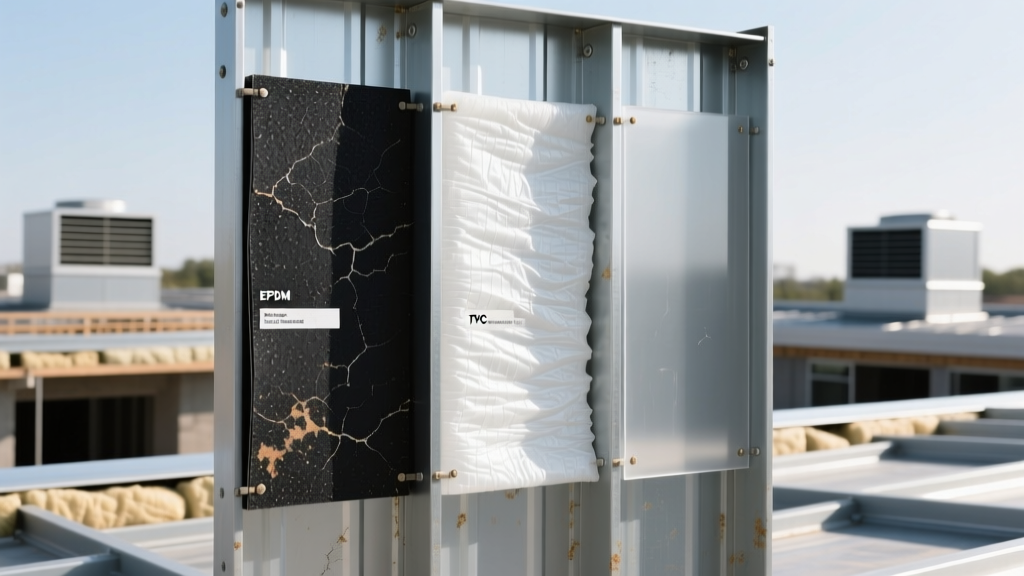
Capital Expenditure and the Membrane Decision
Commercial low-slope roofs represent a massive capital expenditure, often costing between $8 and $15 per square foot fully installed. The single most critical variable dictating whether that investment lasts 15 years or 35 years is the specific roof membrane selected. While structural decking and insulation play vital roles, the membrane serves as the primary waterproofing barrier against UV radiation, thermal shock, and precipitation. Understanding the precise durability profiles, chemical compositions, and failure modes of the dominant single-ply membranes is essential for facility managers and commercial architects.
The Big Three: EPDM, TPO, and PVC Durability Profiles
EPDM (Ethylene Propylene Diene Monomer): The Rubber Workhorse
EPDM is a synthetic rubber membrane renowned for its exceptional resilience in extreme temperature fluctuations and high-wind environments. A properly installed, fully adhered 60-mil EPDM roof membrane routinely achieves a 30- to 40-year lifespan. Its primary vulnerability lies in the seams. Unlike thermoplastic membranes, EPDM relies on liquid adhesives or double-sided seam tapes. Over decades, UV exposure and thermal cycling can degrade these adhesives, leading to seam peeling and water infiltration.
Specification Insight: For ballasted systems using river-washed stone, specify a 90-mil EPDM membrane to resist puncture from shifting aggregate. For fully adhered systems over polyiso insulation, 60-mil reinforced EPDM provides the optimal balance of tear resistance and cost-efficiency.
TPO (Thermoplastic Polyolefin): The Reflective Standard
TPO dominates the modern commercial sector due to its heat-welded seams and highly reflective white surface, which significantly reduces cooling loads. Early-generation TPO membranes from the late 1990s suffered from severe UV degradation, becoming brittle within a decade. Modern formulations utilize advanced Hindered Amine Light Stabilizers (HALS) and thicker top weathering plies, pushing expected lifespans to 25–30 years.
Specification Insight: Do not merely specify '60-mil TPO.' The critical metric is the thickness of the top ply above the reinforcing scrim. A standard 60-mil TPO may only offer 20 mils of top ply, whereas an 80-mil premium product (such as GAF EverGuard Extreme) provides up to 40 mils of weathering surface, effectively doubling the membrane's resistance to UV erosion and physical abrasion before the scrim is exposed.
PVC (Polyvinyl Chloride): The Chemical-Resistant Heavyweight
PVC membranes have been in use since the 1960s and offer a proven 25- to 35-year lifespan. The defining advantage of PVC is its hot-air welded seams, which fuse the sheets into a monolithic, watertight bond that is inherently stronger than the membrane itself. Furthermore, PVC is highly resistant to chemical exposure, animal fats, and industrial pollutants, making it the undisputed choice for restaurants and manufacturing facilities.
Specification Insight: Standard PVC relies on plasticizers to remain flexible. Over 20+ years, plasticizer migration can cause the membrane to shrink and become brittle. To mitigate this, specify KEE (Ketone Ethylene Ester) polymer blends, such as Sika Sarnafil or Johns Manville PVC, which utilize solid polymer plasticizers that resist leaching, ensuring long-term flexibility in freezing climates.
Comparative Lifespan and Cost Matrix
The following matrix outlines the 2026 baseline metrics for material performance and fully installed costs (material, labor, and standard insulation overlay) across a 10,000 sq. ft. commercial footprint.
| Membrane Type | Expected Lifespan | Installed Cost (per sq. ft.) | Seam Method | Primary Vulnerability |
|---|---|---|---|---|
| EPDM (60-mil) | 30 - 40 Years | $5.50 - $8.00 | Tape / Liquid Adhesive | Seam degradation, shrinkage |
| TPO (60-mil) | 22 - 28 Years | $6.00 - $9.50 | Hot-Air Weld | Top-ply UV erosion, thermal shock |
| TPO (80-mil) | 28 - 35 Years | $7.50 - $11.00 | Hot-Air Weld | Puncture from heavy hail |
| PVC (50-mil) | 25 - 35 Years | $7.00 - $10.50 | Hot-Air Weld | Plasticizer loss, cold-weather brittleness |
Environmental Stressors and Membrane Failure Modes
According to the Whole Building Design Guide (WBDG), environmental factors are the leading catalyst for premature roof membrane failure. Specifying a membrane without accounting for the building's microclimate guarantees a shortened lifecycle.
Flat roofs with inadequate taper (less than 1/4 inch per foot) will experience ponding water. While PVC and TPO are highly resistant to constant water immersion, EPDM is susceptible to biological growth (algae and fungi) in stagnant water, which can degrade the rubber compound over time. If your roof design features internal drains and low slopes, thermoplastic membranes (TPO/PVC) are mandatory.
In regions with massive diurnal temperature swings (e.g., the American Southwest or high-altitude zones), roof surfaces can experience a 100°F temperature drop within hours. This causes rapid expansion and contraction. Mechanically attached TPO membranes can suffer from 'billowing' and seam stress under these conditions. Fully adhered systems utilizing heavy-duty fleece-back membranes are required to distribute thermal loads evenly across the insulation board.
The Grease and Oil Factor
A frequently overlooked failure mode occurs on roofs housing restaurant HVAC exhaust units. Animal fats and vegetable oils aerosolized by kitchen exhaust fans will settle on the roof membrane. EPDM and TPO will absorb these lipids, causing the membrane to swell, soften, and ultimately dissolve. PVC is inherently resistant to lipid absorption. If your building houses food service operations, a PVC roof membrane or a specialized KEE-blended alternative is non-negotiable.
Actionable Maintenance Framework to Maximize Lifespan
Even the most robust PVC or 80-mil TPO membrane will fail prematurely if the underlying insulation becomes saturated. Implement this strict maintenance protocol to protect your capital investment:
- Bi-Annual Visual Inspections: Conduct inspections in spring and fall. Focus exclusively on penetrations (HVAC curbs, pipe boots, and scuppers). 90% of leaks occur at flashing transitions, not in the field of the membrane.
- Post-Event Infrared Thermography: Following any hail storm or wind event exceeding 60 mph, hire a certified roofing consultant to perform an infrared moisture survey. Water trapped beneath the membrane will retain heat differently than dry insulation, allowing technicians to map wet areas before structural decking rot occurs.
- Seam Probing (TPO/PVC): Every five years, a technician should use a blunt-nosed seam probe to test the integrity of hot-air welded seams. Any seam that catches or peels must be immediately re-welded or patched with a 6-inch cover strip.
- Reflectivity Maintenance: For TPO and PVC, the U.S. Department of Energy notes that dirt and biological buildup can reduce solar reflectance by up to 30% over five years, increasing cooling costs and accelerating UV degradation. Schedule professional low-pressure washing every 3 to 4 years to maintain the membrane's cool-roof rating.
Expert Verdict: Which Roof Membrane Should You Specify?
There is no universally superior roof membrane; there is only the correct membrane for your specific operational and environmental parameters. Use this decision framework to finalize your specification:
- Specify EPDM if: You are designing a ballasted roof, operating in a northern climate with severe winter thermal cycling, and require the most cost-effective material for a massive footprint (e.g., a 100,000 sq. ft. warehouse) where cooling loads are not a primary concern.
- Specify TPO (80-mil) if: You are pursuing LEED certification, require high solar reflectance to reduce HVAC costs in southern climates, and want the security of heat-welded seams without the premium price tag of PVC.
- Specify PVC (or KEE) if: The building houses restaurants, chemical processing facilities, or manufacturing plants that emit airborne oils and pollutants. It is also the superior choice for roofs with complex geometries and high penetration counts, as the monolithic welding capability allows for highly customized, watertight flashing details.
For comprehensive wind-uplift standards and attachment guidelines specific to your geographic wind zone, always cross-reference your membrane selection with the Single-Ply Roofing Industry (SPRI) testing protocols and local building codes.