How to Clean and Repair White Roofing Materials on Flat Roofs
Learn how to clean, inspect, and repair white roofing materials like TPO, PVC, and elastomeric coatings to restore solar reflectance and prevent leaks.

The Reflectivity Degradation Curve
White roofing materials—primarily Thermoplastic Polyolefin (TPO), Polyvinyl Chloride (PVC), and white elastomeric coatings—dominate the commercial low-slope market due to their high Solar Reflectance Index (SRI). By reflecting solar radiation, these systems significantly reduce building cooling loads. However, the Cool Roof Rating Council (CRRC) data shows that unmaintained white membranes can lose 15% to 25% of their initial solar reflectance within the first three years due to soiling, biological growth, and surface oxidation. Maintaining these materials requires specialized cleaning protocols and material-specific repair techniques that differ vastly from traditional dark EPDM or modified bitumen systems.
Material-Specific Failure Modes and Repair Tactics
Not all white roofing materials degrade in the same manner. Identifying the exact membrane or coating type is the mandatory first step before selecting repair adhesives, primers, or welding parameters. Using incompatible repair materials on single-ply membranes will result in immediate chemical degradation and voided warranties.
| Material Type | Primary Vulnerabilities | Targeted Repair Protocol |
|---|---|---|
| TPO (45-80 mil) | Heat-weld seam splitting, UV surface crazing, puncture from hail or foot traffic. | Score and clean failed seams. Apply TPO-specific primer. Heat-weld a minimum 45-mil TPO patch with a 6-inch overlap on all sides. |
| PVC (45-60 mil) | Plasticizer migration (brittleness), chemical ponding damage, shrinkage at flashings. | Solvent-weld or hot-air weld PVC patches. Use PVC-compatible liquid flashings for complex penetrations. Never use TPO patches on PVC. |
| White Silicone Coatings | Extreme dirt pickup (hydrophobic nature), loss of mil thickness, blistering over wet substrate. | Power wash to remove dirt. Cut out blisters, dry substrate, and re-apply high-solids silicone at 1.5 gallons per 100 sq. ft. to achieve 22 dry mils. |
| White Acrylic Coatings | Ponding water re-emulsification, chalking, UV chalk runoff staining facades. | Remove degraded acrylic. Install tapered polyiso insulation to eliminate ponding. Re-coat with a polyurethane topcoat or high-grade acrylic. |
Restoring Solar Reflectance: The Cleaning Protocol
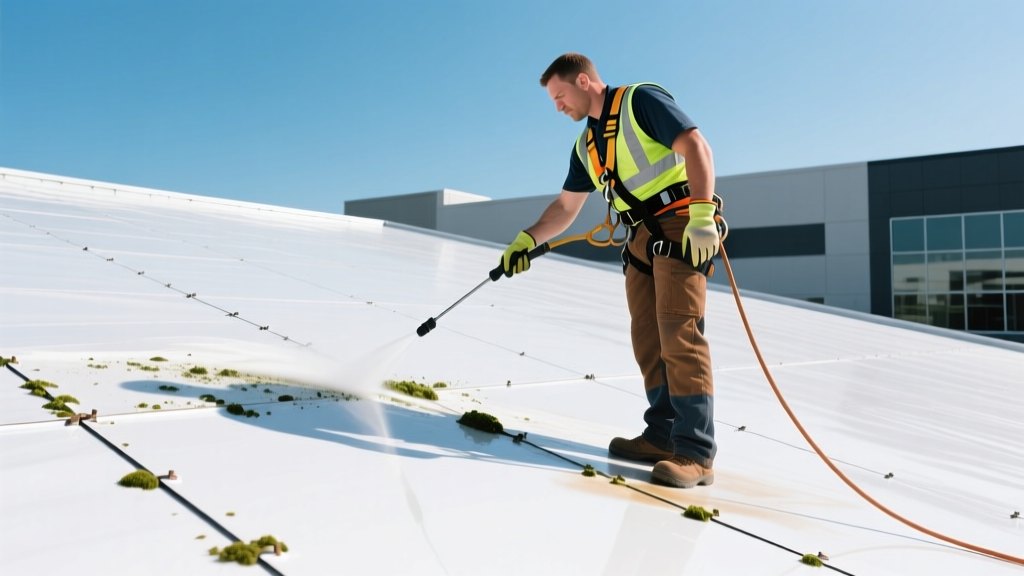
According to the U.S. Department of Energy, restoring a cool roof's reflectivity requires removing biological matter and atmospheric soot without damaging the membrane's top ply or protective coating. High-pressure washing is a common contractor error that strips granules from coatings and scores single-ply membranes.
- Debris Removal and Dry Sweeping: Clear all leaves, branches, and accumulated debris from drains and scuppers. Ponding water accelerates biological growth on white membranes.
- Low-Pressure Soft Washing: Use a pressure washer rated for a maximum of 800 PSI equipped with a 40-degree fan tip. Maintain a minimum 12-inch distance from the membrane surface. High-pressure pinpoint streams will instantly puncture 45-mil TPO or PVC.
- Chemical Application: Apply a trisodium phosphate (TSP) solution or a commercial roof cleaner specifically formulated for single-ply membranes (e.g., Simple Green Oxy Solve Roof Cleaner). For heavy algae or mold, a diluted sodium hypochlorite solution (10% active ingredient) is effective. Crucial: Avoid petroleum-based solvents, citrus-based degreasers, and harsh acids, which will dissolve PVC plasticizers and degrade TPO polymers.
- Dwell Time and Agitation: Allow the solution to dwell for 15 to 20 minutes. For stubborn biological stains, use a soft-bristle push broom. Never use wire brushes or stiff nylon bristles that will scratch the reflective top ply.
- Thorough Rinsing: Rinse the roof completely with clean water. Residual cleaning chemicals left on the surface will attract dirt faster once dry, defeating the purpose of the cleaning.
Executing Precision Seam and Puncture Repairs
When white roofing materials suffer mechanical damage or seam failure, the repair must restore both the waterproofing integrity and the continuous reflective surface. Patching requires strict adherence to temperature and overlap specifications.
Heat Welding Parameters for TPO and PVC
Automatic heat welders (such as the Leister VARIMAT or Herz) are required for long seam repairs. Hand welders (e.g., Leister Triac) are reserved for detailing, corners, and patches.
- Ambient Temperature Compensation: Welder temperatures must be adjusted based on ambient conditions. For TPO, baseline air temperature is typically 1000°F to 1150°F. In cold weather (below 40°F), increase temperature by 50°F and decrease travel speed. In high heat (above 85°F), decrease temperature to prevent scorching the membrane.
- Travel Speed: Maintain an automatic welder speed of 6 to 12 feet per minute. Too fast results in a cold weld (seam will peel); too slow burns through the membrane.
- Probe Testing: Every welded seam and patch must be tested with a blunt-nose seam probe once cooled. Apply moderate pressure along the edge of the weld. If the probe catches or penetrates, the area must be scored, cleaned, and re-welded with a hand welder.
Maintenance Timelines and Cost Baselines
Proactive maintenance extends the lifecycle of white roofing materials by 5 to 10 years. Facility managers should budget for the following maintenance intervals based on regional environmental factors.
Projected Maintenance Costs (Per 10,000 Sq. Ft.)
- Bi-Annual Inspections: $300 - $500 (Focus on seam integrity, flashing adhesion, and drain clearance).
- Reflective Cleaning (Every 2-3 Years): $1,200 - $2,500 (Varies heavily by water access and roof height).
- Seam and Puncture Repairs: $45 - $85 per linear foot for heat-welded patches; $15 - $30 per puncture for liquid flashing repairs.
- Re-Coating (Year 10-15): $25,000 - $40,000 (Includes power washing, primer, and 25-30 dry mils of white silicone or polyurethane).
Fatal Maintenance Errors to Avoid
The National Roofing Contractors Association (NRCA) frequently documents premature roof failures caused by incompatible maintenance materials. Avoid these critical errors when servicing white roofing materials:
- Never use asphalt-based products: Applying asphalt emulsion, bitumen tape, or black roof cement to TPO or PVC will cause immediate chemical incompatibility, melting the single-ply membrane and creating massive leaks.
- Avoid incompatible walkway pads: Only use walkway pads specifically manufactured for the membrane type. PVC walkway pads contain plasticizers that will migrate into TPO, causing the TPO to become brittle and crack under foot traffic.
- Do not ignore ponding water on acrylics: While white silicone coatings can withstand indefinite ponding water, white acrylic coatings will re-emulsify and wash away if water stands for more than 48 hours. Address drainage issues before re-coating with acrylic.
By implementing strict, material-specific cleaning and repair protocols, facility managers can ensure their white roofing materials maintain peak SRI values and structural integrity well past their initial warranty periods.
Written by
Priya KapoorPriya Kapoor is a real estate market analyst and construction economics researcher with expertise in housing affordability, development feasibility, and infrastructure investment. She holds a Master of Regional Planning from Cornell University and previously worked as a senior analyst at CBRE's Investment Properties group, where she modeled returns for $4B in mixed-use development pipelines. Priya now runs an independent research practice advising developers, municipalities, and REITs on construction cost forecasting and market timing. She publishes the quarterly "BuildMat Market Pulse" report tracking material price indices across 12 commodity categories. Based in Austin, TX, Priya serves on the board of Habitat for Humanity Austin and is a marathon runner.
More from Priya Kapoor
View all
Construction Cost
Cost to Build a 1600 Sq Ft Home in 2026: Full Breakdown
Accurate 2026 cost to build a 1600 sq ft home—material, labor, and regional pricing breakdowns included. Plan your budget with real-time estimates.
Aug 11, 2026

Wood & Lumber
Name the Types of Wood for Pressure Treatment and Preservation
Learn how to name the types of wood best suited for pressure treatment. Compare species treatability, chemical retention levels, and 2026 preservation costs.
Aug 4, 2026

Stone & Masonry
Stone Veneer Suppliers Lindenhurst: 2026 Cost Analysis
Analyze 2026 stone veneer costs in Lindenhurst, NY. Compare local supplier pricing, delivery fees, and Suffolk County installation labor rates.
Aug 4, 2026