How Much Does It Cost to Replace a Roof? 2026 Installation Labor Guide
Discover exactly how much it costs to replace a roof in 2026. We break down installation labor, tear-off fees, decking repairs, and pitch multipliers.
The True Cost of Roof Replacement: Beyond the Shingle Price
When homeowners ask, "how much does it cost to replace a roof," the standard answer is a national average of $11,500 to $16,800 for a 2,000-square-foot architectural asphalt shingle roof. However, this figure obscures the reality of installation labor, which accounts for 45% to 60% of the total invoice. The final price is dictated not just by the material you choose, but by the tear-off complexity, decking remediation, roof pitch, and the meticulousness of the flashing and ventilation installation. Understanding the procedural breakdown of a roof replacement is the only way to accurately evaluate contractor bids and avoid catastrophic installation failures.
Phase 1: Tear-Off, Hauling, and Decking Remediation
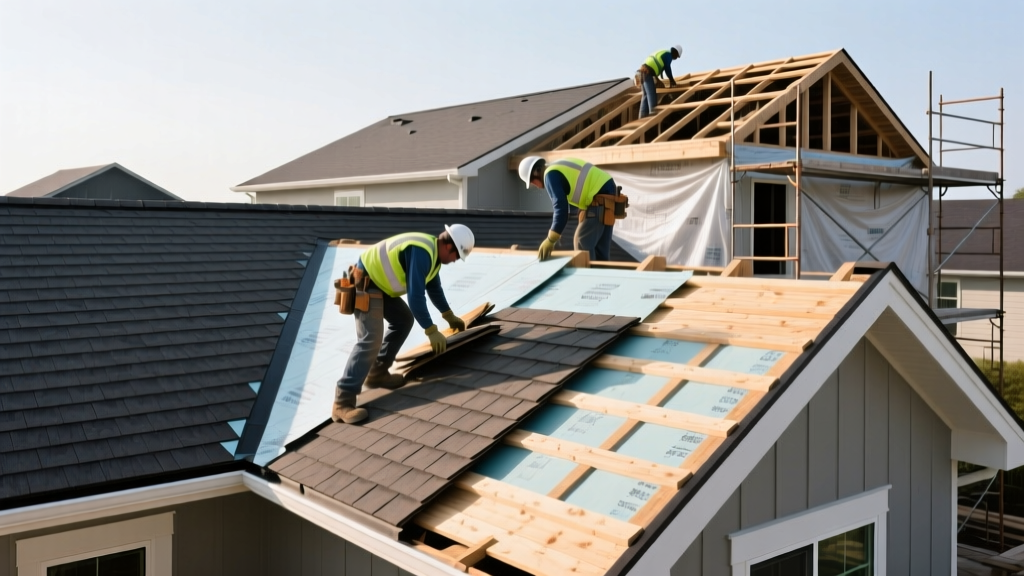
The installation process begins with destruction. A complete tear-off to the bare deck is mandatory for a proper warranty and to inspect the structural substrate. Contractors typically charge between $150 and $220 per square (100 square feet) for labor and disposal. For a standard 20-square roof, expect to pay $3,000 to $4,400 just for the tear-off. This includes the cost of a specialized roofing dumpster, which ranges from $450 to $850 depending on local landfill tipping fees and weight limits.
Decking Replacement: The Hidden Variable
Once the old shingles and underlayment are removed, the roof deck (usually OSB or plywood) is exposed. It is standard to replace 10% to 20% of the decking due to rot or delamination. The material and labor cost to replace a 4x8 sheet of decking ranges from $85 to $140 per sheet.
Phase 2: Underlayment, Ice & Water Shield, and Pitch Multipliers
Before a single shingle is laid, the roof must be sealed. The International Residential Code (IRC R905.2.8.5) mandates the use of an ice barrier (ice and water shield) in the eaves for climates where the average January temperature is 25°F or less. High-quality self-adhering membranes, such as GAF WeatherWatch or Grace Ice & Water Shield, cost $1.50 to $2.50 per square foot installed, compared to $0.50 to $0.80 for synthetic underlayment (like GAF FeltBuster) applied to the rest of the deck.
How Roof Pitch Dictates Labor Costs
The steepness of your roof fundamentally alters the installation procedure, safety requirements, and labor time. Contractors apply pitch multipliers to the base labor rate to account for the slower pace and specialized equipment required on steeper slopes.
| Roof Pitch | Classification | Labor Multiplier | Installation Requirements |
|---|---|---|---|
| 4/12 to 6/12 | Standard / Walkable | Base Rate (1.0x) | Standard harnesses, no roof jacks required. |
| 7/12 to 9/12 | Steep | +15% to 20% | Roof jacks and scaffolding required; slower material staging. |
| 10/12 to 12/12 | Very Steep | +30% to 45% | Full scaffolding, specialized safety rigging, extended install time. |
| 13/12 and above | Extreme / Mansard | +50% to 75% | Requires specialized high-angle access teams and equipment. |
Phase 3: Shingle Application and Fastening Protocols
The physical installation of the shingles is where procedural shortcuts most commonly occur. Architectural shingles require specific fastening patterns to achieve their rated wind resistance (often 110 mph to 130 mph). While standard application calls for a 4-nail pattern per shingle, high-wind regions or steep pitches (over 21/12) mandate a 6-nail pattern.
Contractors must use 12-gauge hot-dipped galvanized roofing nails with a minimum 3/8-inch head and a length of 1-1/4 inches to ensure penetration through the decking. The use of staple guns or electro-galvanized nails is a severe code violation and will instantly void the manufacturer's warranty. Labor for a meticulous 6-nail hand-nailed or properly calibrated pneumatic installation costs roughly 10% to 15% more than a standard 4-nail application, but it is non-negotiable for long-term performance.
Phase 4: Flashing, Edge Metal, and Ventilation Details
The field of the roof rarely fails; failures occur at the penetrations, transitions, and edges. Proper flashing installation is labor-intensive and separates premium contractors from budget crews.
- Drip Edge Installation: Code requires metal drip edge at the eaves (installed under the underlayment) and at the rakes (installed over the underlayment). Properly bending and overlapping aluminum drip edge adds $1.50 to $2.50 per linear foot in labor and materials.
- Step Flashing vs. Continuous Flashing: Where the roof meets a vertical wall or chimney, individual 5x7 inch step flashing pieces must be woven into every course of shingles. Budget contractors often use continuous "L-flashing" or rely on roofing cement, which guarantees a leak within 5 to 7 years. Proper step flashing installation adds $300 to $600 to the labor cost of an average home.
- Ventilation Integration: Installing a continuous ridge vent (such as GAF Cobra III) requires cutting a precise 2-inch channel along the entire roof ridge. This labor, combined with the intake soffit venting, typically costs $600 to $1,100 but is critical for preventing ice dams and extending shingle life by regulating attic temperatures.
If a contractor answers the question "how much does it cost to replace a roof" with a bid that is 30% to 40% below market average, they are likely proposing a "roof-over" (installing new shingles directly over the old ones). While this saves $3,000+ on tear-off and decking labor, it voids the shingle manufacturer's warranty, traps existing moisture, and adds dangerous dead-load weight to your roof trusses. Never accept an overlay bid for a primary residence.
Regional Labor Variations and Permitting
Finally, the cost to replace a roof is heavily influenced by local municipal requirements. Permitting fees generally range from $150 to $500, but jurisdictions with strict wind-borne debris requirements (such as Miami-Dade County in Florida or coastal Texas) require enhanced inspection protocols and specialized hurricane-clipping installation procedures that can increase total labor costs by 20%. According to data compiled by HomeGuide's Roof Replacement Cost Report, labor rates in high-cost-of-living areas like the Northeast and Pacific Northwest can push the installation portion of the bill 25% higher than the national median.
When evaluating bids, demand a line-item breakdown that separates material costs from tear-off, decking prep, flashing labor, and ventilation. Cross-reference their proposed installation methods with the standards outlined by the National Roofing Contractors Association (NRCA) and regional building codes. For further localized pricing data and contractor vetting, resources like Angi's Roofing Cost Guide can provide baseline estimates to ensure your installation budget aligns with current market realities.