Best Roofing Nails for Shingles & Metal: 2026 Brand Deep-Dive
Compare top roofing nail brands for 2026. Deep dive into Grip-Rite, Maze, and Bostitch coil and stick nails, specs, pricing, and code compliance.
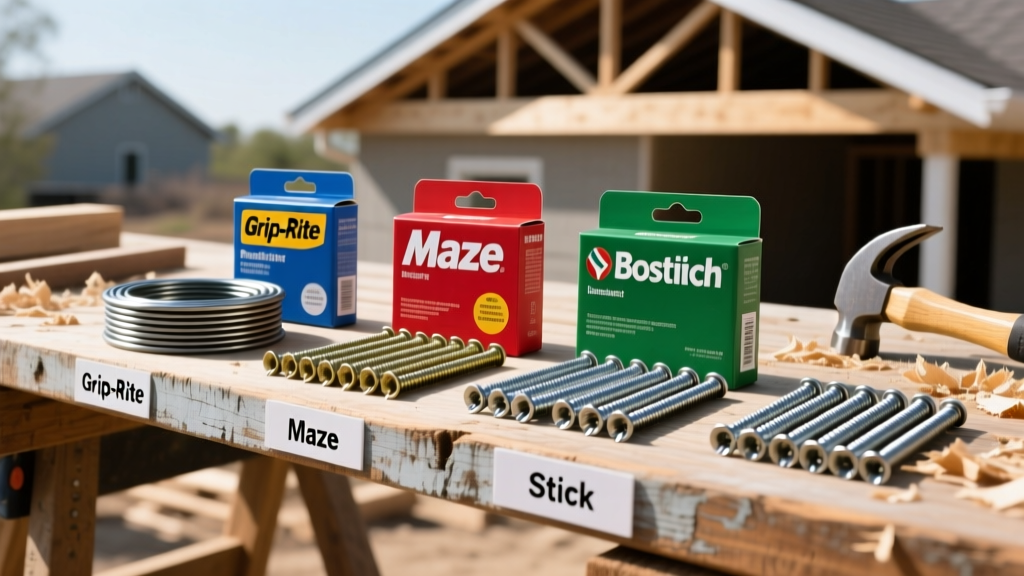
Roofing fasteners are the most frequently overlooked component of a roofing system, yet they are responsible for the majority of wind-uplift failures and premature roof degradation. While architectural shingles and synthetic underlayments receive the most marketing attention, the structural integrity of the entire assembly relies on a 3/8-inch metal head gripping the roof deck. As building codes tighten for the 2026 construction season—particularly regarding International Building Code (IBC) wind-uplift resistance—selecting the correct roofing nails is no longer optional.
This deep-dive analyzes the three dominant fastener brands in the North American market: Grip-Rite, Maze Nails, and Bostitch. We break down their flagship product lines, metallurgical coatings, exact specifications, and real-world pricing to help contractors and homeowners make informed purchasing decisions.
The ASTM F1667 Baseline: What Codes Demand
Before comparing brands, it is critical to understand the baseline standard. The Asphalt Roofing Manufacturers Association (ARMA) and the International Residential Code (IRC) mandate that roofing nails comply with ASTM F1667. For standard asphalt shingles, this dictates:
- Shank Diameter: Minimum 12-gauge (0.105 inches).
- Head Diameter: Minimum 3/8-inch (0.375 inches) with a low-profile, flat head.
- Penetration: Must penetrate at least 3/4-inch into the roof sheathing, or fully through if the sheathing is thinner than 3/4-inch.
- Shank Type: While smooth shanks are technically permitted in low-wind zones, ring shank roofing nails are now required by most manufacturers to validate wind warranties up to 110-130 mph.
Grip-Rite: The High-Volume Contractor Standard
Grip-Rite, a division of Pro-Fasteners, dominates the big-box retail and wholesale distribution channels. They are the default choice for high-volume production builders and roofing crews prioritizing speed and cost-efficiency.
Product Spotlight: Grip-Rite 1171 Ring Shank
The 1171 series is Grip-Rite’s flagship stick nail for asphalt shingles. Available in 1-1/4-inch and 1-3/4-inch lengths, the 1-1/4-inch variant is the workhorse for standard 1/2-inch or 5/8-inch OSB and plywood decking.
Head Diameter: 3/8'
Shank: Ring Shank (0.105')
Coating Options: Electro-Galvanized (EG) or Hot-Dipped Galvanized (HDG)
Approximate Yield: 1.5 lbs per square (100 sq ft)
The Coating Caveat
Grip-Rite offers both EG and HDG finishes. Electro-galvanized nails feature a microscopically thin zinc layer (typically 0.36 mils). While they are 30% cheaper upfront, they are highly susceptible to red rust within 5 to 7 years in humid or coastal climates. Hot-dipped galvanized (HDG) nails are submerged in molten zinc, creating a metallurgical bond with a coating thickness of 2.0 mils or more. For any roof expected to last beyond 20 years, specifying Grip-Rite HDG is mandatory.
Maze Nails: The Premium & Coastal Specialist
Based in Illinois, Maze Nails operates in the premium tier of the fastener market. They are the go-to brand for custom home builders, historic restorations, and coastal projects where salt spray rapidly destroys inferior fasteners.
Product Spotlight: Maze Stormguard Double Hot-Dipped
The Stormguard line is engineered specifically to exceed Miami-Dade County Notice of Acceptance (NOA) requirements and ASTM F1667 standards for severe marine environments.
- The 'Double' Advantage: Maze pulls the nails through the zinc bath twice. This eliminates the bare spots and thin edges that occasionally occur in single-dip manufacturing processes, ensuring a uniform zinc envelope.
- Slate & Cedar Options: Beyond standard 3/8-inch heads, Maze produces 1/2-inch head nails specifically designed for heavy synthetic slate and cedar shakes, preventing the fastener from pulling through the softer or thicker material under wind load.
- Stainless Steel Line: For copper flashing integration or extreme salt-air zones (within 1,500 feet of the ocean), Maze offers Type 304 and Type 316 stainless steel roofing nails, which are entirely immune to galvanic corrosion when in contact with copper drip edges.
Bostitch: The Pneumatic Coil Specialist
While stick nails are common for small repairs and steep, complex roofs, production roofing crews rely on pneumatic coil nailers to maintain pace. Bostitch (now part of the Senco family) engineers both the tools and the fasteners to prevent misfires and jamming.
Product Spotlight: Bostitch RN45B Coil Roofing Nails
The RN45B series is designed to feed flawlessly through the Bostitch RN45B-1 pneumatic roofing nailer. These nails are collated with wire welds rather than plastic or glue, which prevents melting and gumming up the tool’s magazine during hot summer roof installations.
2026 Specification Matrix: Matching Nail to Material
Selecting the correct fastener requires matching the shank, length, and coating to the specific roofing material and deck thickness. Use this matrix to specify materials for your next project:
| Roofing Material | Required Length | Shank Type | Head Diameter | Recommended Brand/Line |
|---|---|---|---|---|
| Architectural Asphalt (Standard Deck) | 1-1/4' | Ring Shank | 3/8' | Grip-Rite 1171 HDG |
| Asphalt over 2' Rigid Insulation | 3-1/2' to 4' | Ring Shank | 1/2' | Maze Extra-Long HDG |
| Cedar Shakes (18' Certigrade) | 1-1/2' to 2' | Ring Shank | 3/8' | Maze Stainless 304 |
| Standing Seam Metal (Cleats) | 1' to 1-1/4' | Smooth or Ring | 3/8' Low Pro | Grip-Rite EG (Concealed) |
Common Failure Modes & How Top Brands Prevent Them
1. Shingle Pops (Nail Back-Out)
The Cause: Using smooth shank nails in high-wind regions, or driving nails into the gaps between OSB panels where the wood lacks structural density.
The Fix: Ring shank nails from Grip-Rite and Maze act like miniature screws. The angled rings on the shank create a one-way mechanical lock with the wood fibers. Pull-out resistance for a 12-gauge ring shank nail is typically 300% higher than a smooth shank equivalent.
2. Galvanic Rust Streaks
The Cause: Mixing fastener metals. If a roofer uses standard steel nails near a copper valley flashing, a galvanic cell is created. The steel nail becomes the anode and corrodes rapidly, leaving black and red streaks down the roof.
The Fix: Isolate metals. When fastening within 12 inches of copper or lead flashing, switch to Maze Type 304 Stainless Steel nails to prevent galvanic reaction.
3. Head Punch-Through
The Cause: Pneumatic nailers set to 100+ PSI driving the 3/8-inch head completely through the fiberglass mat of the asphalt shingle, leaving only the shank holding the material.
The Fix: Use Bostitch coil nailers with adjustable depth dials. The head should sit perfectly flush, dimpling the granule surface without breaking the mat.
Pricing & Yield Economics (2026 Market Rates)
Fastener costs represent less than 2% of a total roof replacement budget, yet dictate the longevity of the remaining 98%. Here is the current wholesale pricing landscape:
- Electro-Galvanized (EG) Coil Nails: $35 - $42 per box (1,200 count). Cost per square: ~$1.20.
- Hot-Dipped Galvanized (HDG) Stick Nails: $16 - $22 per pound. Cost per square: ~$2.50.
- Type 304 Stainless Steel Stick Nails: $45 - $55 per pound. Cost per square: ~$7.00.
While upgrading from EG coil nails to HDG stick nails adds approximately $150 to a standard 25-square residential roof, it prevents catastrophic wind blow-offs and premature rust degradation, easily paying for itself in warranty preservation and avoided callback repairs.