Roof Roll Material Selection Framework for Low-Slope Buildings
Evaluate asphalt, modified bitumen, TPO, and EPDM roof roll materials. Use this framework to match membrane specs to slope, climate, and budget.

The Core Taxonomy of Roof Roll Materials
Selecting the correct roof roll material requires moving beyond basic price comparisons and evaluating the chemical composition, seam integrity, and structural demands of the building envelope. In low-slope and flat roofing applications (defined as slopes less than 3:12), rolled membranes dominate the market. These materials are manufactured in factory-controlled rolls to minimize on-site seams, but their performance varies drastically based on polymer type and installation methodology.
Asphalt Roll Roofing (Mineral-Surfaced)
Governed by ASTM D3909 and D4601 standards, mineral-surfaced asphalt roll roofing is the most rudimentary option. It consists of an organic or fiberglass mat saturated and coated with asphalt, then embedded with ceramic granules. While highly economical, it lacks the elastomeric properties required for structural movement and is strictly limited to slopes of 2:12 or greater to prevent water ponding and capillary action at the overlaps.
Modified Bitumen (SBS and APP)
Modified bitumen bridges the gap between traditional asphalt and modern synthetics. SBS (Styrene-Butadiene-Styrene) incorporates synthetic rubber, granting the membrane high tensile strength and flexibility in freezing temperatures (ASTM D6164). APP (Atactic Polypropylene) utilizes plasticizers for superior UV resistance and is typically torch-applied. Both are deployed in multi-ply systems, offering exceptional puncture resistance for roofs with heavy foot traffic.
Single-Ply Thermoplastics (TPO and PVC)
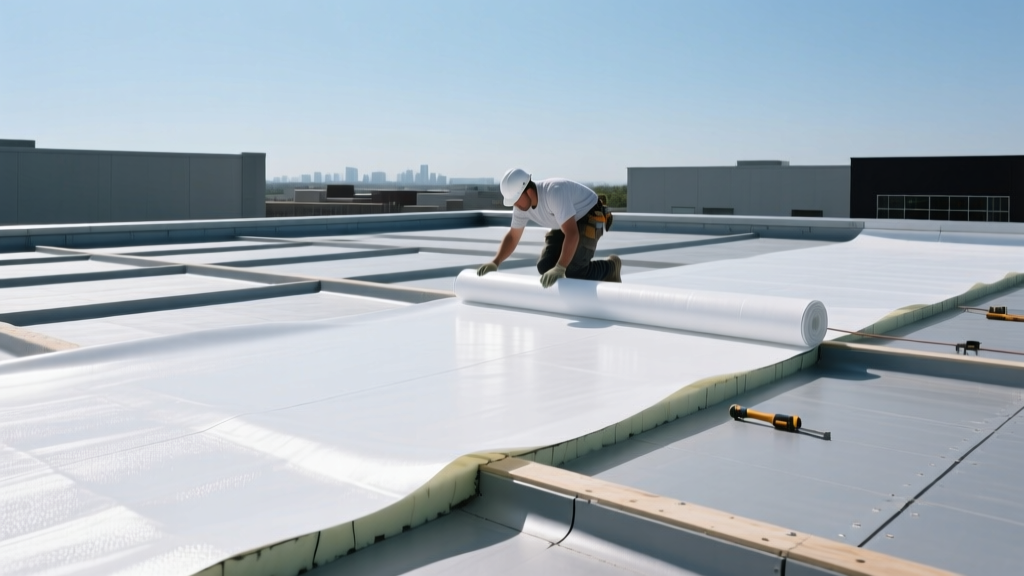
Thermoplastic Olefin (TPO) and Polyvinyl Chloride (PVC) are single-ply membranes that soften when heated and harden when cooled. This chemical property allows seams to be thermally welded using hot-air guns at temperatures exceeding 1,000°F, creating a monolithic, watertight bond that is stronger than the membrane itself. TPO has become the dominant commercial roof roll material in North America due to its inherent solar reflectance and cost-efficiency.
Single-Ply Thermosets (EPDM)
Ethylene Propylene Diene Monomer (EPDM) is a thermoset rubber. Unlike thermoplastics, EPDM cannot be heat-welded; seams must be sealed using specialized primer, liquid adhesives, or factory-applied seam tape. While highly resistant to ozone and extreme temperature fluctuations, the reliance on chemical adhesives for seam integrity introduces a distinct lifecycle vulnerability.
No roof roll material is entirely immune to continuous water immersion. If your deck lacks a minimum 1/4:12 slope for positive drainage, you must install tapered polyisocyanurate insulation to create artificial slope before deploying any single-ply or modified bitumen membrane. Warranties for TPO and EPDM are universally voided if ponding water remains for more than 48 hours after precipitation.
The 4-Step Selection Framework
Step 1: Assess Deck Slope and Drainage Velocity
The physical geometry of your roof deck dictates the baseline material category. For slopes between 1:12 and 2:12, modified bitumen or mechanically fastened single-ply systems are mandatory. Asphalt roll roofing is disqualified. For dead-flat decks (0:12), fully adhered EPDM or TPO combined with tapered insulation and internal drains are the only code-compliant options.
Step 2: Climate and Thermal Shock Resistance
Thermal shock—the rapid expansion and contraction caused by sudden temperature drops (e.g., a summer thunderstorm hitting a 160°F roof)—causes membrane fatigue. In northern climates with severe winter freezes, SBS modified bitumen or 60-mil EPDM outperforms standard TPO, which can become brittle and prone to shattering upon impact in sub-zero conditions. Conversely, in high-UV, southern climates, white TPO reflects up to 80% of solar radiation, significantly reducing cooling loads and preventing the thermal degradation seen in black EPDM membranes. The U.S. Department of Energy notes that cool roofing materials like white TPO can reduce peak cooling demand by 10% to 15%.
Step 3: Penetration Density and Seam Integrity
Count the number of HVAC units, skylights, pipes, and parapet corners on the roof. Every penetration requires membrane flashing and seam work. If the roof has a high penetration density, EPDM is often preferred because its rubber-like elasticity allows it to be stretched and formed around complex geometries using pre-fabricated pipe boots and liquid flashing. TPO requires intricate heat-welding at every corner, increasing labor costs and the risk of installer error.
Material Comparison Matrix
| Material | ASTM Standard | Min. Slope | 2026 Installed Cost (per sq.ft.) | Expected Lifespan | Primary Vulnerability |
|---|---|---|---|---|---|
| Asphalt Roll | D3909 / D4601 | 2:12 | $1.75 - $2.80 | 5 - 10 Years | Cracking, granule loss |
| SBS Mod-Bit | D6164 | 1:12 | $4.50 - $6.50 | 15 - 20 Years | Blistering from trapped moisture |
| TPO (60-mil) | D6878 | 1/4:12* | $5.00 - $8.00 | 20 - 30 Years | Seam failure if under-welded |
| EPDM (60-mil) | D4637 | 1/4:12* | $4.50 - $7.50 | 25 - 30 Years | Adhesive degradation at seams |
*Requires tapered insulation for positive drainage to maintain manufacturer warranty.
Cost vs. Lifecycle Value Analysis
When budgeting for a roof roll material, separating material costs from labor is critical. Asphalt roll roofing is heavily material-weighted but requires minimal specialized labor. Conversely, single-ply membranes like TPO feature relatively low material costs (often under $1.50 per square foot for the membrane itself), but the labor, fasteners, plates, and hot-air welding equipment drive the installed price up to $8.00 per square foot.
From a lifecycle perspective, the Environmental Protection Agency (EPA) highlights that reflective cool roofs (like white TPO) not only extend the membrane's lifespan by reducing thermal degradation but also lower building HVAC costs. Over a 20-year period, the energy savings of a TPO system in a cooling-dominated climate frequently offset the higher initial installation cost compared to black EPDM or modified bitumen.
Common Installation Failures and Edge Cases
Even the highest-grade roof roll material will fail prematurely if installation protocols are ignored. Be aware of these specific failure modes:
- EPDM Shrinkage: Over time, uncured EPDM membranes can shrink, pulling away from flashings and parapet walls. Fix: Specify reinforced EPDM or ensure a minimum 60-mil thickness, and use secure termination bars with compression seals at all edges.
- TPO Cold Welds: If the ambient temperature drops below 40°F, or if the welder speed is too fast, TPO seams will appear fused but will peel apart under wind uplift. Fix: Mandate daily test welds and destructive peel tests by the foreman before full-scale seaming begins.
- Mod-Bit Blisters: Torch-applied SBS over a damp concrete deck traps moisture, which vaporizes and creates massive blisters. Fix: Install a vapor retarder or use a cold-process adhesive system if the deck moisture content exceeds manufacturer limits.
- Asphalt Granule Loss: Foot traffic on mineral-surfaced asphalt rolls dislodges the UV-protective granules, exposing the asphalt to rapid oxidation. Fix: Install walkway pads over all designated service paths leading to HVAC units.
Final Decision Logic Tree
Use this rapid framework to finalize your specification:
- Is the budget strictly under $3.00/sq.ft. and the slope > 2:12? Select Mineral-Surfaced Asphalt Roll. Accept the 10-year replacement cycle.
- Is the building in a severe cold-weather climate with high wind uplift? Select SBS Modified Bitumen (torch or cold-adhered) for its elastomeric tear resistance.
- Is the roof highly complex with dozens of pipes and parapet corners? Select 60-mil EPDM. The adhesive seaming and pre-fabricated boots will drastically reduce labor hours and corner-leak risks.
- Is the roof large, relatively open, and located in a high-heat/sun climate? Select 60-mil or 80-mil mechanically attached TPO. The heat-welded seams provide superior wind uplift resistance, and the white reflectivity will yield immediate ROI on cooling costs.
Written by
David NakamuraDavid Nakamura is a licensed architect (AIA) and construction technology writer focused on sustainable building methods, mass timber engineering, and high-performance building envelopes. He holds a Master of Architecture from the University of Washington and is a certified Passive House Consultant (CPHC). David spent eight years at the Seattle firm Mithun, where he led the design of three LEED Platinum projects, before founding his own practice specializing in net-zero residential design. He serves on the editorial advisory board of GreenBuilder Magazine and has authored peer-reviewed papers on cross-laminated timber (CLT) connections for the Journal of Structural Engineering. In his spare time, David teaches woodworking at Pratt Fine Arts Center and kayaks the Puget Sound.
More from David Nakamura
View all
Construction Cost
Labor Cost to Build a Deck Per Sq Ft: 2026 Installation Guide
Discover the exact labor cost to build a deck per sq ft in 2026. This installation guide breaks down contractor rates, complexity factors, and hidden fees.
Aug 4, 2026

Construction Cost
How Much Does It Cost to Build a 3 Bedroom House? Financing Guide
Learn exactly how much it costs to build a 3 bedroom house and explore 2026 financing options, construction loan types, and budget frameworks for your build.
Aug 4, 2026

Construction Cost
Cost to Build a Tennis Court: 2026 Guide
How much does it cost to build a tennis court in 2026? Breakdowns for asphalt, concrete, and synthetic surfaces plus fencing and lighting.
Jul 30, 2026