Reflective Roofing Materials Compared: TPO, PVC, and Metal
Compare top reflective roofing materials. Analyze TPO, PVC, and cool-coated metal systems for SRI ratings, costs, and commercial applications.

The Science of Solar Reflectance Index (SRI)
Selecting the right reflective roofing materials requires looking beyond simple color. The industry standard for measuring a roof's ability to reject solar heat is the Solar Reflectance Index (SRI), which combines both solar reflectance and thermal emittance into a single metric. According to the Lawrence Berkeley National Laboratory Heat Island Group, a standard black asphalt roof has an SRI of roughly 5, while high-performance cool roofs must achieve an initial SRI of at least 82 to meet stringent energy codes like California's Title 24 or the International Energy Conservation Code (IECC).
When specifying reflective systems for low-slope or steep-slope commercial applications, facility managers and architects must balance initial material costs, long-term membrane durability, and chemical resistance. Below is a technical comparison of the three dominant reflective systems: TPO, PVC, and cool-coated standing seam metal.
Quick Decision Framework
- Choose TPO if: You have a standard low-slope commercial roof with a tight budget and no exposure to airborne grease or industrial chemicals.
- Choose PVC if: The building houses a restaurant, manufacturing facility, or airport where the roof will be exposed to fats, oils, grease (FOG), or hydrocarbon emissions.
- Choose Metal if: The roof has a slope greater than 2:12, requires a 40+ year lifespan, or needs to support heavy snow loads and solar panel arrays.
TPO (Thermoplastic Polyolefin): The Budget-Friendly Standard
Thermoplastic Polyolefin (TPO) currently commands the largest market share in the commercial low-slope sector. It is a single-ply membrane composed of a blend of polypropylene and ethylene-propylene rubber, reinforced with polyester scrim.
Specifications & Pricing
While 45-mil TPO was historically the baseline, recent wind-uplift testing and hail impact data have shifted the industry standard. For commercial applications in 2026, specify a minimum 60-mil thickness (such as GAF EverGuard Extreme or Carlisle Sure-Weld) to ensure adequate puncture resistance and long-term weathering. Premium 80-mil options are available for high-hail zones.
- Initial SRI: 100 to 110
- Aged SRI (3 years): 80 to 90 (highly dependent on dirt accumulation and cleaning schedules)
- Installed Cost: $4.50 to $7.50 per square foot (fully adhered 60-mil system over polyiso insulation)
Failure Modes & Edge Cases
The primary vulnerability of TPO lies in the seams. TPO relies on hot-air welding, which requires precise temperature control. If the welder moves too quickly or the ambient temperature drops below 40°F, the seam can experience a 'cold weld,' leading to microscopic blistering and eventual moisture intrusion. Additionally, early-generation TPO formulations suffered from premature cracking under high UV exposure in southern climates; ensure the product specified includes advanced UV stabilizers and meets ASTM D6878 standards.
PVC (Polyvinyl Chloride): The Chemical-Resistant Premium
PVC single-ply membranes have been utilized since the 1960s and remain the premier choice for roofs subjected to harsh chemical environments. Unlike TPO, PVC is inherently resistant to a wide array of industrial pollutants and animal fats.
Specifications & Pricing
PVC membranes (such as Sika Sarnafil or FiberTite) are typically available in 50-mil, 60-mil, and 80-mil thicknesses. The seams are chemically welded using a solvent, which creates a monolithic, watertight bond that is often stronger than the membrane itself. This makes PVC highly forgiving in colder weather installations where hot-air welding TPO becomes problematic.
- Initial SRI: 105 to 115
- Aged SRI (3 years): 90 to 100 (PVC resists biological growth and dirt retention slightly better than TPO)
- Installed Cost: $6.00 to $10.00 per square foot
Failure Modes & Edge Cases
The most critical edge case for PVC is plasticizer migration. PVC requires liquid plasticizers to remain flexible. If PVC comes into direct contact with expanded polystyrene (EPS) insulation or unseparated asphalt-based substrates, the plasticizers will leach out of the membrane, causing it to become brittle and shatter. Always specify a separation slip sheet or use polyisocyanurate (polyiso) insulation when designing a PVC roof assembly. Furthermore, PVC is highly susceptible to damage from rooftop grease exhaust; while it resists FOG better than TPO, direct, unfiltered exhaust will still degrade the membrane over time.
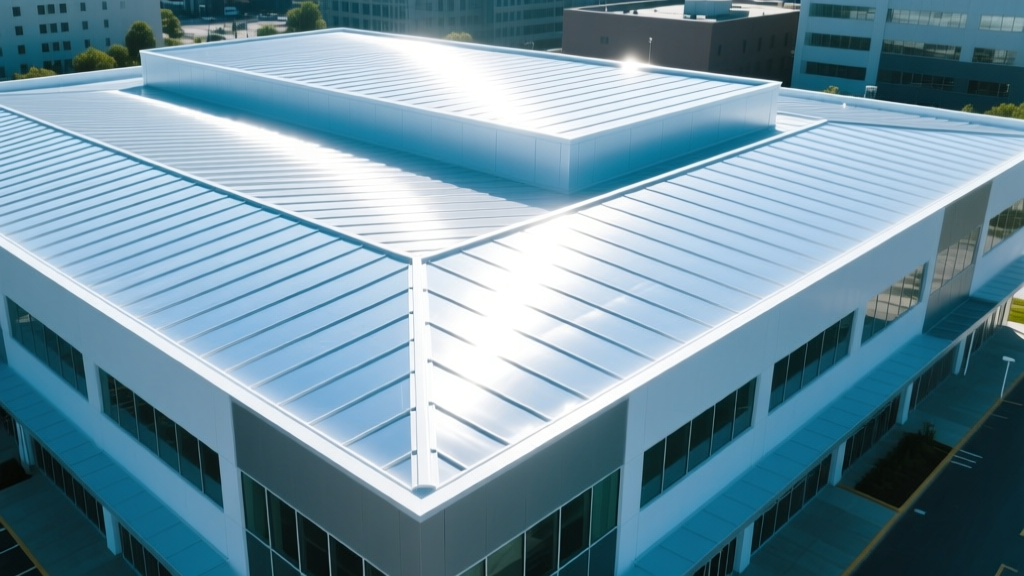
Cool-Coated Standing Seam Metal: The Sloped Roof Solution
For roofs with a pitch of 2:12 or greater, single-ply membranes are not viable. Standing seam metal roofing, paired with a highly reflective cool roof fluoropolymer coating (such as Kynar 500 or Hylar 5000 based PVDF resins), provides exceptional solar reflectance with unmatched longevity.
Specifications & Pricing
Specify 24-gauge or 22-gauge Galvalume steel panels with a minimum 2-inch mechanical lock seam. Manufacturers like MBCI and ATAS offer specialized 'cool color' palettes that utilize infrared-reflective pigments. These pigments reflect the invisible infrared spectrum of sunlight, allowing even darker colors (like bronze or slate gray) to achieve an SRI above 50, though bright whites and tans will push the SRI above 70.
- Initial SRI: 70 to 85 (for white/light PVDF coatings)
- Aged SRI (3 years): 50 to 65
- Installed Cost: $12.00 to $18.00 per square foot (including structural sub-purlins and synthetic underlayment)
Failure Modes & Edge Cases
Metal roofs fail primarily due to thermal expansion and contraction. If the panels are pinned too tightly to the deck without allowing for clip movement, the metal will 'oil-can' (visible waviness) or tear at the fastener penetrations. Ensure the specification calls for concealed sliding clips that accommodate up to 1.5 inches of thermal movement. Additionally, in coastal environments, standard Galvalume will corrode; specify an aluminum-zinc alloy coating or a full aluminum panel to prevent salt-spray degradation.
Head-to-Head Comparison Matrix
| Feature | 60-Mil TPO | 60-Mil PVC | 24-Ga Cool Metal |
|---|---|---|---|
| Initial SRI | 100 - 110 | 105 - 115 | 70 - 85 |
| Expected Lifespan | 15 - 22 years | 20 - 30 years | 40 - 60 years |
| Seam Method | Hot-Air Welded | Chemical Solvent | Mechanical Lock |
| Chemical Resistance | Poor (Fails with FOG) | Excellent | Moderate (Coating dependent) |
| Puncture Resistance | Moderate | High | Very High |
Technical FAQs
Does a reflective roof increase winter heating costs in cold climates?
The 'winter heating penalty' is a common concern, but empirical data from the Department of Energy shows it is largely negligible. In northern climates, winter days are shorter, the sun sits at a lower angle, and snow cover naturally insulates the roof and reflects sunlight regardless of the membrane color. The massive reduction in summer cooling loads and the extension of HVAC equipment lifespan far outweigh the marginal increase in winter heating expenses.
How do I maintain the SRI of a TPO or PVC roof over time?
Reflective roofing materials lose SRI points primarily through dirt, soot, and biological growth (algae/moss). To maintain an SRI above 80, implement a biannual cleaning protocol using a low-pressure wash (under 500 PSI) and a non-abrasive, pH-neutral detergent. Avoid harsh solvents or stiff-bristled brooms, which can micro-scratch the top ply of the membrane, creating grooves that trap dirt and permanently lower the reflectance.
Can I install a cool roof coating over an existing black asphalt roof?
Yes, but surface preparation is critical. You cannot apply acrylic or silicone reflective coatings directly over asphalt without a bleed-through inhibitor. Asphalt oils will migrate through the coating, turning it yellow and destroying its reflectivity. You must first apply a specialized asphalt-bleed-blocking primer, or install a recovery board (like high-density polyiso) over the existing asphalt before applying the reflective coating. For detailed restoration protocols, consult the Cool Roof Rating Council product directory to verify the specific coating's compatibility with bituminous substrates.
Written by
Elena RodriguezElena Rodriguez is a civil engineer and technical writer specializing in concrete technology, masonry systems, and ASTM/ACI compliance. She earned her B.S. in Civil Engineering from Texas A&M University and spent a decade at a materials testing laboratory, performing over 2,000 concrete compressive strength tests and masonry prism evaluations. Elena is an ACI-certified Field Testing Technician (Grade I) and a member of ASTM Committee C12 on Natural Building Stone. She currently consults on forensic engineering cases involving concrete failures and moisture intrusion. Based in San Antonio, TX, Elena is a proud member of the Society of Women Engineers (SWE) and coaches her daughter's FIRST Robotics team.
More from Elena Rodriguez
View all
Walls & Panels
Cost Analysis: Light Gauge Steel Framing Advantages and Disadvantages
Evaluate light gauge steel framing advantages and disadvantages through a strict cost analysis lens, comparing material, labor, and lifecycle expenses.
Aug 4, 2026

Walls & Panels
Gypsum Board Types: Exact Specifications, Thickness & Dimensions
Compare standard, Type X, and moisture-resistant gypsum board types. Get exact specifications, thicknesses, dimensions, and ASTM standards for your project.
Aug 4, 2026

Fire Resistance
Best Fire-Resistant Outdoor Decking Materials: 2026 Buyer Guide
Discover the best fire-resistant outdoor decking materials for 2026. Compare Class A PVC, aluminum, and hardwood options for WUI compliance and safety.
Aug 4, 2026