RV Roof Sealant Durability: Lifespan Analysis and Failure Modes
Analyze RV roof sealant durability, comparing silicone, polyurethane, and acrylic lifespans, UV resistance, and common failure modes.
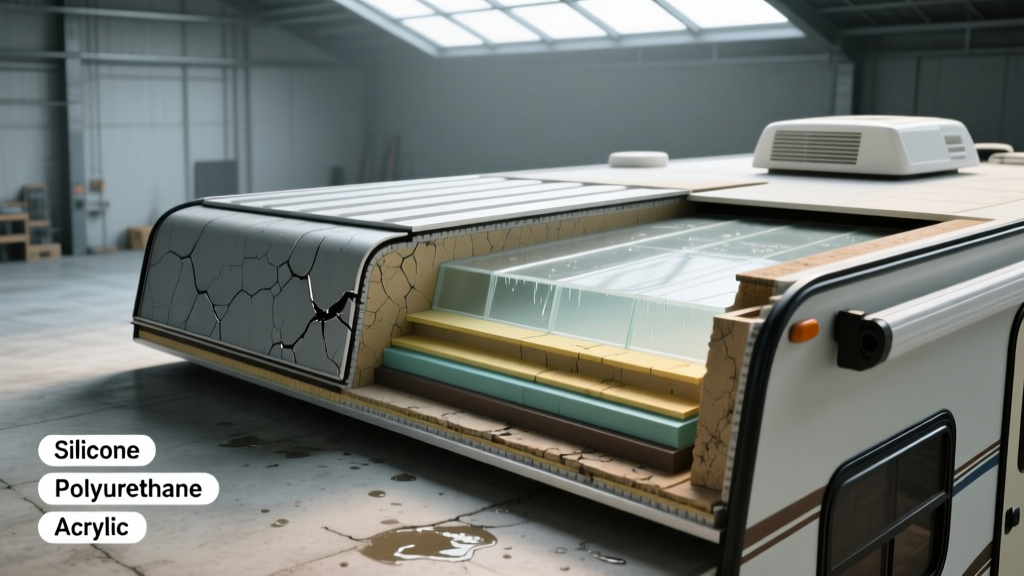
The structural integrity of a recreational vehicle relies entirely on its ability to shed water while enduring extreme thermal cycling. Unlike residential asphalt shingle roofs, an RV roof expands and contracts significantly—up to 3/16 of an inch per 10 feet of membrane length—between freezing winter nights and 150°F summer surface temperatures. The RV roof sealant applied at penetrations, seams, and perimeter edges is the sole barrier against catastrophic water intrusion. Understanding the chemical composition, degradation vectors, and precise application metrics of these sealants is critical for maximizing their operational lifespan.
The Chemistry of Degradation: Why RV Sealants Fail
Sealant failure on RV roofs is rarely due to a single factor; it is typically a compounding result of UV radiation, thermal shear, and chemical incompatibility. Polymers used in sealants undergo photo-oxidation when exposed to ultraviolet light, which breaks the molecular chains and causes the material to chalk, crack, or lose elasticity. To combat this, premium sealants incorporate Hindered Amine Light Stabilizers (HALS), which scavenge free radicals and significantly slow UV degradation.
Thermal shear is the second primary failure vector. As the roof substrate expands and contracts, the sealant must elongate and compress without losing adhesion to the substrate. Sealants with a low modulus of elasticity will tear cohesively (splitting down the middle of the bead) or fail adhesively (peeling away from the roof material) when the thermal movement exceeds their elongation limits.
Material Lifespan Matrix: Chemistry and Performance
Selecting the correct sealant requires matching the chemical formulation to the specific roof substrate (EPDM, TPO, fiberglass, or aluminum) and the geometry of the joint (horizontal lap vs. vertical penetration). Below is a comparative analysis of the dominant sealant chemistries used in the RV industry.
| Sealant Chemistry | Industry Standard Product | Expected Lifespan | UV Resistance | Primary Substrates | Avg Cost / Tube |
|---|---|---|---|---|---|
| Self-Leveling Acrylic/Polyurethane | Dicor 501LSW-1 Lap Sealant | 4–7 Years | High | EPDM, TPO, Alpha Systems | $9.00 - $11.00 |
| Non-Leveling Elastomeric Polyurethane | Geocel ProFlex RV | 5–10 Years | Very High | Fiberglass, Aluminum, Glass | $10.00 - $13.00 |
| Butyl Rubber Tape | Eternabond RoofSeal Plus | 10–15+ Years | Extreme | All RV Roof Types | $35.00 - $45.00 (Roll) |
| Pure Silicone | GE Silicone II Kitchen/Bath | 2–4 Years (on RVs) | Moderate | Glass, Metal ONLY | $6.00 - $8.00 |
Real-World Failure Modes and Edge Cases
Even the highest-rated RV roof sealants will fail prematurely if subjected to specific environmental or mechanical edge cases. Recognizing these failure modes allows for proactive intervention before water reaches the OSB or luan roof decking.
1. Substrate Preparation Errors (Adhesion Failure)
The most common cause of sealant detachment is improper cleaning prior to application. Using petroleum-based solvents, acetone, or harsh degreasers on EPDM membranes strips the roof of its protective oils and leaves a microscopic residue that prevents the acrylic or polyurethane sealant from achieving a mechanical bond. Furthermore, failing to remove the microscopic layer of chalk (oxidized rubber) before sealing guarantees that the sealant is bonding to the dust, not the roof.
2. Pinholing and Off-Gassing (Cohesive Failure)
When self-leveling sealant is applied too thickly in a single pass (exceeding 3/8-inch depth), the surface skins over while the underlying material remains uncured. As the solvents in the uncured core attempt to off-gas, they push through the cured surface skin, creating microscopic pinholes. These pinholes act as direct conduits for capillary water intrusion, completely bypassing the sealant barrier.
3. Plasticizer Migration in TPO Roofs
While EPDM relies on carbon black for UV resistance, TPO (Thermoplastic Polyolefin) roofs use different chemical stabilizers. Some cheaper, non-RV-specific polyurethane sealants contain aggressive solvents that can melt or blister the top ply of a TPO membrane. Always verify that the sealant Technical Data Sheet (TDS) explicitly lists TPO compatibility.
Application Metrics That Dictate Longevity
Achieving the maximum rated lifespan of an RV roof sealant requires strict adherence to application geometry and environmental parameters. The RV Industry Association and major membrane manufacturers emphasize that how the sealant is applied is just as critical as the chemical formulation chosen.
- Bead Geometry: For horizontal laps and skylight perimeters, the ideal self-leveling bead should be 3/8-inch to 1/2-inch in diameter. This provides sufficient volume to accommodate thermal movement without slumping off the edge of the penetration.
- Vertical Penetrations: Do not use self-leveling sealant on vertical surfaces (e.g., the sides of a roof vent or plumbing stack). The material will sag, creating a thin film that quickly degrades. Use a non-leveling, high-tack elastomeric sealant applied in a continuous 1/4-inch bead.
- Temperature Thresholds: Application must occur when ambient and surface temperatures are strictly between 50°F and 110°F. Applying sealant below 40°F prevents the polymer chains from cross-linking properly, resulting in a permanent tacky state that never fully cures and attracts abrasive dirt.
- Priming Requirements: While modern acrylic lap sealants are marketed as 'no-prime required' on clean EPDM, applying a dedicated EPDM primer to aged, heavily chalked membranes can increase adhesion strength by up to 40%, effectively doubling the service life of the sealant joint.
Maintenance Intervals and Re-sealing Economics
Reactive maintenance—waiting for a ceiling stain to appear before inspecting the roof—is the most expensive approach to RV ownership. Water that breaches the sealant line will travel laterally along the roof decking before dripping, often causing structural rot far from the actual point of entry.
"The cost of a $10 tube of lap sealant and 30 minutes of biannual inspection is negligible compared to the $3,500 to $8,000 required to replace water-damaged luan decking, insulation, and interior ceiling panels. Proactive sealant management is the highest ROI maintenance task an RV owner can perform."
The Biannual Inspection Protocol
Inspect all roof penetrants, seams, and perimeter moldings every six months, specifically in early spring and late autumn. Look for three specific indicators of impending failure:
- Chalking: A light dusting of white powder is normal and indicates the UV stabilizers are working. However, deep cracking or heavy flaking means the polymer matrix is breaking down.
- Edge Lifting: Run a gloved finger along the perimeter of the sealant bead. If the edge lifts or peels away from the substrate with light pressure, the adhesive bond has failed and the joint must be cleaned and re-sealed immediately.
- Compression Set: Press a blunt tool into the sealant. If it does not rebound to its original shape within 10 seconds, the material has lost its elastomeric properties and can no longer accommodate thermal expansion.
Final Selection Framework
When selecting an RV roof sealant, ignore generic hardware store options and source products specifically engineered for the RV and commercial flat-roofing industry. For horizontal seams on EPDM and TPO rubber roofs, a self-leveling acrylic/polyurethane blend like the Dicor 501 series remains the undisputed standard for cost-to-performance ratio. For vertical joints, fiberglass caps, and metal-to-glass transitions, a high-modulus non-leveling polyurethane provides the necessary shear strength. For owners seeking a permanent, zero-maintenance solution on critical perimeter edges, investing in butyl-backed microsealant tape (Eternabond) eliminates the need for recurring liquid sealant applications entirely, provided the substrate is meticulously prepared with a heavy-duty primer and roller compression.