Roofing Materials Prices News: 2026 Material Cost Comparison
Analyze the latest roofing materials prices news for 2026. Compare installed costs, market trends, and specific product pricing for residential roofs.

2026 Roofing Market Overview: Divergent Material Trajectories
Tracking roofing materials prices news in 2026 reveals a market defined by stabilization in traditional sectors and aggressive growth in synthetic alternatives. Unlike the volatile supply chain shocks of the early 2020s, the current pricing landscape is driven by localized labor shortages, shifting raw material demands from adjacent industries (such as electric vehicle manufacturing impacting aluminum costs), and advancements in manufacturing efficiency for composite materials.
For contractors and property owners, understanding the granular cost differences between material tiers is no longer optional. A 5% fluctuation in raw steel or liquid asphalt (bitumen) translates to thousands of dollars on a standard 2,500-square-foot residential roof. This guide breaks down the exact material costs, installation variables, and macroeconomic trends shaping roofing budgets this year.
Q1 2026 Market Snapshot
- Asphalt Shingles: Prices stabilized with a mere 1.8% YoY increase, driven by steady crude oil refining outputs and high inventory levels at major distributors.
- Steel Roofing: Galvalume steel prices dropped 3.2% due to increased domestic mill capacity, but aluminum standing seam costs rose 4.5% due to competing demand from the EV and aerospace sectors.
- Labor Premiums: While material costs flattened, skilled roofing labor rates increased by an average of 6.4% nationwide, making installation efficiency a critical cost driver.
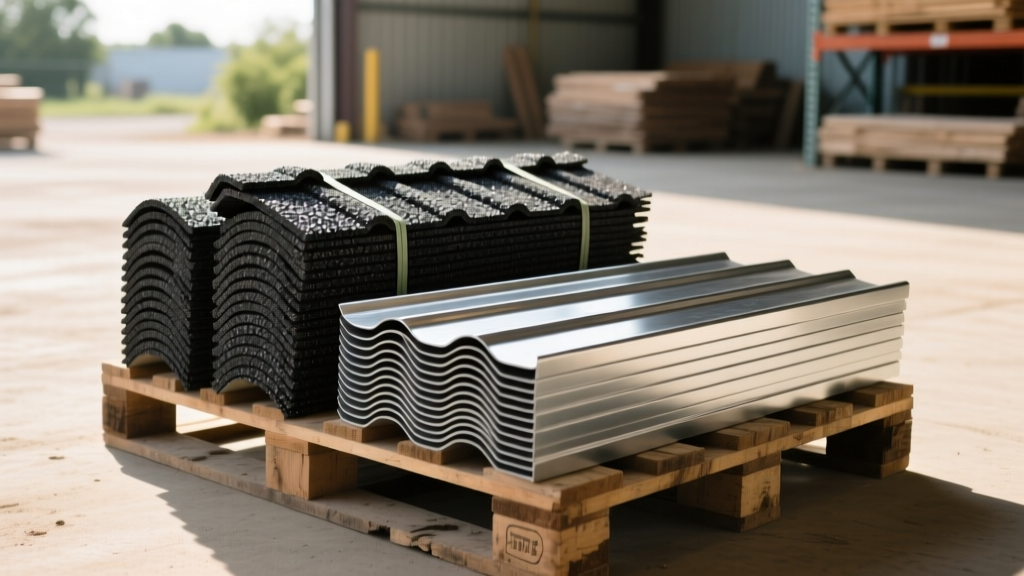
Comprehensive Material Cost Matrix
The following matrix compares material-only costs per square (100 square feet) and fully installed costs for a standard 2,000 sq. ft. residential roof (20 squares) with a 6/12 pitch. Installed costs include tear-off of one existing layer, synthetic underlayment, and standard flashing.
| Material System | Specific Product Benchmark | Material Cost / Sq | Installed Cost / Sq | 2025-2026 Trend |
|---|---|---|---|---|
| 3-Tab Asphalt | GAF Royal Sovereign | $85 - $100 | $350 - $450 | +1.2% |
| Architectural Asphalt | Owens Corning Duration | $115 - $160 | $450 - $650 | +1.8% |
| Exposed Fastener Metal | 29-Ga Galvalume R-Panel | $180 - $240 | $600 - $850 | -1.5% |
| Standing Seam Metal | 24-Ga Steel w/ Kynar 500 | $350 - $550 | $1,100 - $1,600 | +0.5% |
| Synthetic Slate | DaVinci Multi-Width | $320 - $480 | $1,200 - $1,800 | -3.0% |
| TPO Single-Ply (Flat) | 60-mil Carlisle Sure-Weld | $160 - $220 | $550 - $800 | +2.1% |
Note: Data reflects national averages. Regional labor variations can shift installed costs by up to 25% in high-cost-of-living areas like the Northeast and West Coast.
Deep Dive: Material-Specific Pricing Dynamics
Asphalt Shingles: The Bitumen Stabilization Effect
Architectural asphalt shingles remain the dominant residential roofing material in North America. The pricing of these shingles is inextricably linked to liquid asphalt (bitumen), a byproduct of crude oil refining. According to the Bureau of Labor Statistics Producer Price Index, the stabilization of global crude markets and optimized refinery outputs have kept bitumen costs predictable heading into 2026.
However, not all shingles are priced equally. Standard architectural shingles (e.g., CertainTeed Landmark) sit at the $135/square mark. Upgrading to SBS (Styrene-Butadiene-Styrene) modified impact-resistant shingles, such as the Malarkey Legacy, pushes material costs to $190 - $230 per square. The premium is justified in hail-prone regions (like Texas and Colorado), where Class 4 impact ratings routinely yield 15% to 25% discounts on homeowners insurance premiums, effectively paying for the material upgrade within four years.
Metal Roofing: The Steel vs. Aluminum Divergence
The metal roofing sector is currently experiencing a tale of two markets. Galvalume steel (an aluminum-zinc alloy coating over a steel substrate) has seen price relief. Domestic steel mills have expanded capacity, reducing the material cost of 24-gauge standing seam panels to roughly $4.20 per linear foot.
Conversely, pure aluminum roofing—essential for coastal properties within 1,500 feet of saltwater to prevent galvanic corrosion—has surged in price. Aluminum is heavily demanded by the automotive industry for EV battery enclosures and lightweight chassis components. Consequently, .032-inch aluminum standing seam panels now command a 35% to 45% premium over their steel counterparts, pushing material costs past $650 per square.
"Contractors bidding coastal jobs in 2026 must explicitly specify aluminum flashings, gutters, and fasteners alongside the aluminum panels. Mixing stainless steel or galvanized fasteners with aluminum panels in a salt-air environment will trigger rapid galvanic corrosion, voiding manufacturer warranties and leading to catastrophic failure within 36 months."
Synthetic Slate and Shake: Economies of Scale
Synthetic roofing has transitioned from a niche luxury product to a mainstream contender. Manufacturers like DaVinci Roofscapes and Inspire Roofing have scaled their injection-molding and compression-forming operations, resulting in a 3% price reduction for 2026. Synthetic slate offers the Class A fire rating and Class 4 impact resistance of natural slate at roughly 20% of the weight, eliminating the need for expensive structural roof reinforcement (which can add $4,000 to $8,000 to a natural slate installation).
The Hidden Cost Variables: Beyond the Shingles and Panels
Focusing solely on the primary roof covering leads to severe budget miscalculations. The latest construction materials reporting highlights that ancillary components and substrate prep now account for up to 30% of total project costs.
- Roof Decking Replacement: With the phase-out of older plywood manufacturing standards, replacing rotted decking now requires CDX plywood or advanced OSB. Expect to pay $65 to $85 per 4x8 sheet installed. A typical 20-square roof requiring 20% decking replacement will add $650 to $900 to the final invoice.
- Underlayment Upgrades: Traditional #15 asphalt felt is largely obsolete in premium installations. Synthetic underlayments (like GAF FeltBuster or Titanium UDL 50) cost $18 to $28 per square but offer superior tear strength and UV resistance during installation delays. Furthermore, installing a granular-surface ice and water shield (e.g., Grace Ice & Water Shield HT) in all valleys, eaves, and penetrations adds $85 to $110 per roll (2 squares).
- Flashing and Edge Metal: Code requirements in many municipalities now mandate drip edge on all eaves and rakes. Upgrading from standard 26-gauge galvanized drip edge to 24-gauge pre-finished aluminum to match a metal roof adds roughly $1.50 to $2.50 per linear foot.
Decision Framework: Matching Budget to Material
Use the following framework to determine the most financially sound roofing system based on your specific constraints and property profile.
Choose Architectural Asphalt Shingles. Opt for a 130-mph wind warranty rating. Avoid 3-tab shingles; the $100/square savings in material is negated by lower curb appeal and a 15-year shorter lifespan.
Choose SBS Modified Asphalt Shingles or 29-Gauge Exposed Fastener Metal. Ensure the underlayment is a high-tensile synthetic, and use ring-shank nails for decking to prevent uplift during severe microbursts.
Choose .032" Aluminum Standing Seam with concealed clips. Do not use steel, even if painted. Budget an additional 10% for all-aluminum trim, flashings, and stainless steel fasteners to prevent galvanic corrosion.
Choose Synthetic Slate. It provides the exact shadow lines and color variation of quarried slate without requiring a structural engineer to reinforce the roof trusses, saving thousands in framing costs.
Procurement Strategy for 2026
To lock in favorable pricing, contractors and general managers should leverage early-purchase programs offered by major distributors like ABC Supply and Beacon Building Products. These programs allow buyers to lock in Q1 pricing for deliveries scheduled through Q3, insulating projects from mid-year freight surcharges. Furthermore, tracking the National Roofing Contractors Association (NRCA) market updates can provide early warnings regarding localized labor strikes or regional material shortages that inevitably cause spot-price spikes.
Ultimately, navigating roofing materials prices news requires looking past the headline cost per square. By evaluating the total system cost—including substrate prep, specialized flashings, and long-term maintenance—buyers can select a roof system that delivers true lifecycle value rather than just the lowest initial bid.
Written by
Sarah WhitfieldSarah Whitfield is a chartered quantity surveyor (MRICS) and construction cost analyst with 15 years of experience in material pricing, procurement strategy, and project budgeting. She earned her degree in Construction Management from the University of Reading (UK) and has worked on projects ranging from $2M custom homes to $180M mixed-use developments across North America and Europe. Sarah currently leads cost estimating for BuildMat Insight, maintaining a proprietary database of 4,000+ material price points updated quarterly. She is a frequent contributor to RSMeans cost data panels and has presented at the International Cost Engineering Council (ICEC) congress. Based in Denver, CO, Sarah is an avid trail runner and volunteer mentor for Women in Construction.
More from Sarah Whitfield
View all
Wood & Lumber
What Are the Different Types of Wood? A Builder's Guide
Compare structural softwoods, finish hardwoods, and engineered lumber. Analyze Janka ratings, MOE values, and 2026 pricing for construction.
Aug 4, 2026

Walls & Panels
Steel Framing vs Wood Framing: Corrosion and Moisture Defense
Compare steel framing vs wood framing for moisture resistance. Learn about galvanized coatings, condensation risks, and corrosion protection strategies.
Jul 21, 2026

Stone & Masonry
How to Cut Stone Veneer: Wet Saw vs Grinder Comparison
Compare the best tools for cutting stone veneer. We review wet saws, angle grinders, and chop saws to help you achieve clean, chip-free cuts.
Jul 21, 2026