TPO Roof Performance Ratings, Thickness, and Specs
Analyze TPO roof performance ratings, mil thickness specs, ASTM standards, and 2026 costs to specify the right single-ply membrane for commercial projects.
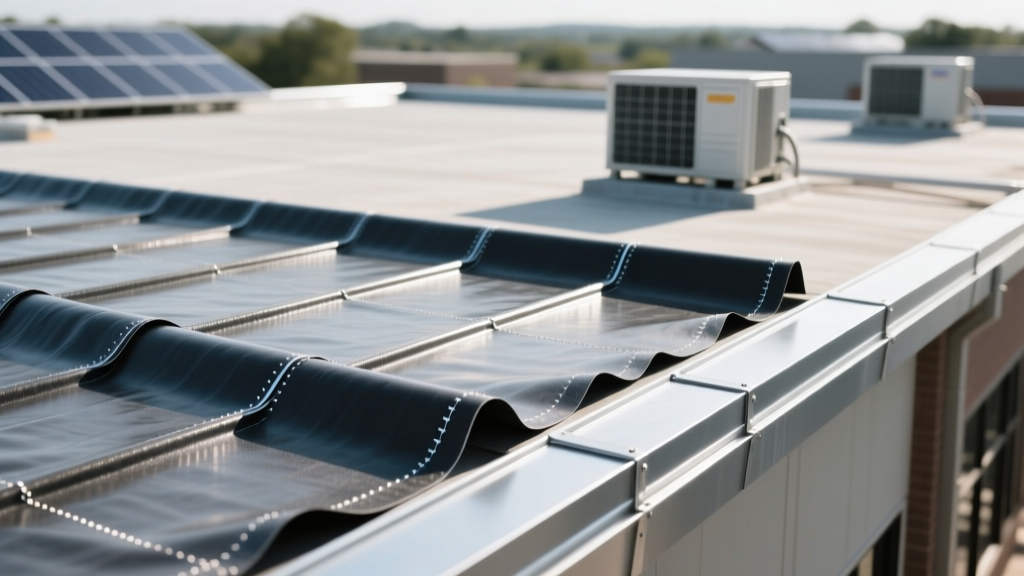
Core Material Specifications and ASTM D6878
Thermoplastic Polyolefin (TPO) has captured over 40% of the North American low-slope commercial roofing market due to its balance of durability, heat-weldable seams, and cost-effectiveness. When specifying a TPO roof, the governing material standard is ASTM D6878 (Standard Specification for Thermoplastic Polyolefin Based Sheet Roofing). This standard dictates the minimum physical properties for both unreinforced and reinforced TPO membranes.
For commercial applications, polyester-reinforced TPO is the mandatory specification. The internal polyester scrim provides dimensional stability, preventing the membrane from shrinking or expanding under extreme thermal cycling. Unreinforced TPO is strictly limited to flashing details and pipe boots. Under ASTM D6878, reinforced TPO must meet strict criteria for tensile strength (minimum 200 lbf/inch), elongation (minimum 15%), and heat aging resistance.
Mil Thickness and Performance Matrix
Membrane thickness (measured in mils) is the primary driver of puncture resistance, longevity, and material cost. While 45-mil TPO is still manufactured, it is increasingly relegated to residential or temporary structures. The commercial baseline has shifted decisively toward 60-mil and 80-mil membranes to withstand severe weather events and foot traffic from HVAC maintenance.
| Thickness | Puncture Resistance (ASTM D4830) | Best Application Scenario | 2026 Material Cost (Per Sq Ft) |
|---|---|---|---|
| 45 Mil | 40 lbf | Low-traffic residential, covered assemblies | $1.10 - $1.35 |
| 60 Mil | 55 lbf | Standard commercial, retail, warehouses | $1.50 - $1.85 |
| 80 Mil | 75 lbf | High-traffic roofs, schools, hospitals | $2.05 - $2.40 |
| 90 Mil | 90+ lbf | Severe hail zones, heavy equipment decks | $2.60 - $3.10 |
Wind Uplift, Fire Ratings, and FM Global Approvals
Performance ratings for wind uplift and fire resistance dictate the fastening patterns and substrate requirements of the TPO assembly. The Single-Ply Roofing Industry (SPRI) provides the foundational wind design standards (ANSI/SPRI WD-6) that engineers use to calculate perimeter, corner, and field fastener spacing.
Wind Uplift Classifications
Most commercial TPO systems are tested to FM 4474 or UL 1897. A standard FM 1-90 rating means the assembly can withstand 90 pounds per square foot of negative uplift pressure. In coastal regions or high-wind corridors, specifications must demand an FM 1-120 or FM 1-135 rating. Achieving these higher ratings requires transitioning from fully adhered systems to mechanically attached systems with high-density polyiso insulation and increased fastener densities in the corner zones (often 6-inch on-center spacing).
Fire Resistance (UL 790 / ASTM E108)
TPO membranes inherently achieve a Class A fire rating (the highest classification) when installed over non-combustible decks (like steel or concrete) or when paired with fire-rated gypsum cover boards over wood decks. The Class A rating ensures the membrane is effective against severe fire test exposure, preventing flame spread across the roof surface.
Thermal Welding and Seam Integrity
The most critical vulnerability of any single-ply membrane is the seam. Unlike EPDM, which relies on chemical adhesives or tape, TPO utilizes hot-air thermal welding. This process melts the top and bottom plies of overlapping membranes, fusing them into a continuous, homogeneous layer that is actually stronger than the membrane itself.
Improper welding is the leading cause of TPO roof failure. The hot-air welder must be calibrated to a precise temperature window, typically between 950°F and 1,100°F at the nozzle, depending on ambient conditions. If the ambient temperature drops below 40°F, the weld speed must be reduced, and the temperature increased. Always mandate that contractors perform daily test welds and conduct destructive peel and shear tests before commencing full-scale seaming.
Standard specifications require a minimum 1.5-inch (38mm) weld overlap, though many premium manufacturers now mandate a 2-inch (50mm) overlap to accommodate robotic welders and ensure a continuous seal. The resulting seam should exhibit a minimum peel strength of 3.5 pounds per inch of width.
Solar Reflectance and Cool Roof Compliance
White TPO membranes are highly reflective, making them a default choice for meeting modern energy codes like IECC, ASHRAE 90.1, and California's Title 24. To verify performance, architects must reference the Cool Roof Rating Council (CRRC) directory.
- Initial Solar Reflectance (SR): Premium white TPO membranes boast an initial SR of 0.80 to 0.85, meaning they reflect 80-85% of solar radiation.
- Three-Year Aged SR: Due to dust, pollution, and biological growth, reflectance drops over time. High-quality TPO maintains an aged SR of 0.70 to 0.75.
- Thermal Emittance (TE): TPO naturally exhibits a high TE of 0.85 to 0.90, allowing it to efficiently radiate absorbed heat back into the atmosphere.
For projects pursuing LEED v4.1 certification or local utility rebates, specifying a TPO membrane with a minimum three-year aged Solar Reflectance Index (SRI) of 82 is required for low-slope applications.
2026 Installed Cost Projections by Assembly Type
Material costs only represent a fraction of the total project budget. The installation method (mechanically attached, fully adhered, or induction welded) and the insulation package drastically alter the final price. Below are the projected 2026 fully installed costs for a standard commercial TPO roof, including a single layer of polyisocyanurate insulation and cover board.
| Attachment Method | Labor Intensity | Estimated Installed Cost (Per Sq Ft) | Primary Advantage |
|---|---|---|---|
| Mechanically Attached | Low | $6.50 - $8.00 | Fastest installation, cost-effective |
| Fully Adhered | High | $8.50 - $11.00 | Superior wind uplift, no fastener penetrations |
| Induction Welded | Medium | $7.75 - $9.50 | Aesthetic (no visible plates), high wind resistance |
Architectural Specification Checklist
To avoid value-engineering compromises and ensure the roof system performs as designed, include these explicit parameters in your bid documents:
- Membrane Thickness: Explicitly state '60-mil minimum, polyester-reinforced TPO' to prevent contractors from substituting 45-mil stock.
- Top Ply Verification: Require manufacturer documentation proving the top weathering ply is a minimum of 28 mils thick.
- Seam Overlap: Mandate a 2-inch minimum overlap for all robotic and hand-welded seams.
- Insulation Fastening: Specify that polyiso insulation must be mechanically fastened independently of the membrane to prevent wind flutter and membrane fatigue.
- Warranty Requirements: Demand a 20-year or 30-year No Dollar Limit (NDL) manufacturer warranty, which requires the contractor to be a certified, licensed applicator for that specific brand (e.g., Carlisle, GAF, Firestone).