Best Roofing Materials in Pasadena, CA: Climate & Fire Guide
Discover the best roofing materials in Pasadena, CA for 2026. Compare tile, metal, and cool-roof shingles for heat reflectance and WUI fire compliance.

The Pasadena Climate Matrix: Heat, Fire, and Title 24
Selecting the right roof in Southern California requires navigating a complex intersection of microclimates, strict energy codes, and severe fire risks. Pasadena sits at the base of the San Gabriel Mountains, placing many neighborhoods—particularly those north of Washington Boulevard and east of Hill Avenue—directly within the Wildland-Urban Interface (WUI). During autumn Santa Ana wind events, ember intrusion is a primary cause of structural loss.
Simultaneously, Pasadena experiences summer temperatures that routinely exceed 95°F, making attic heat gain a major driver of residential cooling costs. Under the 2022 California Energy Code (Title 24, Part 6), which remains the enforced standard through 2026, all new and replacement steep-slope roofs in Climate Zone 10 must meet specific Cool Roof requirements. According to the California Energy Commission, steep-slope roofs must achieve a minimum Solar Reflectance Index (SRI) of 16, while low-slope roofs require an SRI of 63.
Top-Tier Roofing Materials for Pasadena Homes
To satisfy both Title 24 energy mandates and Chapter 7A fire codes, Pasadena contractors rely on three primary material categories. Each offers distinct trade-offs regarding structural load, longevity, and aesthetic integration with the city's historic Craftsman and Mid-Century architectural styles.
1. Concrete and Clay Tile (The WUI Standard)
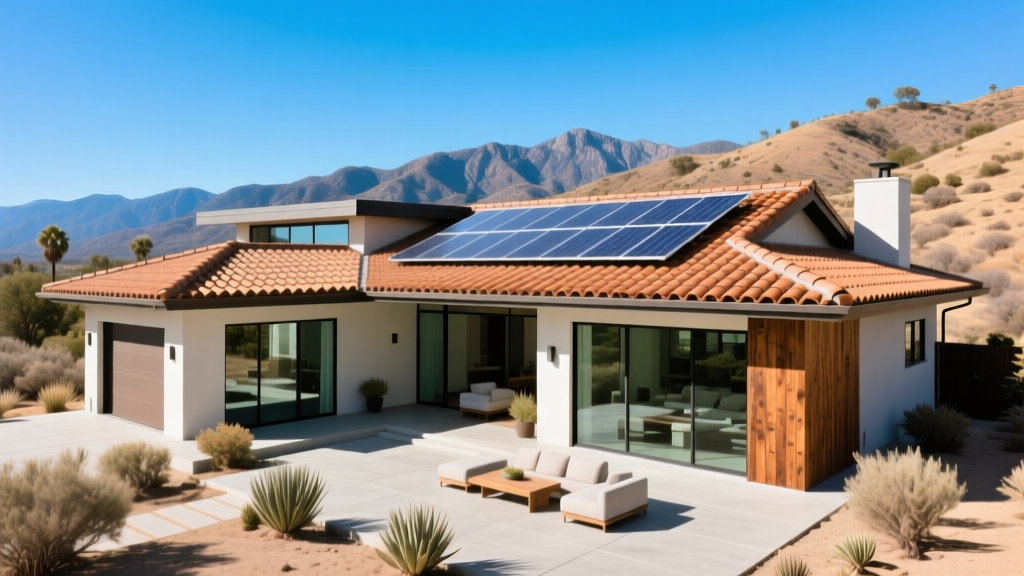
Clay and concrete tiles are the dominant roofing materials in Pasadena, CA, prized for their thermal mass and inherent non-combustibility. Products like Eagle Roofing Capistrano and Ludowici Spanish Tile carry a natural Class A fire rating without relying on chemical treatments.
- Thermal Performance: The natural air gap created by battens between the tile and the deck allows for passive ventilation, reducing attic heat transfer by up to 40% compared to direct-to-deck asphalt.
- Wind Uplift Resistance: When installed with mechanical fasteners and hurricane clips (required by code for perimeter zones), tile systems easily withstand 110+ mph Santa Ana gusts.
- The Weight Factor: Concrete tiles weigh between 900 and 1,100 lbs per square (100 sq ft). Retrofitting a 1920s Craftsman home from shingles to tile typically requires structural framing reinforcement, adding $4,500 to $8,500 to the project baseline.
2. Stone-Coated Steel (The Lightweight Fire Shield)
For homes in historic districts where the visual profile of wood shake or barrel tile is desired but structural framing cannot support the dead load, stone-coated steel is the premier alternative. Brands like Gerard Roofing Technologies (Canyon Shake) and DECRA stamp Galvalume steel into traditional profiles and coat them with natural stone granules.
- Fire & Wind: Achieves Class A fire resistance and carries a 120 mph wind warranty. The interlocking panels prevent ember intrusion beneath the roofing plane.
- Weight: At roughly 150 lbs per square, stone-coated steel can be installed directly over existing battens or solid decking without requiring a structural engineer's stamp for framing upgrades.
- Acoustic & Thermal: Requires a high-density synthetic underlayment and proper attic insulation to mitigate rain noise and thermal bridging, as metal conducts heat rapidly if an air gap is not maintained.
3. Title 24 Compliant Cool Asphalt Shingles
Standard architectural shingles will fail Title 24 inspections in Pasadena unless they utilize specialized cool-roof granules. The GAF Timberline HDZ Reflector Series and Owens Corning TruDefinition Duration Cool are engineered with IR-reflective pigments that bounce solar radiation away from the roof surface, achieving an SRI of 20 or higher.
- Cost Efficiency: Asphalt remains the most budget-friendly option, though the premium for cool-roof granules adds roughly 15% to the material cost over standard architectural shingles.
- Installation Specifics: To survive Santa Ana winds, Pasadena roofers must utilize a 6-nail fastening pattern (rather than the standard 4-nail) and apply a 3-inch band of roofing cement under every tab on the eaves and rakes.
- Lifespan: Expect a realistic lifespan of 20 to 25 years in the intense Southern California UV environment, significantly shorter than tile or metal.
Material Comparison Matrix: Cost & Performance
| Material Type | 2026 Installed Cost (Per Sq Ft) | CRRC SRI Rating | Weight / Square | WUI Chapter 7A |
|---|---|---|---|---|
| Concrete Tile (Eagle) | $19.50 - $26.00 | 22 - 35 (Color dependent) | 950 lbs | Fully Compliant |
| Clay Tile (Ludowici) | $28.00 - $42.00 | 25 - 40 | 850 lbs | Fully Compliant |
| Stone-Coated Steel (Gerard) | $17.00 - $24.00 | 18 - 28 | 150 lbs | Fully Compliant |
| Cool Asphalt (GAF HDZ Reflector) | $9.50 - $13.50 | 20 - 24 | 240 lbs | Compliant (Class A) |
Note: Installed costs reflect 2026 Southern California labor rates, including tear-off of one existing layer, synthetic underlayment, and standard flashing. Structural reinforcement or dry-rot repair is excluded.
Critical Edge Cases: Vents, Solar, and Underlayment
The roofing material itself is only one component of a fire-resistant, energy-efficient assembly. Pasadena building inspectors heavily scrutinize three secondary elements during final sign-off:
Ember-Resistant Venting
Standard corrugated plastic or mesh roof vents will melt or allow wind-blown embers into the attic. In WUI zones, you must install Brandguard Vents or Vulkan Vents, which utilize intumescent coatings or micro-mesh stainless steel screens that block embers smaller than 1/8th of an inch.
Solar PV Integration
With Pasadena Water and Power (PWP) mandating solar readiness on new builds, the roofing material must accommodate racking systems. Clay and concrete tiles require specialized flashings (like QuickMount Pro) that replace individual tiles to maintain the waterproof envelope. Stone-coated metal and standing seam roofs allow for non-penetrating clamps, drastically reducing the risk of future roof leaks.
High-Temp Underlayment
Underneath tile and metal roofs, attic temperatures can exceed 160°F. Standard felt paper (ASTM D226) will dry out, crack, and fail within a decade. Specify a high-temp synthetic underlayment, such as Grace Ice & Water Shield HT or Epilay Protectite, rated for continuous exposure up to 240°F.
Frequently Asked Questions
Can I install a cool roof over my existing shingles?
While California code allows up to two layers of asphalt shingles, overlaying is highly discouraged in Pasadena. The added weight stresses aging trusses, and the trapped heat between layers will prematurely degrade the new cool-roof granules. Furthermore, an overlay prevents the installation of modern ice-and-water shield equivalents at the eaves and hides dry rot in the OSB decking. Always budget for a full tear-off.
Do flat roofs on Mid-Century modern homes require different materials?
Yes. Low-slope roofs (under 2:12 pitch) fall under different Title 24 mandates, requiring an SRI of 63. For Pasadena's flat-roofed Mid-Century homes, a 60-mil TPO (Thermoplastic Polyolefin) or PVC membrane in white is the standard. These materials reflect up to 85% of solar radiation and resist the pooling water that occurs during rare but heavy winter atmospheric river events.
How often should I clean my tile roof in Pasadena?
Clay and concrete tiles are porous and will harbor algae or lichen if shaded by mature oak or pine trees. Pressure washing is strictly prohibited, as it strips the factory sealant and forces water under the laps. Instead, schedule a soft-wash chemical treatment (using a dilute sodium hypochlorite solution) every 4 to 5 years, applied by a licensed contractor who uses walk-pads to prevent tile fracture.
Written by
Marcus ChenMarcus Chen is a licensed structural engineer (PE) and building materials analyst with over 12 years of experience across residential, commercial, and industrial construction. He holds a Master of Science in Civil Engineering from UC Berkeley and spent six years at Thornton Tomasetti before transitioning to independent consulting and technical writing. Marcus specializes in material selection for seismic-prone regions, concrete reinforcement strategies, and lifecycle cost analysis. His work has been cited by the American Concrete Institute (ACI) and the Structural Engineers Association of California (SEAOC). When he is not on a job site or at his desk, you will find him hiking the Sierra Nevada or restoring a 1920s craftsman bungalow in Oakland, CA.
More from Marcus Chen
View all
Construction Cost
How Much Did the Eiffel Tower Cost to Build?
How much did the Eiffel Tower cost to build in 1889? We adjust for inflation and compare its budget to modern skyscraper construction.
Aug 4, 2026

Fire Resistance
What Is a Fire Resistant Material? Testing & Certification Guide
Discover what is a fire resistant material through ASTM and UL testing. Learn how fire ratings, certifications, and assemblies work in construction.
Aug 4, 2026

Construction Cost
How Much Did the Burj Khalifa Cost to Build?
How much did the Burj Khalifa cost to build? We break down the $1.5B project and extract 5 money-saving strategies for your next build.
Jul 30, 2026