Matching the Best Types of Roof Shingles to Your Home Scenario
Discover how to match different types of roof shingles to your specific climate, budget, and architectural needs with our scenario-based guide.
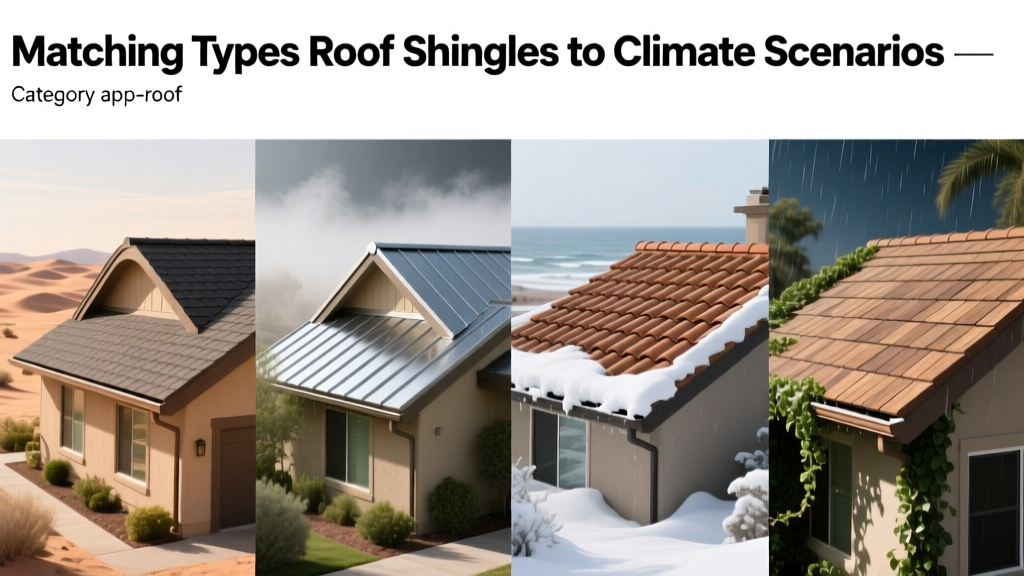
The Scenario-Based Shingle Selection Framework
Choosing from the various types of roof shingles is rarely about finding the single "best" material; it is about matching the material's physical properties to your home's specific environmental stressors, structural load limits, and architectural constraints. A premium impact-resistant shingle that excels in hail-prone Oklahoma may be a wasted investment in coastal Florida, where wind uplift and salt spray dictate performance. This framework maps specific shingle categories to their ideal real-world applications, providing exact product specifications, material costs per square (100 square feet), and code requirements for each scenario.
High-Wind and Hurricane-Prone Coastal Zones
In coastal regions subject to tropical storms and nor'easters, the primary failure mode for asphalt roofing is not water infiltration, but wind uplift leading to sequential peeling. Standard architectural shingles typically fail at sustained winds of 110 mph. For coastal applications, you must specify shingles tested to ASTM D7158 Class H (capable of withstanding 150 mph wind uplift).
Recommended Specifications for Coastal Builds
- Product Lines: GAF Timberline AS II, Owens Corning Duration Storm, or Malarkey Everest Premium.
- Sealant Technology: Look for proprietary wider sealant strips (e.g., GAF's Time-Release Adhesive) that bond faster and resist thermal cycling.
- Fastening Pattern: A 6-nail pattern per shingle is mandatory in high-velocity hurricane zones (HVHZ), compared to the standard 4-nail pattern. Nails must be ring-shank or corrosion-resistant hot-dipped galvanized to prevent rust-jacking in salt-air environments.
Wildfire-Prone and Arid Western Climates
In the Wildland-Urban Interface (WUI) across California, Colorado, and the Pacific Northwest, airborne embers are the leading cause of structural ignition. While standard fiberglass asphalt shingles carry a Class A fire rating, the underlying decking and gaps at the eaves remain vulnerable. Furthermore, arid climates demand high Solar Reflectance Index (SRI) values to reduce cooling loads.
Material Matching for Fire and Heat
For maximum ember resistance, stone-coated metal shingles (such as Decra or Gerard) outperform asphalt. Metal shingles eliminate the combustible asphalt matrix entirely and feature interlocking side laps that prevent ember intrusion. If asphalt is required for budget reasons, specify a Class A fire-rated architectural shingle paired with a fire-resistant underlayment (like Grace Ice & Water Shield HT) that extends at least 24 inches past the interior wall line.
"To achieve the IBHS FORTIFIED Home standard in wildfire zones, the roof covering must maintain its Class A rating without relying on the underlying decking for fire resistance, and all vents must be retrofitted with 1/8-inch metal mesh to block embers." - IBHS FORTIFIED Roof Standards
Historic and Architecturally Strict Neighborhoods
Historic districts and high-end custom builds often mandate the aesthetic of natural slate or cedar shakes. However, natural slate weighs between 800 and 1,200 lbs per square, requiring extensive (and expensive) structural reinforcement of the roof trusses. Cedar shakes require constant maintenance and fail modern fire codes in many municipalities.
The Synthetic Alternative Matrix
Synthetic and composite shingles provide the exact visual profile of historic materials at a fraction of the structural load.
- DaVinci Multi-Width Slate: Weighs roughly 300 lbs per square. Made from virgin resins with UV stabilizers. Material cost: $650 - $850 per square.
- EcoStar Majestic Niagra: Recycled rubber/plastic matrix mimicking thick-cut slate. Highly impact-resistant (UL 2218 Class 4). Material cost: $500 - $700 per square.
- Brava Roof Tile (Composite Shake): Mineral-filled polyolefin that replicates the shadow lines of hand-split cedar. Material cost: $600 - $800 per square.
Budget-Conscious Suburban Builds: 3-Tab vs. Architectural
For investment properties, flips, or budget-restricted new builds, the choice usually narrows to 3-tab versus standard architectural laminate shingles. While 3-tab shingles (e.g., GAF Royal Sovereign) cost roughly $90 to $110 per square for materials, they are increasingly viewed as a liability in real estate appraisals.
Comparative Cost and Performance Matrix
The following table breaks down material costs, installed costs, and performance thresholds for the primary types of roof shingles discussed.
| Shingle Type | Material Cost (Per Square) | Installed Cost (Per Sq. Ft.) | Wind Rating | Impact Rating | Ideal Scenario |
|---|---|---|---|---|---|
| 3-Tab Asphalt | $90 - $120 | $3.50 - $4.50 | 60 - 80 mph | None | Budget flips, detached garages |
| Architectural Laminate | $130 - $180 | $4.50 - $6.50 | 110 - 130 mph | Class 2 | Standard suburban residential |
| Impact-Resistant (SBS) | $220 - $350 | $6.50 - $9.00 | 130 mph | UL 2218 Class 4 | Hail-prone Midwest/Texas |
| Stone-Coated Metal | $350 - $500 | $9.00 - $14.00 | 120+ mph | Class 4 | WUI Fire zones, Coastal |
| Synthetic Slate | $500 - $850 | $12.00 - $18.00 | 110 mph | Class 3 or 4 | Historic districts, Luxury builds |
Critical Installation Variables That Void Warranties
Selecting the correct shingle is only half the battle. Manufacturers will deny warranty claims for premature granule loss, blow-offs, and algae streaking if specific installation parameters are ignored.
1. Drip Edge and Ice & Water Shield Integration
According to the Department of Energy and modern building codes, a metal drip edge is mandatory at the eaves and rakes. The critical sequencing error occurs when contractors install the underlayment *over* the drip edge at the eaves. The correct sequence is: drip edge first, then ice and water shield overlapping the drip edge by at least 1/4 inch. This prevents wind-driven rain from wrapping under the membrane and rotting the fascia.
2. Valley Weaving vs. Closed-Cut Valleys
In regions with heavy snow loads or torrential downpours, open valleys (lined with W-valley metal flashing) shed water 40% faster than closed-cut woven asphalt valleys. Woven valleys trap debris and accelerate granule wear at the intersection point. For homes with a roof pitch under 4:12, metal valley flashing is not just recommended; it is a strict requirement to prevent capillary water draw.
3. Algae Resistance in High-Humidity Zones
If your home is located in the Southeast or Pacific Northwest, standard asphalt shingles will develop Gloeocapsa magma (black algae streaks) within 3 to 5 years. You must specify shingles with copper-infused granules (e.g., GAF StainGuard Plus or Owens Corning StreakFighter). Note that zinc strips installed at the ridge are a temporary fix and often wash out within 48 months, whereas copper-infused granules provide 15+ years of protection.