Calculating the Cost of a New Roof: Scenario-Based Pricing for 2026
Discover the true cost of a new roof in 2026. Match your specific home scenario to the right materials, from asphalt shingles to standing seam metal.
The Fallacy of the "Average" Roofing Estimate
Searching for the average cost of a new roof yields wildly misleading data. A national average of $11,500 means nothing when a 2,000-square-foot architectural shingle roof in Ohio costs $9,800, while a similarly sized standing seam metal roof in coastal Florida costs $34,000. The true cost of a new roof is dictated by application-fit: matching the material's physical properties to your specific structural slope, regional climate loads, and long-term performance requirements.
This 2026 scenario-matching guide bypasses generic averages. Instead, we break down exact installed costs, material specifications, and hidden structural variables for the three most common residential and light-commercial roofing scenarios.
Scenario 1: The Budget-Conscious Suburban Build
Application Profile: Moderate Climate, Standard Pitch (4:12 to 9:12)
For standard suburban homes in regions without extreme hurricane or wildfire risks, architectural asphalt shingles remain the most cost-effective application. However, not all shingles are equal. In 2026, the baseline standard is a heavy-weight architectural shingle with a Class 4 impact rating (UL 2218) and high-wind warranties up to 130 mph.
2026 Installed Cost Breakdown:
- Material Cost: $1.85 to $2.40 per square foot.
- Labor & Overhead: $2.50 to $3.80 per square foot.
- Total Installed: $4.35 to $6.20 per square foot.
- Typical 2,500 sq. ft. Roof (25 squares): $10,875 to $15,500.
Crucial Specification: Do not skip the synthetic underlayment. While traditional #15 felt paper costs $0.15 per square foot, synthetic options like GAF FeltBuster cost $0.22 per square foot but offer 600% greater tear resistance during installation and provide a secondary water barrier if shingles are compromised.
Scenario 2: The High-Wind & Wildfire Corridor
Application Profile: Coastal Zones, WUI (Wildland-Urban Interface), Steep Pitch
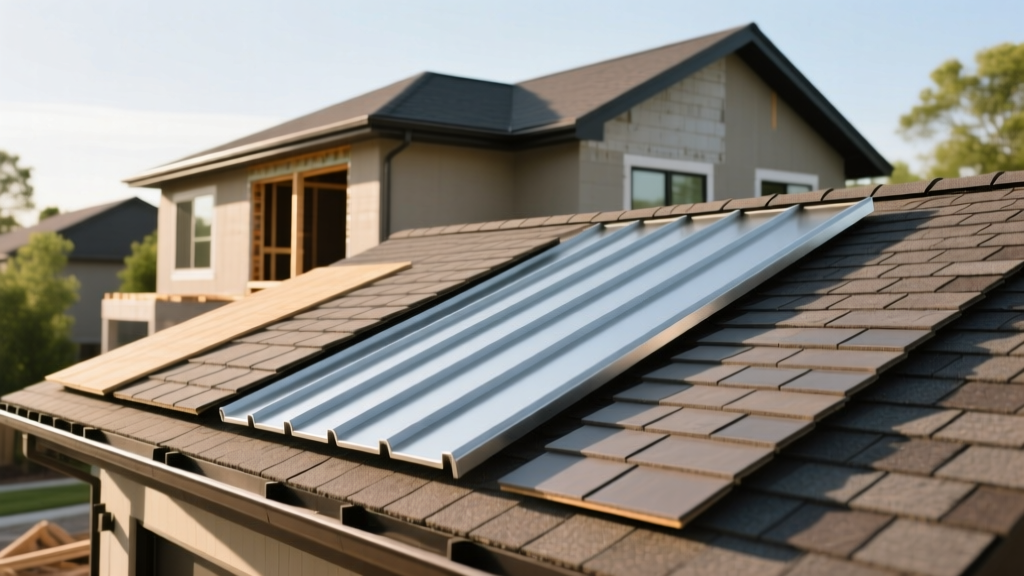
Homes in Florida's High-Velocity Hurricane Zones (HVHZ) or California's WUI areas require materials that resist uplift and ember ignition. Asphalt shingles, even Class 4 rated ones, are increasingly rejected by insurance underwriters in these zones. The application-fit solution is 24-gauge standing seam metal or interlocking concrete tile.
According to the Insurance Institute for Business & Home Safety (IBHS), continuous clip standing seam metal roofs demonstrate near-total survivability in wind tunnel tests exceeding 150 mph, provided the clips are fastened directly into the roof decking or purlins with structural screws rather than standard nails.
2026 Installed Cost Breakdown (24-Gauge Concealed Clip Standing Seam):
- Material & Fabrication: $6.50 to $9.00 per square foot.
- Specialized Labor: $7.50 to $11.00 per square foot.
- Total Installed: $14.00 to $20.00 per square foot.
- Typical 2,500 sq. ft. Roof: $35,000 to $50,000.
For wildfire zones where metal is aesthetically restricted by HOAs, specify interlocking concrete tile (e.g., Boral Eagle Flat). Concrete is non-combustible (Class A) and heavy enough to resist uplift, though it requires a structural engineering assessment to ensure the home's trusses can support the 950 lbs per square weight load.
Scenario 3: The Modern Low-Slope Addition
Application Profile: Slopes between 1:12 and 3:12, Urban Infill, Modern Architecture
Low-slope roofs cannot shed water fast enough for shingles or metal panels, which require a minimum 3:12 pitch to prevent capillary action and wind-driven rain intrusion. The correct application here is a single-ply thermoplastic membrane, specifically TPO (Thermoplastic Polyolefin) or EPDM (Ethylene Propylene Diene Monomer).
For unvented flat roof assemblies, the U.S. Department of Energy highly recommends white TPO membranes due to their high solar reflectance index (SRI), which can reduce cooling loads by up to 15% in hot climates.
2026 Installed Cost Breakdown (60-Mil Mechanically Attached TPO):
- Membrane & Insulation (Polyiso): $3.20 to $4.80 per square foot.
- Labor & Heat Welding: $4.50 to $6.50 per square foot.
- Total Installed: $7.70 to $11.30 per square foot.
2026 Scenario-to-Material Cost Matrix
| Scenario | Optimal Material | Installed Cost / Sq. Ft. | Expected Lifespan | Wind Rating |
|---|---|---|---|---|
| Suburban Standard | Architectural Asphalt (Class 4) | $4.35 - $6.20 | 30 Years | 130 mph |
| HVHZ / Coastal | 24-Ga Standing Seam Metal | $14.00 - $20.00 | 50+ Years | 150+ mph |
| WUI / Wildfire | Interlocking Concrete Tile | $16.50 - $24.00 | 50+ Years | 110 mph |
| Low-Slope / Flat | 60-Mil TPO Membrane | $7.70 - $11.30 | 25 Years | 90 mph |
The Hidden Cost Multipliers: Where Estimates Fail
Contractor quotes often exclude structural variables that are only discovered after tear-off. To accurately forecast the cost of a new roof, you must account for these three hidden multipliers:
1. Decking Replacement (The OSB vs. Plywood Variable)
Older homes often feature spaced plank decking or deteriorating OSB (Oriented Strand Board). In 2026, replacing a sheet of 5/8-inch OSB costs roughly $55 to $70 installed, while 5/8-inch CDX plywood costs $75 to $95 installed. If your roof requires 30% decking replacement (common in homes over 25 years old), add $1,800 to $3,200 to your baseline estimate.
2. Code-Mandated Drip Edge and Ice Barriers
The International Residential Code (IRC) strictly mandates metal drip edge flashing at eaves and rakes. Furthermore, in climates where the average January temperature is 25°F or lower, an ice barrier (self-adhering polymer-modified bitumen sheet, like Grace Ice & Water Shield) is required at the eaves extending 24 inches inside the exterior wall line. This adds $1.10 to $1.60 per linear foot to the project.
3. Tear-Off and Disposal Surcharges
Tearing off a single layer of asphalt shingles costs $0.45 to $0.75 per square foot. However, if your home has two existing layers (the legal maximum in most jurisdictions before mandatory full tear-off), the labor and landfill tipping fees double. Always verify how many layers are currently on your roof before accepting a baseline quote.
"The most expensive roof is the one that requires premature replacement due to poor ventilation. A $15,000 shingle roof will fail in 12 years if the attic lacks balanced intake (soffit) and exhaust (ridge) ventilation, as trapped heat bakes the shingles from underneath." — Senior Forensic Roofing Inspector, National Roofing Contractors Association (NRCA).
Scenario-Matching Decision Framework
Use this logical flow to determine your optimal material application before soliciting contractor bids:
- Assess the Pitch: Is the roof slope less than 3:12? If yes, stop. You must use TPO, EPDM, or Modified Bitumen. Do not install shingles or standard metal panels.
- Check Regional Hazards: Are you in a WUI (wildfire) zone or an HVHZ (hurricane) zone? If yes, eliminate standard asphalt shingles to ensure insurability. Move to standing seam metal or concrete tile.
- Evaluate Structural Load: If choosing concrete tile or slate, has a structural engineer verified the truss load capacity? If no, budget $2,500 to $6,000 for truss reinforcement before proceeding.
- Calculate the Breakeven Horizon: Will you own the home for more than 15 years? If yes, the premium for standing seam metal (Scenario 2) yields a positive ROI through eliminated replacement cycles and insurance premium discounts (often 15-25% lower in wind-prone areas).
Finalizing Your 2026 Roofing Budget
Calculating the cost of a new roof requires moving beyond square-footage multipliers and focusing on application-fit. By matching your specific pitch, climate exposure, and structural capacity to the correct material system—and budgeting for the inevitable hidden decking and code-compliance variables—you transform a volatile construction expense into a predictable, long-term asset protection strategy. Always demand line-item quotes that separate material, labor, tear-off, and structural repair to ensure your scenario is accurately priced.