Crawl Space Vapor Barrier Selection: Matching Mil Thickness to Soil
Match the right crawl space vapor barrier to your home's soil and climate. Compare 6-mil to 20-mil polyethylene costs, perm ratings, and installation tips.
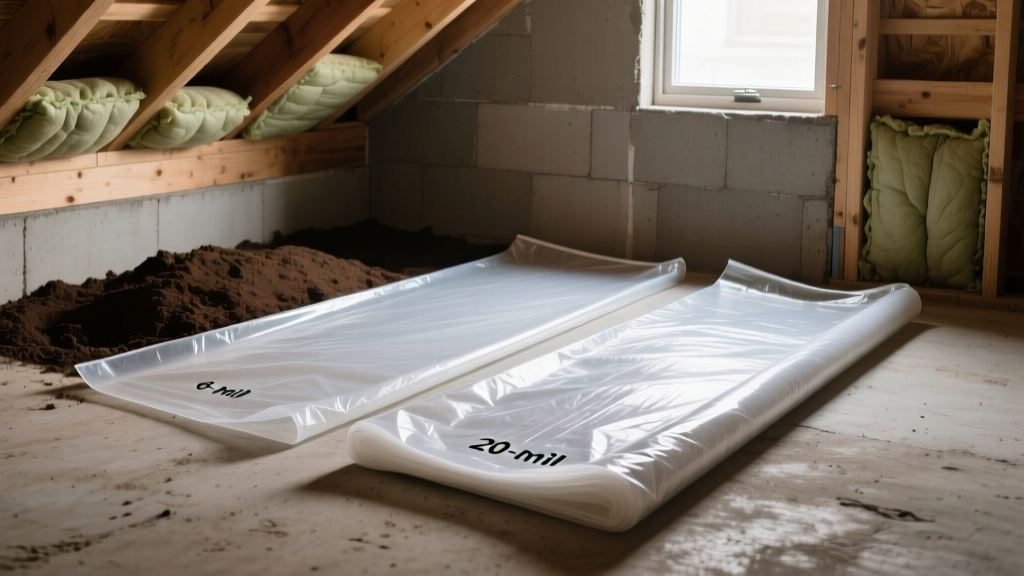
The Failure of Generic Poly: Why Application-Fit Matters
For decades, contractors defaulted to 6-mil clear polyethylene for crawl space ground covers. By 2026, building science has definitively proven that unreinforced 6-mil poly is inadequate for modern, fully encapsulated crawl spaces. It degrades under UV exposure, tears easily during HVAC maintenance, and fails to stop capillary moisture in expansive soils. Selecting a crawl space vapor barrier requires matching the material's tensile strength, puncture resistance, and perm rating to your specific soil profile and hydrostatic conditions.
The ASTM E1745 standard classifies plastic water vapor retarders into Classes A, B, and C based on tensile strength and puncture resistance. A proper application-fit strategy dictates that you never install a Class C barrier in a high-traffic or high-moisture environment.
The Mil Thickness and Perm Rating Matrix
"Mil" refers to one-thousandth of an inch (0.001"). However, thickness alone does not determine durability; the manufacturing process (extruded vs. cross-laminated vs. string-reinforced) dictates the actual puncture resistance. Below is the 2026 material matrix for high-density polyethylene (HDPE) and linear low-density polyethylene (LLDPE) barriers.
| Thickness | Construction Type | ASTM E1745 Class | Perm Rating | Avg. Material Cost (per sq. ft.) |
|---|---|---|---|---|
| 6-mil | Unreinforced LLDPE | Class C | 0.06 | $0.12 - $0.18 |
| 10-mil | Coextruded HDPE | Class C / B | 0.04 | $0.25 - $0.35 |
| 12-mil | Cross-Laminated | Class A | 0.02 | $0.40 - $0.55 |
| 15-mil | String-Reinforced | Class A | 0.01 | $0.60 - $0.75 |
| 20-mil | Woven/Scrim-Reinforced | Class A | < 0.01 | $0.80 - $1.10 |
Scenario Matching: Which Barrier Fits Your Crawl Space?
Scenario 1: Arid Climates with Sandy, Well-Draining Soil
The Environment: Low annual rainfall, sandy soil that percolates water rapidly, no history of standing water, and an unconditioned (vented) crawl space.
The Fit: 10-mil Coextruded HDPE. In dry environments where the primary goal is simply to block soil-gas radon and baseline earth moisture, a 10-mil barrier provides adequate protection. Products like CrawlSpace Technologies 10-mil SilverBack offer a reflective surface that helps bounce light in dark spaces while maintaining a Class B puncture rating. Do not waste budget on 20-mil materials here; the hydrostatic pressure is negligible.
Scenario 2: Expansive Clay Soils with Seasonal Moisture
The Environment: Heavy clay soils that shrink and swell, moderate seasonal rain, and a mix of dirt floor and shallow concrete footings.
The Fit: 12-mil to 15-mil Cross-Laminated Poly. Clay soils exert lateral and upward pressure as they expand when wet. Unreinforced films will stretch and micro-tear under this stress. Cross-laminated barriers (like Raven Industries VaporGuard 12-mil) feature multiple layers of film bonded at opposing angles, providing immense dimensional stability. According to the DOE Building America Solution Center, maintaining a continuous, unbroken seal is critical in clay-heavy regions to prevent seasonal humidity spikes from warping hardwood floors above.
Scenario 3: High Water Table & Full Encapsulation
The Environment: Coastal regions, flood zones, or properties with active underground springs. The space is being fully sealed, insulated, and conditioned with a dehumidifier.
The Fit: 20-mil String-Scrim Reinforced Barrier. When a crawl space is converted into conditioned living space, the vapor barrier becomes the primary building envelope. A 20-mil woven barrier (such as GuardianLiner 20-mil) contains a heavy-duty polyester string grid laminated between poly layers. This prevents catastrophic tearing if a contractor drops a tool, or if a homeowner crawls through to service plumbing. Furthermore, in high water table scenarios, hydrostatic pressure can push groundwater against the underside of the liner; the tensile strength of 20-mil scrim prevents the seams from blowing out under pressure.
If you are conditioning your crawl space and tying it into the home's HVAC system, local building codes often require the vapor barrier to meet a Class A fire rating per ASTM E84 (Surface Burning Characteristics). Standard polyethylene is highly flammable. When purchasing 12-mil or 20-mil barriers for conditioned spaces, explicitly verify that the manufacturer's spec sheet lists an ASTM E84 Class A flame and smoke index rating.
Seaming and Termination: Where 90% of Failures Occur
Buying a 20-mil barrier is useless if the seams and wall terminations fail. The EPA's moisture control guidelines emphasize that capillary action and vapor drive will exploit the smallest gap. Follow these exact application-fit specifications for sealing:
- Seam Overlap: Maintain a minimum 6-inch overlap on all horizontal floor seams. For high water table scenarios, increase this to 12 inches.
- Seam Tape Selection: Never use standard duct tape or cheap acrylic tapes. Use double-sided butyl tape (e.g., Trex Protect or specialized crawl space butyl) for floor-to-floor seams. Butyl remains pliable for decades and accommodates minor soil shifting without losing adhesion.
- Wall Termination: Run the barrier 6 to 12 inches up the foundation wall. Do not rely on tape to hold the liner to porous Concrete Masonry Units (CMU). Instead, use a PVC termination bar mechanically fastened into the masonry with concrete tapcons, or apply a thick bead of acoustic sealant/mastic behind the liner before pressing it into the wall.
- Pier Wrapping: Every structural support pier must be wrapped. Cut the liner to fit snugly around the pier, run it 6 inches up the column, and seal the vertical seam with waterproof mastic tape.
Decision Framework: Tape vs. Mastic
| Application Area | Recommended Sealant | Why It Fits |
|---|---|---|
| Floor-to-Floor Seams | 4" Double-Sided Butyl Tape | Handles horizontal shear stress; remains flexible in cold temps. |
| Floor-to-Wall Transitions | Single-Sided Woven Tape + Mastic | Mastic fills the porous voids in CMU block; woven tape bridges the gap. |
| Pier Wraps & Pipe Penetrations | Waterproof Acrylic Mastic | Conforms to irregular, non-flat surfaces where tape cannot lay flat. |
2026 Material Cost & Labor Estimates
Budgeting for a crawl space vapor barrier requires looking beyond the roll cost. Accessories and fasteners account for nearly 30% of the total material expense in a professional-grade encapsulation.
For a standard 1,200 sq. ft. crawl space with a 3-foot perimeter (140 linear feet of wall), expect the following material breakdown for a 20-mil full encapsulation:
- 20-mil Scrim Barrier (1,500 sq ft roll with waste factor): $1,350 - $1,500
- Butyl Seam Tape (four 4"x180' rolls): $220 - $280
- CMU Mastic / Acoustic Sealant (12 tubes): $120 - $150
- PVC Termination Bars & Tapcons (140 LF): $210 - $250
- Total Material Cost: $1,900 - $2,180 (approx. $1.58 to $1.81 per sq. ft. of floor space).
Professional installation labor typically adds $1.50 to $3.00 per square foot, depending on access difficulty, debris removal, and whether a dehumidifier or sump pump integration is required. By matching the exact mil thickness and reinforcement type to your specific soil and hydrostatic profile, you eliminate the risk of paying twice for a failed 6-mil liner replacement within three years.