Best Heavy Duty Waterproof Material for Foundations (2026 Review)
We review the top heavy duty waterproof material options for below-grade foundations, comparing TPO, polyurethane, and bentonite costs and performance.

The Reality of Below-Grade Hydrostatic Pressure
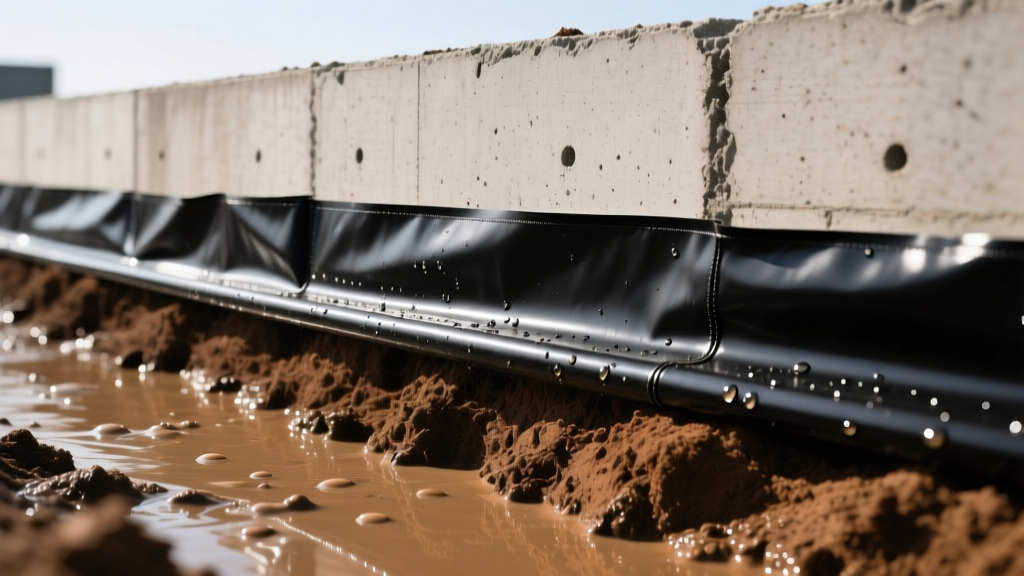
When designing below-grade structures, standard dampproofing (like asphaltic coatings) fails under sustained hydrostatic pressure. Selecting a true heavy duty waterproof material requires evaluating tensile strength, elongation properties, and chemical resistance against soil contaminants. As of 2026, the commercial construction sector relies on three primary membrane technologies for deep foundations and plaza decks: liquid-applied polyurethanes, fully bonded TPO sheets, and bentonite composite panels. According to the Whole Building Design Guide (WBDG), positive-side waterproofing must withstand continuous water exposure without degradation, bridging structural cracks up to 1/16 inch without tearing.
Testing Criteria for Heavy Duty Waterproof Materials
To qualify as heavy duty, membranes must pass rigorous ASTM standards. We evaluated the following products based on three critical metrics:
- ASTM C836 / C1305: Standard for liquid-applied elastomeric membranes, testing crack-bridging ability at sub-zero temperatures (-15°F).
- ASTM D5385: Hydrostatic head resistance. A true heavy duty material must withstand a minimum of 231 feet of hydrostatic head pressure (100 psi) without weeping.
- Puncture Resistance (ASTM D4833): Crucial for below-grade applications where backfill aggregate and rebar tying can compromise the membrane.
Product Review Matrix: 2026 Market Leaders
| Product | Technology | Dry Thickness | Hydrostatic Resistance | 2026 Material Cost (per sq ft) | Cure / Set Time |
|---|---|---|---|---|---|
| Tremco Tremproof 201 | 100% Solids Polyurethane | 60 mils | 231 ft head | $2.60 - $3.10 | 24-48 hours |
| Sika SikaProof-1200 | Fully Bonded TPO Sheet | 47 mils (1.2mm) | 231+ ft head | $3.50 - $4.20 | Immediate (taped seams) |
| CETCO VOLTEX DS | Bentonite / HDPE Composite | 1/4 inch (6mm) | Self-sealing up to 100 psi | $1.80 - $2.40 | Immediate (requires confinement) |
In-Depth Review: Tremco Tremproof 201 (Liquid Polyurethane)
Tremproof 201 is a single-component, moisture-cure, 100% solids polyurethane membrane. Because it contains no solvents, it eliminates the shrinkage associated with water-based or solvent-cut products, resulting in a consistent 60-mil dry film thickness. Tremco CPG formulates this specifically for high-movement joints and complex foundation geometries where sheet membranes struggle to conform.
Pros & Cons: Tremproof 201
Pros: Seamless application eliminates lap vulnerabilities. High elongation (up to 800%) accommodates significant structural settling. Can be applied to green (damp) concrete.
Cons: Highly sensitive to substrate outgassing. If applied over uncured concrete without a proper primer (like Tremco Vulkem 116 Primer), pinholes will form, creating direct water pathways.
Application Insight: Apply using a notched squeegee at 1/16-inch notch depth to guarantee mil thickness. Do not backfill until the membrane is fully cured and a protection board (like 1/4-inch asphaltic core board) is mechanically fastened or adhered over the membrane.
In-Depth Review: Sika SikaProof-1200 (TPO Sheet Membrane)
SikaProof-1200 represents the evolution of sheet membranes. It is a post-applied, fully bonded TPO (Thermoplastic Polyolefin) system featuring a specialized adhesive layer and a non-woven fleece backing. When structural concrete is poured against the fleece, it mechanically locks into the concrete matrix, preventing lateral water migration even if the membrane is punctured during backfilling.
Pros & Cons: SikaProof-1200
Pros: Immediate watertight integrity (no cure time). The mechanical bond to concrete eliminates lateral water tracking. Highly resistant to soil chemicals and methane gas.
Cons: Requires meticulous seam detailing. Heat welding in windy or sub-40°F conditions often results in cold joints. Material cost is at the premium end of the spectrum.
Application Insight: According to Sika USA's technical guidelines, all transverse and longitudinal seams must be overlapped by a minimum of 4.75 inches. For blind-side applications (applying membrane to shoring before pouring concrete), use SikaProof Tape-150 for seams to avoid open-flame heat welding in confined excavation trenches.
In-Depth Review: CETCO VOLTEX DS (Bentonite Composite)
VOLTEX DS utilizes a fundamentally different waterproofing mechanism. It sandwiches a layer of high-swell sodium bentonite clay between a woven geotextile and a high-density polyethylene (HDPE) liner. When exposed to moisture, the bentonite swells up to 10 times its dry volume, forming an impermeable gel that seals cracks and voids in the concrete. The HDPE layer provides the heavy duty puncture resistance required during rebar installation.
Pros & Cons: CETCO VOLTEX DS
Pros: Self-healing properties mean minor concrete cracks post-cure are automatically sealed by the swelling clay. Lowest material cost of the three. Zero VOC emissions.
Cons: Requires continuous confinement (minimum 2 inches of structural concrete) to generate the swelling pressure. Cannot be used in high-salinity soils or areas with constant leaching groundwater, which degrades the bentonite's swelling capacity.
Application Insight: The most common failure mode for bentonite panels is premature hydration. If rain falls on the exposed VOLTEX before the concrete pour, the clay will swell prematurely, losing its ability to seal future cracks. Always stage installation to minimize exposure time and have 6-mil polyethylene tarps ready to cover the membrane if weather turns.
Cost Breakdown and ROI Analysis
When budgeting for a heavy duty waterproof material in 2026, material costs only tell half the story. Labor and accessory costs drastically alter the final square-foot price:
- Liquid Polyurethane (Tremproof 201): Material is $2.85/sq ft, but labor for squeegee application, detailing penetrations, and primer adds $2.50/sq ft. Total Installed: ~$5.35/sq ft.
- TPO Sheet (SikaProof-1200): Material is $3.85/sq ft. Labor for unrolling, taping seams, and detailing is faster but requires skilled welders/tapers, adding $2.10/sq ft. Total Installed: ~$5.95/sq ft.
- Bentonite Composite (VOLTEX DS): Material is $2.10/sq ft. Labor is extremely fast (nailing to forms and overlapping), adding just $1.20/sq ft. Total Installed: ~$3.30/sq ft.
While Bentonite offers the lowest upfront cost, liquid and TPO systems provide a lower risk profile in complex architectural geometries (e.g., elevator pits with multiple pipe penetrations), justifying the 60% cost premium in high-value commercial builds.
Decision Framework: Which Material Fits Your Project?
Use this rapid-selection matrix to finalize your specification:
- Choose Liquid Polyurethane if: Your foundation features complex penetrations, numerous pipe sleeves, or irregular geometries where sheet lap-seams would be a liability.
- Choose TPO Sheet Membrane if: You are executing a blind-side application against lagging or shotcrete, and need immediate watertight integrity without waiting for liquid cure times before tying rebar.
- Choose Bentonite Composite if: You are working on a large, simple footprint (like a big-box retail slab-on-grade or deep parking garage wall) with non-saline groundwater, and need to minimize total installed costs.
Final Specification Note
Regardless of the heavy duty waterproof material selected, the system is only as strong as its protection course. Never omit the protection board or drainage mat. In 2026, specify a dimpled drainage mat with a minimum compressive strength of 15,000 psf (like Tremco TremDrain) placed directly over the waterproofing layer to relieve hydrostatic pressure and protect the membrane from backfill abrasion.
Written by
David NakamuraDavid Nakamura is a licensed architect (AIA) and construction technology writer focused on sustainable building methods, mass timber engineering, and high-performance building envelopes. He holds a Master of Architecture from the University of Washington and is a certified Passive House Consultant (CPHC). David spent eight years at the Seattle firm Mithun, where he led the design of three LEED Platinum projects, before founding his own practice specializing in net-zero residential design. He serves on the editorial advisory board of GreenBuilder Magazine and has authored peer-reviewed papers on cross-laminated timber (CLT) connections for the Journal of Structural Engineering. In his spare time, David teaches woodworking at Pratt Fine Arts Center and kayaks the Puget Sound.
More from David Nakamura
View all
Construction Cost
Labor Cost to Build a Deck Per Sq Ft: 2026 Installation Guide
Discover the exact labor cost to build a deck per sq ft in 2026. This installation guide breaks down contractor rates, complexity factors, and hidden fees.
Aug 4, 2026

Construction Cost
How Much Does It Cost to Build a 3 Bedroom House? Financing Guide
Learn exactly how much it costs to build a 3 bedroom house and explore 2026 financing options, construction loan types, and budget frameworks for your build.
Aug 4, 2026

Construction Cost
Cost to Build a Tennis Court: 2026 Guide
How much does it cost to build a tennis court in 2026? Breakdowns for asphalt, concrete, and synthetic surfaces plus fencing and lighting.
Jul 30, 2026