Decoding Luxury Vinyl Plank Flooring Waterproof Ratings & Specs
Analyze luxury vinyl plank flooring waterproof ratings, SPC vs WPC core specs, and ASTM moisture standards for high-humidity installations.
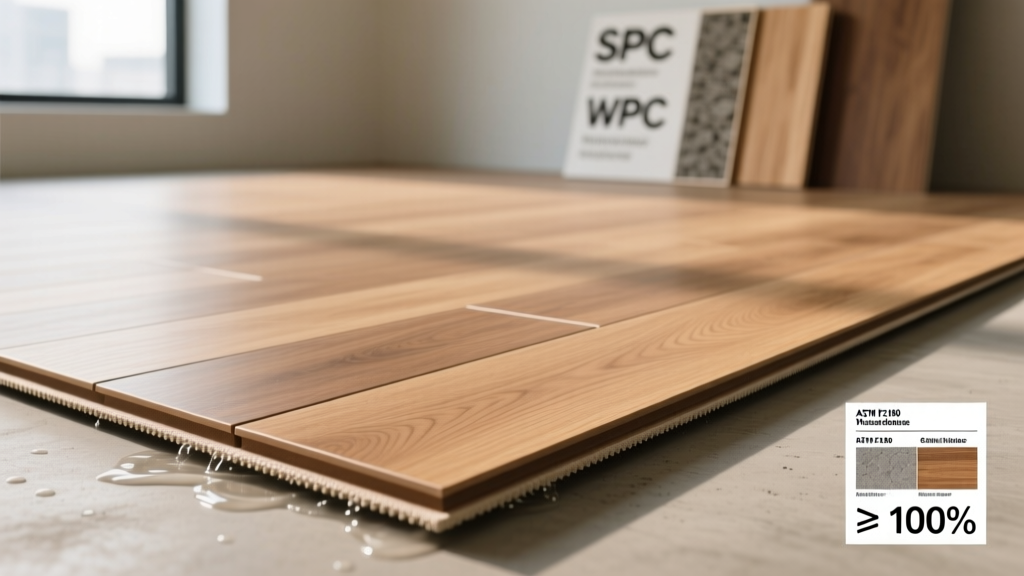
The term "waterproof" is heavily leveraged in modern flooring marketing, but for architects, contractors, and facility managers, it requires strict technical qualification. When evaluating luxury vinyl plank flooring waterproof claims, professionals must look beyond surface-level warranties and examine core density, dimensional stability metrics, and locking mechanism tolerances. A plank that will not absorb water is not inherently immune to moisture-related system failure if the subfloor emits vapor or if hydrostatic pressure compromises the seams.
Core Material Specifications: SPC vs. WPC Density and Stability
The structural integrity of any rigid core luxury vinyl plank (LVP) under wet conditions is dictated by its composite makeup. The industry primarily relies on two extruded cores: Stone Plastic Composite (SPC) and Wood Plastic Composite (WPC).
Stone Plastic Composite (SPC)
SPC is engineered from a high-density blend of limestone powder (calcium carbonate), polyvinyl chloride (PVC) resin, and thermal stabilizers. The absence of foaming agents results in a highly compacted core with a specific gravity typically ranging from 1.8 to 2.0 g/cm³. This extreme density grants SPC superior dimensional stability. Under the EN 651 testing standard for dimensional stability, high-grade SPC exhibits a length/width variation of less than 0.05% when subjected to extreme temperature and humidity fluctuations. This makes SPC the mandatory specification for environments with direct UV exposure combined with high moisture, such as sunrooms or enclosed patios.
Wood Plastic Composite (WPC)
WPC incorporates a foaming agent into the PVC and limestone matrix, creating microscopic air pockets that lower the core density to approximately 0.9 to 1.1 g/cm³. While this provides superior underfoot comfort and acoustic dampening, the cellular structure makes WPC slightly more susceptible to thermal expansion. In continuous wet environments with high ambient heat (e.g., commercial locker rooms), WPC can exhibit expansion rates up to 0.12%, which may stress the mechanical locking systems over time.
Decoding Industry Moisture & Absorption Standards
True waterproof performance is quantified through standardized laboratory testing, not marketing literature. The primary benchmark for material water resistance is ASTM D570 (Standard Test Method for Water Absorption of Plastics).
While the core resists absorption, the wear layer dictates the floor's ability to resist surface moisture degradation and chemical cleaners. For wet areas, specify a minimum 20-mil (0.5mm) urethane or ceramic-bead reinforced wear layer. Thinner 12-mil residential layers are prone to micro-scratching, which can trap moisture and harbor bacterial growth in commercial wet environments.
Core Performance Matrix
| Specification Metric | SPC (Stone Plastic Composite) | WPC (Wood Plastic Composite) |
|---|---|---|
| Core Density (g/cm³) | 1.80 - 2.00 | 0.90 - 1.10 |
| Dimensional Stability (EN 651) | ≤ 0.05% | ≤ 0.12% |
| Water Absorption (ASTM D570) | < 0.05% | < 0.10% |
| Impact Resistance (ASTM F2266) | High (Dent resistant) | Moderate (Prone to deep dents) |
| Best Application | Commercial wet areas, high UV | Residential bathrooms, basements |
The Weak Link: Locking Mechanisms and Edge Swelling
The most common point of failure in a "waterproof" LVP installation is not the plank itself, but the seam. Water ingress through the joints leads to subfloor mold, adhesive degradation, and edge-curling. Modern mechanical locking systems, such as Valinge 5G or Unilin, utilize precision-milled tongue-and-groove profiles. However, standard milled PVC edges are not inherently watertight.
To achieve true surface-water resistance, specify planks that feature a factory-applied hydrophobic edge seal. Some premium manufacturers apply a thermoplastic polyurethane (TPU) or silicone-based micro-coating to the locking profiles during extrusion. This creates a capillary break that prevents surface water from wicking into the seam via surface tension. When specifying for commercial restrooms or healthcare facilities, mandate an integrated hydrophobic seam seal or require the installer to apply a liquid seam sealer (such as a proprietary polyurethane joint compound) during installation.
Subfloor Moisture Emission and Hydrostatic Pressure
A critical misunderstanding in the industry is that waterproof LVP can be installed over damp concrete without mitigation. While the LVP will not degrade, trapping moisture against a concrete slab creates severe secondary issues. According to the EPA's guidelines on moisture control, trapping vapor against organic or semi-permeable subfloor materials can lead to rapid mold proliferation and the breakdown of underlying adhesives.
Furthermore, hydrostatic pressure from below can physically push LVP planks apart. If a below-grade basement experiences seasonal water table rises, the resulting upward pressure can exceed the tensile strength of the mechanical locking system, causing the seams to unzip. In below-grade applications with a history of hydrostatic pressure, a dimpled subfloor membrane or a fluid-applied vapor barrier is mandatory to relieve pressure before the LVP is laid.
Alkaline Degradation Risks
When moisture migrates through concrete, it carries alkaline salts (calcium hydroxide). If this moisture pools beneath the LVP, the high pH levels (often exceeding 11.0) will saponify and destroy any pressure-sensitive adhesives used at the perimeter or on stairs. Always pair moisture-prone concrete installations with a 100% solids epoxy primer to lock down alkalinity.
Specification Checklist for High-Moisture Environments
Use this precise framework when drafting project specifications for areas subject to standing water, high humidity, or frequent wet cleaning:
- Core Type: Specify SPC with a minimum density of 1.9 g/cm³ for maximum dimensional stability.
- Thickness: Minimum 5.0mm total plank thickness (including a 4.0mm core and 1.0mm attached acoustic pad).
- Wear Layer: 20-mil minimum, featuring a ceramic bead or aluminum oxide finish to resist chemical cleaning agents.
- Seam Technology: Require factory-applied hydrophobic edge coating on the mechanical lock.
- Subfloor Prep: Mandate ASTM F2170 RH testing (max 80%) and ASTM F3191 pH testing (max 9.0) prior to installation.
- Perimeter Sealing: Require a 100% silicone bead at all wall transitions, doorways, and plumbing penetrations to prevent surface water from migrating under the floating floor.
By shifting the focus from superficial marketing claims to verifiable ASTM standards, core densities, and locking mechanics, specifiers can ensure that luxury vinyl plank flooring performs flawlessly in demanding wet environments over its entire lifecycle.