Best Soft Waterproof Material Options for Flexible Roofs 2026
Reviewing the best soft waterproof material options for flexible roofs in 2026. Compare EPDM, TPO, and liquid polyurethane costs, specs, and failure modes.

Defining Soft Waterproof Materials in Modern Construction
In structural waterproofing, the term soft waterproof material refers to elastomeric and thermoplastic membranes that maintain high flexibility, low Shore A hardness (typically 50-80A), and extreme elongation at break (>200%). Unlike rigid cementitious coatings or hot-applied modified bitumen, soft materials accommodate structural settling, thermal expansion, and joint movement without cracking. According to the Whole Building Design Guide (WBDG), single-ply and liquid-applied soft membranes dominate the low-slope roofing and plaza deck markets due to their superior ability to bridge dynamic cracks.
This 2026 product review evaluates the three most reliable soft waterproofing systems on the market: EPDM rubber sheets, liquid-applied polyurethane elastomers, and TPO thermoplastic membranes. We analyze real-world pricing, installation tolerances, and specific failure modes to help contractors and architects specify the right material for flexible substrates.
Product Review 1: Elevate (formerly Firestone) EPDM RubberGard
EPDM (Ethylene Propylene Diene Monomer) remains the benchmark for soft sheet waterproofing. The Elevate RubberGard series, available in 45-mil and 60-mil thicknesses, is a fully vulcanized, cross-linked rubber membrane. Its molecular structure lacks double bonds in the polymer backbone, granting it exceptional resistance to UV radiation and ozone degradation.
Performance and Elongation Characteristics
The 60-mil RubberGard membrane exhibits an elongation at break exceeding 300% before curing, and retains over 200% after years of weathering. This makes it an ideal soft waterproof material for structures prone to micro-movements, such as timber-frame commercial buildings or steel-deck warehouses. However, EPDM is highly susceptible to puncture. If installed over rough concrete or irregular substrates, a protective separation layer (like a 1/4-inch asphaltic protection board) is mandatory.
Seam Integrity: The Primary Failure Point
The membrane itself rarely fails; the seams do. Traditional liquid contact adhesives degrade under prolonged UV exposure and ponding water. For 2026 installations, manufacturers strongly recommend using self-adhering butyl seam tapes (such as QuickSeam Splice Tape) paired with a specialized EPDM primer. This creates a chemical cross-link at the overlap, transforming two separate sheets into a single continuous soft membrane.
- Unmatched UV and ozone resistance
- Remains highly flexible at -40°F
- Material cost is highly competitive
- Poor resistance to hydrocarbon oils and grease
- Black variants contribute to urban heat island effect
- Seam prep is labor-intensive
Product Review 2: Sika Sikalastic-618 Polyurethane Liquid Membrane
When dealing with complex geometries, penetrations, or irregular parapets, sheet goods become difficult to detail. Sika Sikalastic-618 is a single-component, moisture-cured polyurethane that cures into a seamless, highly elastic soft waterproof coating. It bridges the gap between liquid coatings and sheet membranes by building significant mil thickness in a single pass.
Curing Profile and Substrate Sensitivity
Sikalastic-618 cures by reacting with ambient humidity. While this eliminates the need for mixing two components, it introduces a critical edge case: outgassing. If applied over damp concrete (moisture content >4%) or green concrete that is still off-gassing moisture, the chemical reaction generates carbon dioxide bubbles, resulting in pinholes that compromise the waterproofing layer. Substrate moisture testing via a calcium chloride test (ASTM F1869) is non-negotiable before application.
Pricing and Coverage Rates
Liquid polyurethanes are premium products. Expect material costs to range from $2.80 to $3.50 per square foot, depending on the required dry mil thickness. For standard plaza decks, a 60-mil wet application (yielding roughly 45 dry mils) is standard. To achieve this, contractors typically apply a primer coat followed by two heavy topcoats, embedding a fiberglass reinforcement mat in the first topcoat to increase tensile strength.
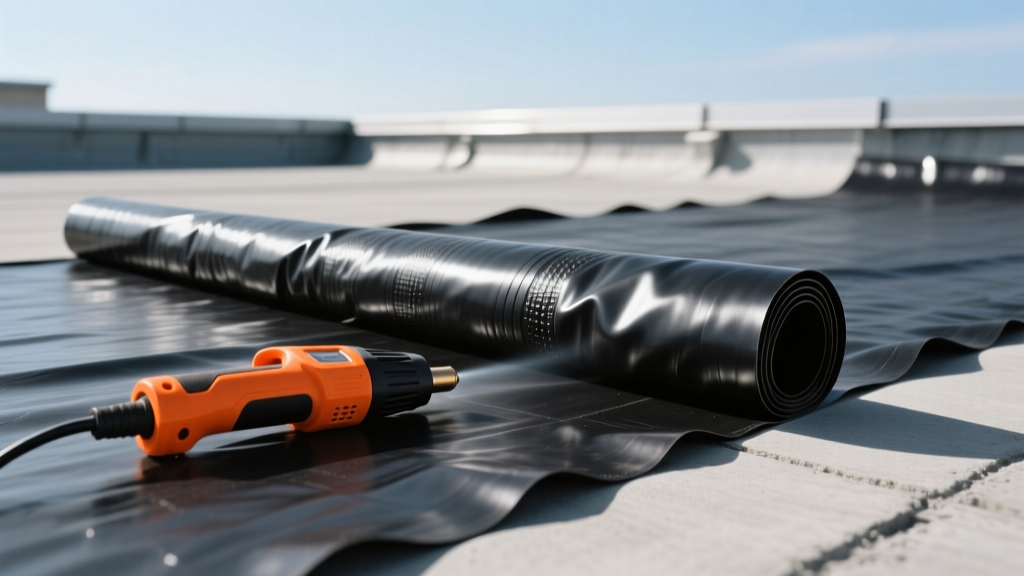
Product Review 3: GAF EverGuard 60-mil TPO
Thermoplastic Polyolefin (TPO) is a blend of polypropylene and ethylene-propylene rubber. GAF EverGuard 60-mil is a reinforced TPO membrane that offers the soft flexibility of rubber with the heat-weldable seams of thermoplastics. The U.S. Department of Energy heavily promotes white TPO membranes for their high solar reflectance index (SRI), which significantly reduces cooling loads in commercial buildings.
Heat-Welded Seams vs. Adhesives
Unlike EPDM, TPO seams are fused using hot air welders operating at 1,000°F to 1,200°F. This creates a monolithic, homogenous seam that is actually stronger than the membrane itself. However, this requires specialized equipment and trained operators. Ambient temperature dictates the welder speed and heat settings; welding in temperatures below 40°F requires pre-heating the membrane edges to prevent cold-weld fractures.
Comparative Matrix: Soft Membrane Specifications
The following table contrasts the physical properties and 2026 market pricing of these three leading soft waterproof materials. Pricing reflects material-only costs for commercial-scale projects (10,000+ sq ft) and excludes insulation, fasteners, and labor.
| Material | Thickness | Tensile Strength | Elongation | Cost / Sq Ft |
|---|---|---|---|---|
| EPDM (Elevate RubberGard) | 60 mil | 1,300 psi | > 300% | $0.85 - $1.15 |
| Polyurethane (Sikalastic-618) | 45 dry mil | 1,500 psi | > 450% | $2.80 - $3.50 |
| TPO (GAF EverGuard) | 60 mil | 3,500 psi (reinforced) | > 250% | $0.95 - $1.40 |
Substrate Preparation and Edge Cases
The performance of any soft waterproof material is entirely dependent on the substrate preparation. Soft membranes possess low puncture resistance compared to rigid systems. Applying these materials directly over rough concrete, exposed aggregate, or poorly secured polyiso insulation boards will result in immediate mechanical failure.
Managing Ponding Water
While EPDM and liquid polyurethanes are highly resistant to continuous water immersion, TPO membranes can suffer from plasticizer migration and biological growth (algae/mold) under constant ponding water. The National Roofing Contractors Association (NRCA) recommends designing roof decks with a minimum slope of 1/4 inch per foot to ensure positive drainage. If structural re-sloping is impossible, specify a tapered insulation system beneath the soft membrane to direct water to scuppers or internal drains.
Thermal Shock and Membrane Shrinkage
Non-reinforced soft materials, particularly older formulations of EPDM and unreinforced PVC, are prone to thermal shrinkage over time. As the membrane shrinks, it pulls away from parapet walls and rooftop curbs, causing the most common leak points in commercial roofing. Always specify reinforced soft membranes (scrim-backed EPDM or polyester-reinforced TPO) for fully adhered applications to lock in dimensional stability and prevent edge retraction.
Final Sourcing and Specification Recommendations
Selecting the correct soft waterproof material requires matching the membrane's chemical and physical properties to the specific environmental and structural demands of the project:
- Choose EPDM for unheated warehouses, structures in extreme cold climates, or projects where UV resistance is the primary concern and budget constraints are tight.
- Choose Liquid Polyurethane for complex plaza decks, podiums with hundreds of pipe penetrations, or retrofit projects where removing existing flashings is cost-prohibitive.
- Choose TPO for climate-controlled commercial buildings, LEED-certified projects requiring high solar reflectance, and applications where heat-welded seam integrity is paramount.
Always verify that the selected soft waterproof material carries a current ICC-ES Evaluation Report and complies with local building codes for wind uplift resistance (FM 1-90 or higher) in your specific geographic wind zone.
Written by
Sarah WhitfieldSarah Whitfield is a chartered quantity surveyor (MRICS) and construction cost analyst with 15 years of experience in material pricing, procurement strategy, and project budgeting. She earned her degree in Construction Management from the University of Reading (UK) and has worked on projects ranging from $2M custom homes to $180M mixed-use developments across North America and Europe. Sarah currently leads cost estimating for BuildMat Insight, maintaining a proprietary database of 4,000+ material price points updated quarterly. She is a frequent contributor to RSMeans cost data panels and has presented at the International Cost Engineering Council (ICEC) congress. Based in Denver, CO, Sarah is an avid trail runner and volunteer mentor for Women in Construction.
More from Sarah Whitfield
View all
Wood & Lumber
What Are the Different Types of Wood? A Builder's Guide
Compare structural softwoods, finish hardwoods, and engineered lumber. Analyze Janka ratings, MOE values, and 2026 pricing for construction.
Aug 4, 2026

Walls & Panels
Steel Framing vs Wood Framing: Corrosion and Moisture Defense
Compare steel framing vs wood framing for moisture resistance. Learn about galvanized coatings, condensation risks, and corrosion protection strategies.
Jul 21, 2026

Stone & Masonry
How to Cut Stone Veneer: Wet Saw vs Grinder Comparison
Compare the best tools for cutting stone veneer. We review wet saws, angle grinders, and chop saws to help you achieve clean, chip-free cuts.
Jul 21, 2026