Choosing the Best Waterproof Shower Material for Tile and Stone
Compare the best waterproof shower material options. Expert analysis of liquid membranes, sheet systems, and foam boards for tile and stone installations.

The Hidden Cost of Shower Waterproofing Failures
A failed shower pan or wall membrane does not just ruin a tile installation; it compromises the structural framing, breeds toxic mold, and costs an average of $10,000 to remediate. Selecting the correct waterproof shower material is the single most critical decision in a bathroom build. Tile and grout are not waterproof; they are merely the wear surface. The membrane beneath them is the actual waterproofing envelope.
This guide cuts through marketing claims to evaluate the three primary categories of waterproof shower materials—liquid-applied elastomerics, fleece-backed sheet membranes, and extruded polystyrene (XPS) foam boards—based on permeability, application tolerances, and real-world failure modes.
Material Classification and Permeability Standards
Not all waterproofing materials are created equal, particularly when steam is introduced. According to the Tile Council of North America (TCNA) Handbook, a standard shower requires a membrane with a water vapor permeance of 1.0 perm or less. However, continuous-use steam showers demand a much stricter rating of 0.5 perms or less to prevent vapor from migrating into the wall cavity and condensing on cold exterior sheathing.
| Material Type | Popular Examples | Vapor Permeance | Material Cost (per sq ft) | Cure/Ready Time |
|---|---|---|---|---|
| Liquid-Applied | Laticrete Hydro Ban, Mapei AquaDefense | 0.5 - 1.2 perms | $1.50 - $2.50 | 2 - 24 hours |
| Sheet Membrane | Schluter Kerdi, NobleSeal TS | 0.1 - 0.5 perms | $2.50 - $4.00 | Immediate |
| XPS Foam Board | Wedi Building Panel, Johns Manville GoBoard | 0.3 - 0.5 perms | $6.00 - $9.00 | Immediate |
Liquid-Applied Membranes: The Chemistry of Mil Thickness
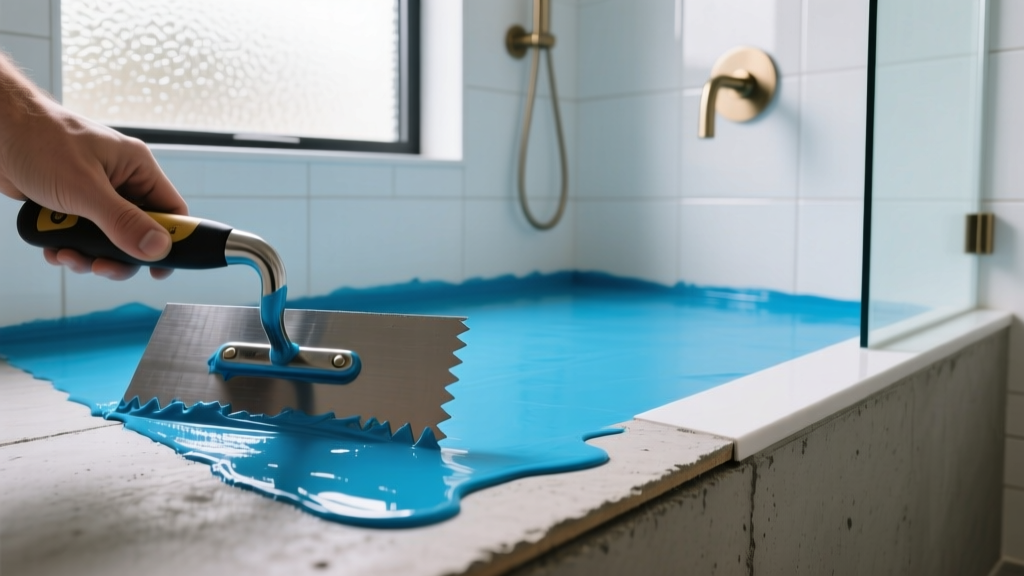
Liquid-applied membranes, such as Laticrete Hydro Ban and Custom Building Products RedGard, are favored for their ability to conform to complex geometries, niches, and curved benches. They form a seamless, monolithic elastomeric barrier. However, their primary failure point is human error during application.
Pros and Cons of Liquid Elastomerics
- Pro: Seamless integration with complex drains and irregular corners without folding or bunching.
- Pro: Lower upfront material cost compared to foam systems.
- Con: Highly dependent on installer technique and ambient humidity for proper curing.
- Con: Requires a 24-hour flood test before tiling can commence, delaying project timelines.
Sheet Membranes and Foam Boards: The Fast-Track Route
Sheet membranes and XPS foam boards eliminate the curing variables associated with liquids. Products like the Schluter Kerdi Shower System utilize a pliable polyethylene core with a specialized fleece webbing on both sides, allowing it to bond directly to the substrate and the tile thinset simultaneously.
Foam boards (such as Wedi or GoBoard) take this a step further by combining the structural substrate, insulation, and waterproofing into a single panel. These are particularly advantageous in exterior wall applications where thermal bridging and condensation are concerns.
The Weak Links in Sheet and Foam Systems
While the field of a sheet membrane is virtually indestructible, the seams and penetrations are where leaks occur. When using fleece-backed sheets, the mandatory 2-inch overlap must be fully encapsulated in unmodified thinset (ANSI A118.4 or A118.1, depending on manufacturer specifications). Starved joints—where too much thinset is squeezed out during embedding—create direct pathways for water.
For XPS foam boards, the fasteners used to secure the panels to the studs puncture the waterproof core. Installers must meticulously apply proprietary sealant (e.g., Wedi 620) over every single washer and screw head. Missing a single fastener seal compromises the entire envelope.
Actual Failure Modes: Why Showers Leak
Understanding how waterproof shower materials fail in the field allows you to preemptively engineer them out of your build. The most common catastrophic failures include:
- Weep Hole Clogging in Mortar Beds: If using a traditional pre-sloped mortar bed with a liquid or sheet liner, the weep holes in the clamping drain must be protected with a weep hole protector and gravel pack. Without this, fine mortar particles clog the weep holes, causing the mortar bed to become a permanent water sponge, leading to efflorescence and bacterial growth.
- Puncture During Tile Setting: Installers using the flat edge of a steel trowel to beat in large-format porcelain tiles can easily slice through thin liquid membranes or puncture sheet membranes. A U-notched trowel and a soft rubber float are mandatory for setting tile over delicate waterproofing layers.
- Picture Framing: When natural stone (like marble or travertine) is installed over a non-breathable waterproof membrane, moisture from the thinset cannot escape downward. It migrates to the edges of the stone, creating dark, permanent halos known as picture framing. For natural stone, a vapor-permeable membrane or a specialized setting bed is required.
2026 Cost Breakdown: Material and Labor Estimates
The following estimates reflect current market pricing for a standard 36-inch by 60-inch alcove shower (approximately 90 square feet of wall and pan area). Labor rates are based on national averages for licensed tile contractors.
| System Type | Material Cost (90 sq ft) | Labor Cost (Installation) | Total Estimated Cost |
|---|---|---|---|
| Liquid-Applied (e.g., Hydro Ban) | $180 - $225 | $450 - $600 | $630 - $825 |
| Sheet Membrane (e.g., Kerdi) | $270 - $360 | $600 - $850 | $870 - $1,210 |
| XPS Foam Board (e.g., Wedi) | $650 - $810 | $500 - $700 | $1,150 - $1,510 |
Expert Decision Framework: Which Material Fits Your Build?
Do not select a waterproof shower material based solely on budget. Use this decision matrix to align the material properties with your specific project parameters.
If you are building a Continuous-Use Steam Shower:
Choose: Fleece-backed sheet membranes (Schluter Kerdi) or PVC/CPE pan liners with a secondary vapor barrier. Avoid standard liquid-applied membranes unless the manufacturer explicitly certifies a perm rating below 0.5 for continuous steam exposure.
If you are installing Large-Format Porcelain on Curved Walls:
Choose: Liquid-applied elastomerics. Sheet membranes cannot compound-curve without creating bulky folds that prevent thinset adhesion and create lippage in the tile above.
If you are on a Strict Timeline (Commercial or Flip):
Choose: XPS Foam Boards or Sheet Membranes. Because there is no liquid cure time or mandatory 24-hour flood test delay, you can begin setting tile the exact same day the panels are seamed and sealed.
If you are using Natural Stone (Marble, Limestone):
Choose: A traditional mortar bed with a CPE liner, or consult the stone supplier. Trapping moisture against the back of calcium-based stones with an impermeable membrane will cause severe discoloration and spalling over time.
Ultimately, the best waterproof shower material is the one that matches your substrate, your tile choice, and your installer's verified expertise. A perfectly applied liquid membrane will always outperform a poorly seamed sheet system, and vice versa. Prioritize the integrity of the seams, the precision of the mil thickness, and strict adherence to the manufacturer's thinset requirements to ensure a lifetime of leak-free performance.
Written by
Marcus ChenMarcus Chen is a licensed structural engineer (PE) and building materials analyst with over 12 years of experience across residential, commercial, and industrial construction. He holds a Master of Science in Civil Engineering from UC Berkeley and spent six years at Thornton Tomasetti before transitioning to independent consulting and technical writing. Marcus specializes in material selection for seismic-prone regions, concrete reinforcement strategies, and lifecycle cost analysis. His work has been cited by the American Concrete Institute (ACI) and the Structural Engineers Association of California (SEAOC). When he is not on a job site or at his desk, you will find him hiking the Sierra Nevada or restoring a 1920s craftsman bungalow in Oakland, CA.
More from Marcus Chen
View all
Construction Cost
How Much Did the Eiffel Tower Cost to Build?
How much did the Eiffel Tower cost to build in 1889? We adjust for inflation and compare its budget to modern skyscraper construction.
Aug 4, 2026

Fire Resistance
What Is a Fire Resistant Material? Testing & Certification Guide
Discover what is a fire resistant material through ASTM and UL testing. Learn how fire ratings, certifications, and assemblies work in construction.
Aug 4, 2026

Construction Cost
How Much Did the Burj Khalifa Cost to Build?
How much did the Burj Khalifa cost to build? We break down the $1.5B project and extract 5 money-saving strategies for your next build.
Jul 30, 2026