Roof Waterproofing Systems: How to Match Materials to Your Scenario
Learn how to match roof waterproofing materials to specific building scenarios. Compare TPO, PVC, EPDM, and liquid membranes for optimal performance.
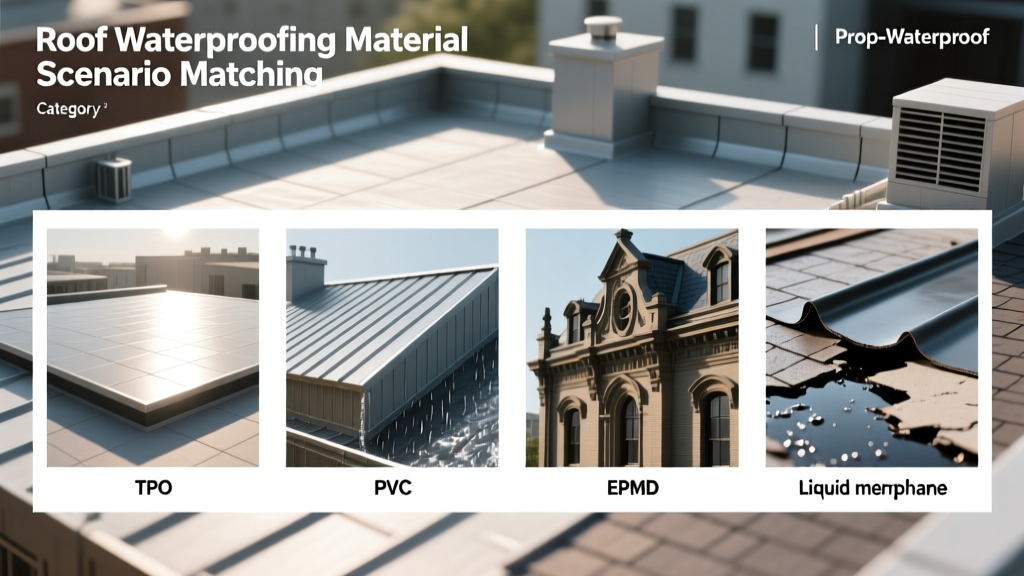
The Cost of Mismatched Roof Waterproofing Systems
Selecting a roof waterproofing membrane based solely on initial material cost is the primary driver of premature building envelope failure. A material that performs flawlessly on a simple, unobstructed warehouse roof will rapidly degrade when subjected to the chemical exhaust of a restaurant kitchen or the hydrostatic pressure of a plaza deck. Proper application-fit requires matching the membrane's chemical, thermal, and mechanical properties to the specific environmental and structural demands of the building.
This guide breaks down four distinct roofing scenarios and identifies the exact material specifications, thicknesses, and installation methods required to achieve a 20- to 30-year service life in current 2026 building environments.
Scenario 1: Low-Slope Commercial Roofs with High Foot Traffic
For standard commercial facilities with regular HVAC maintenance traffic, single-ply thermoplastic membranes are the industry standard. However, the choice between TPO (Thermoplastic Polyolefin) and PVC (Polyvinyl Chloride) must be dictated by the building's exhaust profile.
When to Specify TPO
TPO is highly resistant to UV degradation and offers excellent reflectivity. For standard applications, a 60-mil mechanically attached TPO is sufficient. However, if the roof is located in a region with severe hail or experiences heavy maintenance traffic, upgrade to an 80-mil fleece-backed TPO (such as Carlisle Sure-Weld FleeceBACK). The fleece backing provides puncture resistance and allows for direct adhesion to rough substrates like polyiso insulation without requiring a separation layer.
When to Specify PVC
If the building houses restaurants, laboratories, or manufacturing facilities that vent animal fats, vegetable oils, or chemical solvents onto the roof, TPO will rapidly soften and fail. PVC membranes (like Sarnafil S3015) are inherently resistant to grease and chemical plasticizer migration. Specify a minimum 60-mil PVC with hot-air welded seams. Unlike TPO, PVC seams actually become stronger than the membrane itself when properly welded at 1000°F to 1100°F.
Scenario 2: Complex Geometries and Dense Penetrations
When a roof features dozens of pipe penetrations, irregular parapets, skylights, and tight HVAC curbs, cutting and seaming single-ply sheets becomes a massive liability. Every seam is a potential leak path. In these scenarios, liquid-applied membranes provide a monolithic, fully adhered waterproofing layer that conforms to any geometry.
PMMA vs. Polyurethane Systems
- PMMA (Polymethyl Methacrylate): Ideal for fast-track projects and cold-weather applications. PMMA systems (e.g., Kemper System) cure in 30 to 45 minutes and can be applied in temperatures as low as 20°F (-6°C). They emit a strong odor during application but offer exceptional UV stability without a topcoat.
- Aromatic Polyurethane: Better suited for budget-conscious projects where UV exposure is minimal (e.g., covered terraces or protected membrane roofs). If exposed to sunlight, an aliphatic polyurethane topcoat is mandatory to prevent chalking and degradation.
Application Tip: Liquid systems require strict moisture testing of the concrete substrate before application. Use a calcium chloride test (ASTM F1869) to ensure moisture vapor emission rates are below 3 lbs per 1,000 sq ft per 24 hours to prevent blistering.
Scenario 3: Extreme Temperature Swings and Ponding Water
Thermoset membranes and modified bitumen excel in environments where the roof experiences drastic thermal cycling or where poor drainage leads to chronic ponding water.
EPDM (Ethylene Propylene Diene Monomer)
EPDM remains highly flexible in sub-zero temperatures, making it a top choice for northern climates. However, its primary vulnerability lies in the seams. While 60-mil black EPDM is highly durable, the traditional tape seams can fail over time due to thermal expansion and contraction. To mitigate this, specify hot-air welded EPDM or use liquid-applied sealants at all T-joints and cross-seams. According to the National Roofing Contractors Association (NRCA), proper detailing of flashings and seams is the single most critical factor in EPDM longevity.
Hot-Applied SBS Modified Bitumen
For roofs with heavy ponding water, a two-ply SBS (Styrene-Butadiene-Styrene) modified bitumen system torch-applied over a fiberglass base sheet provides unmatched redundancy. The torch-application melts the asphalt, creating a monolithic bond to the substrate that water cannot penetrate, even if it sits for weeks.
| Feature | 60-Mil EPDM | 2-Ply SBS Mod-Bit |
|---|---|---|
| Ponding Water Resistance | Moderate (Seam vulnerability) | Excellent (Monolithic bond) |
| Cold Weather Flexibility | Superior (-40°F) | Good (-20°F) |
| Installation Method | Fully Adhered or Ballasted | Torch-Applied or Hot Mop |
| Puncture Resistance | Low to Moderate | High |
Scenario 4: Green Roofs and Plaza Decks (Inverted Membranes)
When the waterproofing layer is buried beneath soil, pavers, or vegetation, it must withstand hydrostatic pressure, root penetration, and constant moisture. Single-ply membranes are generally unsuitable here due to the risk of seam failure under continuous submersion.
The gold standard for plaza decks and intensive green roofs is hot-applied fluid rubberized asphalt (e.g., Hydrotech MM6125). This system is applied at 350°F to 400°F in a thick, monolithic layer (typically 180 to 215 mils) directly to the concrete structural deck. It possesses self-healing properties; if a minor crack develops in the concrete substrate, the rubberized asphalt stretches and seals the gap.
Financial Framework: Life-Cycle Cost vs. Initial Install
Matching the right material also means aligning with the owner's financial model. The table below outlines current installed cost ranges and expected lifespans to aid in capital planning.
| Material System | Installed Cost (per sq. ft.) | Expected Lifespan | Best Scenario Fit |
|---|---|---|---|
| 60-Mil TPO (Mechanically Attached) | $4.50 - $6.50 | 15 - 20 Years | Standard Warehouses, Big Box Retail |
| 60-Mil PVC (Fully Adhered) | $6.00 - $8.50 | 20 - 25 Years | Restaurants, Chemical Facilities |
| Liquid PMMA (Cold Applied) | $8.00 - $12.00 | 20 - 30 Years | Complex Penetrations, Balconies |
| Hot-Applied Rubberized Asphalt | $12.00 - $18.00 | 30 - 40+ Years | Plaza Decks, Intensive Green Roofs |
Critical Substrate Preparation Rules
No roof waterproofing material will perform to its engineered lifespan if the substrate is improperly prepared. Before any membrane is deployed, enforce the following site conditions:
- Moisture Content: Concrete decks must be cured for a minimum of 28 days and tested for moisture. Applying fully adhered membranes over damp concrete traps vapor, leading to massive blistering when the sun heats the roof.
- Surface Profile: For liquid-applied systems, the concrete must be shot-blasted or scarified to achieve a CSP (Concrete Surface Profile) of 3 to 5. Smooth troweled concrete will not provide adequate mechanical tooth for chemical adhesion.
- Insulation Fastening: When installing single-ply over polyiso insulation, ensure the insulation is fastened with plates and screws that penetrate the steel deck by at least 3/4 inch. Wind uplift forces will easily tear a membrane if the underlying insulation is not securely anchored.
By rigorously matching the membrane chemistry and installation method to the specific physical and environmental demands of the structure, facility managers and architects can eliminate premature leaks and maximize the return on their building envelope investment.