How to Fix Failing Waterproof Canvas Material: Leaks, Mold & DWR
Diagnose and fix failing waterproof canvas material. Learn expert troubleshooting for seam leaks, mildew, and DWR coating degradation on outdoor fabrics.

The Physics of Canvas Failure
Waterproof canvas material relies on two distinct moisture-blocking mechanisms, and troubleshooting requires identifying which system has failed. Traditional 100% cotton duck canvas utilizes a mechanical seal: the fibers swell when wet, closing the gaps in the weave. Modern synthetic canvases (polyester or nylon blends) and poly-cotton (TC) hybrids rely on chemical barriers, specifically a Durable Water Repellent (DWR) finish on the face and a Polyurethane (PU) or silicone coating on the interior. When these materials leak, the root cause is almost always a breakdown in one of these specific mechanisms. This guide provides field-tested, 2026-standard protocols for diagnosing and repairing the four most common canvas failures.
Diagnostic Matrix: Identifying Your Canvas Failure
Before applying any chemicals or sealants, perform a visual and tactile inspection to isolate the failure point. Use the matrix below to match your symptoms to the correct troubleshooting protocol.
| Symptom | Visual / Tactile Cue | Primary Culprit | Repair Protocol |
|---|---|---|---|
| Localized dripping at stitch lines | Water beads on fabric but seeps through thread holes | Capillary wicking / Thread degradation | Seam Sealing (Section 1) |
| Fabric 'wets out' and turns dark | Water stops beading; canvas feels heavy and saturated | DWR depletion from UV or abrasion | DWR Re-proofing (Section 2) |
| Black spots and musty odor | Fuzzy or powdery dark patches, often on shaded areas | Mildew feeding on cellulose or dirt | Biological Cleaning (Section 3) |
| Interior coating feels sticky or flakes | White or silver PU coating peels off when touched | Hydrolysis and UV degradation | Delamination Stripping (Section 4) |
Scenario 1: Seam Leaks and Pinhole Weeping
Even if the canvas fabric itself is perfectly waterproof, the manufacturing process creates thousands of vulnerabilities. Every time a sewing needle pierces the canvas, it leaves a micro-puncture. If the thread is standard poly-core cotton, it will act as a wick, drawing water through the needle hole via capillary action. High-end marine canvas uses PTFE thread (like Tenara), which is impervious to rot and wicking, but standard awnings and tents use threads that eventually degrade.
The Isopropyl Prep and Seal Method
Do not simply smear sealant over a dirty seam; it will delaminate within weeks. Follow this precise preparation sequence:
- Clean the Seam: Wipe the interior seam line with a lint-free cloth soaked in 70% or higher isopropyl alcohol. This removes manufacturing oils, dirt, and failing factory seam tape.
- Select the Correct Sealant: Match the sealant to the canvas coating. For PU-coated synthetic canvas, use Gear Aid Seam Grip FC (retailing around $9 per 2oz tube). For silicone-treated ripstop or specialized synthetic canvas, you must use Gear Aid Seam Grip SIL (~$11). Using PU sealant on silicone fabric will result in immediate peeling.
- Application: Apply a continuous 2mm bead over the stitch line. Use a disposable foam brush or a gloved finger dipped in soapy water to push the sealant into the needle holes. Allow 24 hours to cure in a low-humidity environment.
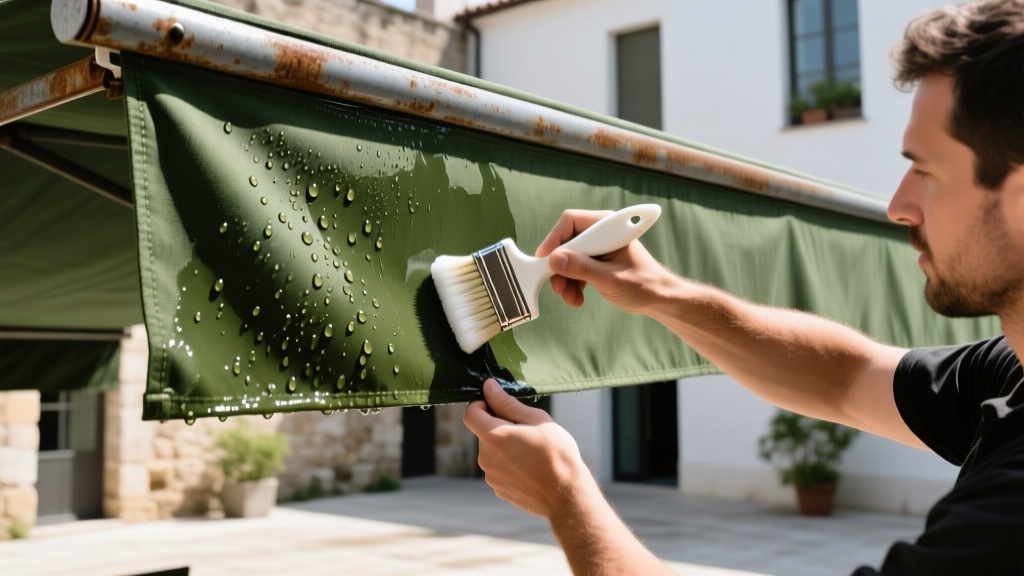
Scenario 2: DWR Depletion and 'Wet-Out'
When water stops beading up and rolling off your canvas, the fabric is experiencing 'wet-out'. The face fabric is saturating with water. While the underlying PU coating might still be stopping water from entering the structure, a wet canvas awning can hold up to twice its dry weight in water, risking structural collapse or severe stretching. Furthermore, saturated canvas loses its breathability, leading to massive interior condensation.
Step-by-Step Re-proofing Protocol
To restore the hydrostatic head rating and beading effect, you must clean and re-treat the canvas while it is still in good structural condition.
- Step 1: Deep Cleanse. Use a technical, non-detergent cleaner like Nikwax Tech Wash. Apply with a soft-bristle brush in circular motions, focusing on high-abrasion areas. Rinse thoroughly with a low-pressure hose until the water runs completely clear.
- Step 2: Apply DWR (Cotton Canvas). For 100% cotton duck or poly-cotton blends, apply Nikwax Cotton Proof (~$12) while the fabric is still damp. This water-based fluorocarbon-free formula bonds to the cellulose fibers without blocking the fabric's natural breathability.
- Step 3: Apply DWR (Synthetic Canvas). For 100% polyester or acrylic marine canvases (like Sunbrella), use a solvent-based or advanced C0 repellent like 303 Marine Fabric Guard (~$28 for 16oz). Apply in two light, overlapping coats. A single heavy coat will pool and create stiff, white residue spots.
Scenario 3: Mildew and Biological Staining
Mildew is a fungal growth that feeds on the natural cellulose in cotton canvas, or on the organic dirt and pollen trapped in the weave of synthetic canvas. According to Penn State Extension, mildew can reduce the tensile strength of natural fibers by up to 30% if left untreated, leading to catastrophic tearing under wind loads.
'The most common mistake in canvas maintenance is the use of chlorine bleach to kill mildew. Bleach destroys cotton fibers at the molecular level, strips factory DWR coatings, and accelerates UV degradation. It is a net-negative for the lifespan of the material.' — National Park Service Textile Conservation Guidelines
The Enzyme and Vine Eradication Method
To kill the fungal root structure without damaging the canvas fibers or the PU backing, use a two-stage biological approach:
- Kill the Spores: Spray the affected area generously with distilled white vinegar or a specialized canvas-safe fungicide like Concrobium Mold Control (~$15/gallon). Avoid products containing sodium hypochlorite (bleach). Allow the solution to dwell for 15 minutes.
- Agitate and Lift: Scrub the area with a medium-stiff bristle brush and a solution of warm water and technical fabric cleaner. The mechanical agitation breaks up the mycelium network embedded in the weave.
- Sunlight Exposure: UV radiation is a natural fungicide. Allow the canvas to dry completely in direct sunlight. The EPA's Guide to Mold and Moisture emphasizes that rapid drying and moisture control are the only permanent preventatives for fungal regrowth.
Scenario 4: UV Degradation and Coating Delamination
If the interior of your canvas tarp, tent, or awning feels tacky, smells like old chemicals, or is flaking off in silver or white flakes, the PU coating is undergoing hydrolysis and UV degradation. This is a terminal failure for the coating itself, though the face fabric may still be structurally sound. No amount of DWR spray will fix a delaminating interior coating.
The Mineral Spirit Strip and Recoat
You must completely remove the failing PU layer before applying a new waterproof barrier.
- Stripping: Lay the canvas flat on a concrete surface. Apply odorless mineral spirits to a stiff scrub brush and vigorously scrub the flaking areas. The failing PU will dissolve into a gummy residue. Wipe it away with heavy-duty shop towels. (Ensure proper ventilation and wear nitrile gloves).
- Recoating: Once the fabric is stripped to the bare woven interior and fully dried, apply a liquid urethane coating like Gear Aid Tent Seal. Use a foam roller to apply a thin, even layer across the entire interior surface. This restores the hydrostatic barrier, though it will slightly reduce the fabric's breathability.
Proactive Maintenance Schedule
Preventative maintenance is significantly cheaper than structural repairs. Implement this bi-annual schedule to maximize the lifespan of your waterproof canvas material.
| Timeframe | Action Required | Materials Needed |
|---|---|---|
| Spring (Pre-Season) | Inspect seams, clean surface dirt, test DWR beading with a spray bottle. | Soft brush, mild soap, spray bottle. |
| Mid-Summer | Re-apply DWR to high-UV exposure areas (top ridges, south-facing slopes). | 303 Fabric Guard or Nikwax Cotton Proof. |
| Autumn (Post-Season) | Deep clean to remove organic matter (pollen, sap, bird droppings) that feeds mildew. | Nikwax Tech Wash, white vinegar. |
| Winter Storage | Ensure 100% dryness before folding. Store in a breathable cotton sack, never in a plastic bin. | Silica gel desiccant packets. |
By understanding the specific chemical and mechanical properties of your canvas, you can move beyond temporary patch jobs and execute permanent, professional-grade repairs that extend the material's operational life by years.
Written by
David NakamuraDavid Nakamura is a licensed architect (AIA) and construction technology writer focused on sustainable building methods, mass timber engineering, and high-performance building envelopes. He holds a Master of Architecture from the University of Washington and is a certified Passive House Consultant (CPHC). David spent eight years at the Seattle firm Mithun, where he led the design of three LEED Platinum projects, before founding his own practice specializing in net-zero residential design. He serves on the editorial advisory board of GreenBuilder Magazine and has authored peer-reviewed papers on cross-laminated timber (CLT) connections for the Journal of Structural Engineering. In his spare time, David teaches woodworking at Pratt Fine Arts Center and kayaks the Puget Sound.
More from David Nakamura
View all
Construction Cost
Labor Cost to Build a Deck Per Sq Ft: 2026 Installation Guide
Discover the exact labor cost to build a deck per sq ft in 2026. This installation guide breaks down contractor rates, complexity factors, and hidden fees.
Aug 4, 2026

Construction Cost
How Much Does It Cost to Build a 3 Bedroom House? Financing Guide
Learn exactly how much it costs to build a 3 bedroom house and explore 2026 financing options, construction loan types, and budget frameworks for your build.
Aug 4, 2026

Construction Cost
Cost to Build a Tennis Court: 2026 Guide
How much does it cost to build a tennis court in 2026? Breakdowns for asphalt, concrete, and synthetic surfaces plus fencing and lighting.
Jul 30, 2026