Waterproof Tape Performance Ratings & ASTM Specifications
Compare waterproof tape performance ratings, ASTM standards, and material specifications for flashing, roofing, and below-grade applications.
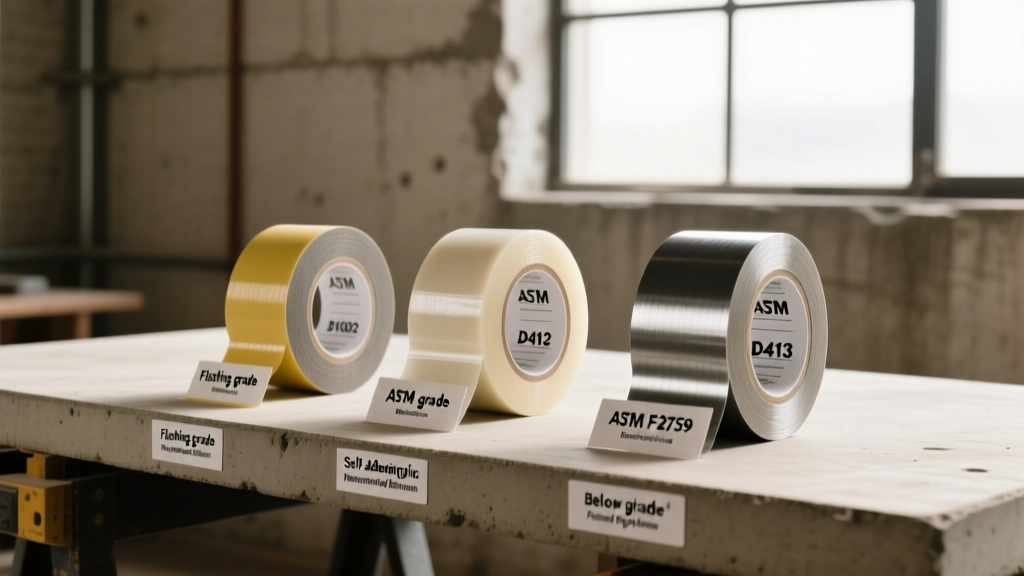
Core Material Chemistries: Butyl, Acrylic, and Bitumen
Selecting the correct waterproof tape requires moving beyond generic marketing claims and evaluating the underlying adhesive chemistry. The building envelope relies on three primary adhesive families for self-adhering flashing and sealing tapes, each with distinct thermal limits, UV resistance, and substrate compatibility profiles.
Butyl Rubber Adhesives
Butyl rubber tapes are non-curing, meaning they remain permanently pliable and tacky throughout their service life. This makes them exceptional for sealing dynamic joints that experience thermal expansion and contraction, such as metal-to-wood transitions or HVAC curb flashings. However, their permanent tackiness is a liability in exposed applications; they readily attract dust and debris, and they degrade rapidly under direct ultraviolet (UV) radiation unless covered. Butyl tapes typically maintain adhesion in service temperatures ranging from -40°F to 180°F (-40°C to 82°C). Because they do not cure hard, they can ooze or squeeze out when subjected to high compression loads in window rough openings.
Acrylic Pressure-Sensitive Adhesives (PSA)
Acrylic-based waterproof tapes represent the current industry standard for above-grade wall flashings and sheathing joint sealing. Unlike butyl, acrylic adhesives 'wet out' and cure slightly over time, increasing their ultimate holding power and shear resistance. They are inherently UV-stable, allowing for extended exposure windows (often 60 to 120 days) during construction delays. High-performance acrylic tapes, such as 3M All Weather Flashing Tape 8067, boast extreme service temperature ranges from -40°F to 240°F (-40°C to 115°C). The primary limitation of acrylics is their sensitivity to application conditions: they require firm mechanical pressure (a J-roller) to achieve initial adhesion and will fail if applied to frost-covered, heavily dusted, or actively wet substrates without a dedicated primer.
Polymer-Modified Bitumen (Asphalt)
Bituminous tapes, often modified with Styrene-Butadiene-Styrene (SBS) or Atactic Polypropylene (APP) polymers, are heavily utilized in below-grade applications, roofing valleys, and ice-and-water shields. They offer excellent self-sealing properties around mechanical fasteners and are highly cost-effective. However, unmodified or poorly modified bitumen becomes brittle at temperatures below 20°F (-6°C) and can soften, flow, and bleed through porous claddings (like fiber cement or light-colored stucco) when surface temperatures exceed 140°F (60°C). Crucially, bitumen is chemically incompatible with Expanded Polystyrene (EPS), Extruded Polystyrene (XPS), and EPDM rubber membranes, causing those materials to melt or degrade upon contact.
Governing ASTM and AAMA Testing Standards
Performance ratings for waterproof tapes are not arbitrary; they are dictated by rigorous laboratory testing protocols. Understanding these standards is critical for specifying tapes that meet local building codes, particularly in High-Velocity Hurricane Zones (HVHZ) or regions with severe freeze-thaw cycles.
AAMA 711-23 (Standard Specification for Self-Adhering Flashing Used for Installation of Exterior Wall Fenestration Products): This is the definitive standard for window and door flashing tapes. It categorizes tapes into three classes based on thickness and performance: Class A (minimum 40 mils), Class B (minimum 25 mils), and Class C (minimum 15 mils). Class A is typically mandated for commercial construction and coastal residential projects due to its superior puncture resistance and long-term hydrostatic head pressure tolerance.
For air and water barrier continuity, tapes are also evaluated under ASTM E2178 (Standard Test Method for Determining Air Leakage of Air Barrier Materials), which requires the material to demonstrate an air permeance not exceeding 0.02 L/s·m² at 75 Pa. When the tape is used to seal sheathing joints, the entire wall assembly is tested under ASTM E2357. Furthermore, roofing-specific waterproof tapes (ice and water shields) must comply with ASTM D1970, which specifically tests for nail sealability, low-temperature flexibility, and slip resistance under foot traffic.
Application-Specific Specifications and Product Data
The following matrix compares four high-performance waterproof tapes frequently specified in commercial and high-end residential envelopes, highlighting their specific chemistries, thicknesses, and ideal use cases.
| Product / Brand | Chemistry | Thickness (mils) | Min. Install Temp | Primary Application |
|---|---|---|---|---|
| ZIP System Flashing Tape | Acrylic | 38 mils | 25°F (-4°C) | Panel sheathing seams, window flanges (AAMA 711 Class B) |
| 3M All Weather 8067 | Acrylic | 35 mils | 0°F (-18°C) | Complex geometry, metal flashings, extreme cold installs |
| Sika SikaTape PRO | Acrylic | 20 mils | 14°F (-10°C) | Vapor-permeable WRB seams, interior air sealing |
| Grace Vycor Plus | Bitumen (SBS) | 40 mils | 40°F (4°C)* | Rough opening pans, masonry ties, below-grade transitions |
*Note: Bitumen-modified tapes like Vycor Plus require the substrate to be primed and the ambient temperature to be significantly higher than acrylics to ensure the adhesive flows into the substrate pores during installation.
Substrate Compatibility and Edge-Case Failures
The most common cause of waterproof tape failure is not a defect in the tape itself, but a chemical or physical incompatibility with the substrate. According to building envelope research published by Building Science Corporation, flashing failures frequently occur at material transitions where differential movement or chemical degradation compromises the adhesive bond.
Never apply asphalt/bitumen-based waterproof tapes directly to EPS, XPS, polyolefin, or EPDM roofing membranes. The volatile organic compounds (VOCs) and solvents in the bitumen will chemically attack and dissolve these plastics and synthetic rubbers, resulting in catastrophic membrane failure. Always use a butyl-based tape or a manufacturer-approved EPDM primer and splice tape for these substrates.
Common Field Failure Modes
- Bitumen Bleed-Through: Applying modified bitumen tapes behind light-colored fiber cement siding or natural stone veneer. Solar heat drives the asphalt oils through the weather-resistive barrier (WRB), staining the exterior cladding.
- Acrylic Adhesion Failure on OSB: Applying acrylic tapes to oriented strand board (OSB) that has high moisture content (>19%) or heavy surface dust from cutting. The adhesive bonds to the dust or water film rather than the wood fibers. Solution: Use a liquid-applied primer or sweep the surface thoroughly before taping.
- Butyl Compression Ooze: Using thick butyl tape in a window sill pan where the window frame exerts high point loads. The tape squeezes out of the joint, leaving voids that allow water infiltration.
Field Installation Parameters for Maximum Adhesion
To achieve the published performance ratings, waterproof tapes must be installed within strict environmental and mechanical parameters. The Whole Building Design Guide (WBDG) emphasizes that the continuity of the building envelope relies entirely on the workmanship of the membrane transitions.
- Surface Preparation: Substrates must be clean, dry, and free of frost. For masonry or concrete, ensure the surface is free of laitance and curing compounds, which act as bond-breakers.
- Temperature Acclimation: In cold weather (below 40°F / 4°C), store tape rolls in a heated environment (70°F) until immediately before use. Cold adhesive loses its initial tack and will not wet out properly on the substrate.
- Mechanical Pressure (The J-Roller Rule): Acrylic tapes require immediate, firm pressure to activate the adhesive. Use a hard rubber J-roller applying approximately 50 lbs of pressure, rolling from the center outward to eliminate air pockets and ensure full contact with the substrate texture.
- Shingling and Lapping: Always install horizontal tapes overlapping vertical tapes to maintain a shingle-lap configuration. Minimum side laps should be 2 inches, and end laps should be 6 inches, firmly rolled at the seams.
For comprehensive guidance on integrating these tapes into continuous control layers, refer to the U.S. Department of Energy's Building Envelope guidelines, which detail the hygrothermal modeling requirements for taped sheathing assemblies in mixed-humid and marine climates.