PVC Waterproof Material Guide: Thickness, Types & Costs
Compare PVC waterproof material options for flat roofs. Explore reinforced vs unreinforced membranes, mil thicknesses, and installation costs.

The Chemistry of PVC Waterproof Material
Polyvinyl Chloride (PVC) is inherently a rigid thermoplastic. To transform it into a flexible, high-performance PVC waterproof material suitable for low-slope and flat roofing, manufacturers compound the base resin with 20% to 30% plasticizers by weight. Historically, monomeric phthalates were used, but these are prone to extraction and migration over time, leading to membrane embrittlement. In 2026, top-tier manufacturers utilize advanced polymeric plasticizers. These larger molecular structures resist extraction from ponding water, chemical exposure, and contact with incompatible substrates, extending the functional lifespan of the membrane well beyond 25 years.
Furthermore, UV stabilizers—primarily titanium dioxide (TiO2)—are integrated into the top ply. TiO2 reflects solar radiation and protects the polymer chains from photodegradation, which is why high-quality PVC membranes are almost exclusively manufactured in white or light gray to maximize solar reflectance and minimize cooling loads in commercial buildings.
PVC and polystyrene (EPS/XPS insulation) are chemically incompatible. If a PVC membrane rests directly against polystyrene, the insulation will absorb the plasticizers from the PVC, causing the membrane to shrink, crack, and shatter within 2 to 3 years. Always specify a separation slip sheet (like a non-woven geotextile or fiberglass mat) when installing PVC over EPS or XPS insulation boards.
Reinforced vs. Unreinforced vs. Fleece-Backed
Selecting the correct structural configuration of your PVC waterproof material is dictated by the deck type, wind uplift requirements, and the complexity of roof penetrations. The industry categorizes these into three primary types under ASTM standards.
| Membrane Type | Composition | Tensile Strength | Primary Application |
|---|---|---|---|
| Type I (Unreinforced) | Homogeneous PVC, no scrim | Low (~90 lbf/in) | Flashings, pipe boots, inside/outside corners |
| Type II (Reinforced) | Polyester scrim encapsulated in PVC | High (>300 lbf/in) | Main field membrane, mechanically attached |
| Type III (Fleece-Back) | Reinforced PVC with polyester fleece backing | High (>300 lbf/in) | Fully adhered systems over concrete or rough decks |
Mil Thickness Selection Framework
The thickness of the PVC waterproof material, measured in mils (1 mil = 1/1000th of an inch), directly correlates to puncture resistance, hail durability, and overall longevity. While 45-mil membranes exist, they are increasingly viewed as inadequate for modern commercial demands.
Cost vs. Longevity Breakdown
- 45 Mil: The absolute minimum code requirement in some jurisdictions. Highly susceptible to puncture from dropped tools, foot traffic, and severe hail. Best for: Covered assemblies (like green roofs or ballasted systems) where UV and physical wear are mitigated. Material cost: ~$1.20 per sq. ft.
- 60 Mil: The undisputed commercial standard. Offers an optimal balance of puncture resistance (approx. 40 lbf) and weight. Handles standard maintenance foot traffic and moderate weather events. Best for: Standard exposed commercial flat roofs. Material cost: ~$1.65 per sq. ft.
- 80 Mil: Heavy-duty specification. Required in FM Global 1-90 wind uplift zones, severe hail regions (Class 4 impact rating), or roofs with high HVAC maintenance traffic. Best for: Critical infrastructure, hospitals, and extreme climate zones. Material cost: ~$2.30 per sq. ft.
Seam Integrity: Heat Welding Parameters
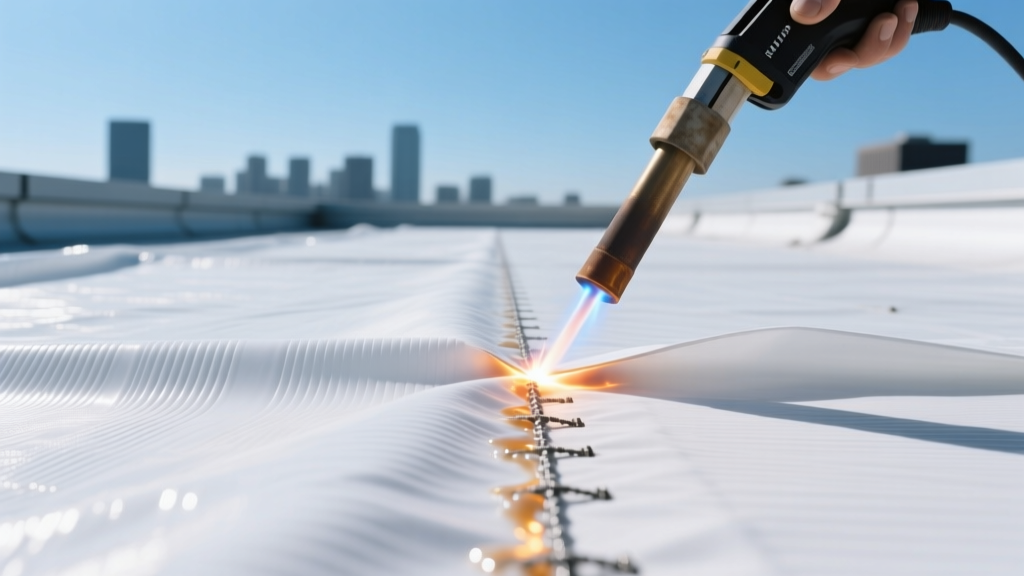
The greatest advantage of a PVC waterproof material is its seam strength. Unlike EPDM (which relies on adhesives or tape) or TPO (which can suffer from inconsistent melt temperatures), PVC is joined using hot air welding. This process melts the top and bottom sheets, fusing them into a monolithic, homogeneous layer that is physically stronger than the membrane itself.
"A PVC seam is only as strong as the surface preparation. Plasticizer exudation and environmental dust will cause false welds. Always wipe the seam overlap with a proprietary PVC cleaner and allow it to flash off before applying the heat nozzle."
— Senior Roofing Foreman, Commercial Single-Ply Division
Critical Welding Metrics:
- Temperature: Automatic welders must be calibrated between 900°F and 1100°F (480°C - 590°C) depending on ambient conditions.
- Speed: 10 to 15 feet per minute for automatic robotic welders; slower for hand-welding with a Leister Triac.
- Overlap: Minimum 1.5 inches for field seams.
- Testing: Every seam must be tested with a blunt cotter pin or specialized seam probe after cooling. If the pin catches or penetrates the edge of the weld, the seam must be cleaned and re-welded immediately.
Common Failure Modes and Edge Cases
Even premium PVC waterproof material will fail if installed incorrectly or subjected to incompatible environments. Understanding these edge cases prevents catastrophic warranty voids.
Warning: Asphalt and Coal Tar Incompatibility
PVC membranes cannot be installed directly over existing asphalt, coal tar pitch, or bitumen roofs. The hydrocarbons in these materials will migrate into the PVC, causing severe discoloration, plasticizer extraction, and premature membrane failure. A physical separation layer, such as a heavy-duty slip sheet or a fully adhered recovery board, is mandatory in re-cover scenarios.
Thermal Shrinkage Pull: While reinforced PVC (Type II) is highly dimensionally stable, poorly anchored perimeters can allow the membrane to shrink up to 1% over a decade. This shrinkage pulls the membrane taut, peeling flashings away from parapet walls or HVAC curbs. Always ensure perimeter securement plates are fastened at a maximum of 12 inches on center, and use termination bars with proper sealant at all vertical transitions.
2026 Pricing and Installation Costs
The total installed cost of a PVC roofing system fluctuates based on deck preparation, insulation thickness, and regional labor rates. The following table outlines average commercial pricing for a fully adhered 60-mil system over a concrete deck.
| Component | Cost per Sq. Ft. (Material) | Cost per Sq. Ft. (Installed) |
|---|---|---|
| 60-Mil Fleece-Back PVC Membrane | $1.85 - $2.15 | $4.50 - $5.50 |
| Polyiso Insulation (2 layers, staggered) | $1.20 - $1.60 | $2.00 - $2.50 |
| Low-VOC Adhesives & Primers | $0.40 - $0.60 | $0.80 - $1.10 |
| Flashings, Fasteners, & Accessories | $0.50 - $0.80 | $1.50 - $2.20 |
| Total System Estimate | $3.95 - $5.15 | $8.80 - $11.30 |
Verifying Industry Standards
When specifying a PVC waterproof material, ensure the product data sheet explicitly states compliance with current industry benchmarks. Do not accept generic claims of "waterproof" without verifiable testing data.
- ASTM D4434: The foundational standard for Poly(Vinyl Chloride) Sheet Roofing. Verify the product meets the latest revision for tensile strength, tear resistance, and artificial weathering. You can review the standard specifications via the ASTM D4434 documentation.
- FM Global & UL Approvals: For commercial properties requiring insurance compliance, the assembly must carry an FM 1-60 or 1-90 wind uplift rating, and a Class A fire resistance rating.
- CRRC Rating: Check the Cool Roof Rating Council database for the membrane's Solar Reflectance Index (SRI). High-quality white PVC maintains an SRI of 100+ when new, and >80 after three years of weathering.
For comprehensive installation guidelines and technical manuals regarding single-ply membranes, contractors and architects should consult the resources provided by the National Roofing Contractors Association (NRCA) and the Single-Ply Roofing Industry (SPRI). Proper specification and adherence to manufacturer-approved installation protocols are the only ways to secure a 20- or 30-year NDL (No Dollar Limit) warranty.
Written by
Priya KapoorPriya Kapoor is a real estate market analyst and construction economics researcher with expertise in housing affordability, development feasibility, and infrastructure investment. She holds a Master of Regional Planning from Cornell University and previously worked as a senior analyst at CBRE's Investment Properties group, where she modeled returns for $4B in mixed-use development pipelines. Priya now runs an independent research practice advising developers, municipalities, and REITs on construction cost forecasting and market timing. She publishes the quarterly "BuildMat Market Pulse" report tracking material price indices across 12 commodity categories. Based in Austin, TX, Priya serves on the board of Habitat for Humanity Austin and is a marathon runner.
More from Priya Kapoor
View all
Construction Cost
Cost to Build a 1600 Sq Ft Home in 2026: Full Breakdown
Accurate 2026 cost to build a 1600 sq ft home—material, labor, and regional pricing breakdowns included. Plan your budget with real-time estimates.
Aug 11, 2026

Wood & Lumber
Name the Types of Wood for Pressure Treatment and Preservation
Learn how to name the types of wood best suited for pressure treatment. Compare species treatability, chemical retention levels, and 2026 preservation costs.
Aug 4, 2026

Stone & Masonry
Stone Veneer Suppliers Lindenhurst: 2026 Cost Analysis
Analyze 2026 stone veneer costs in Lindenhurst, NY. Compare local supplier pricing, delivery fees, and Suffolk County installation labor rates.
Aug 4, 2026