Selecting the Best Waterproof Building Material for Foundations
Compare top waterproof building material options for below-grade foundations, including liquid membranes, bentonite clay, and dimple boards.

The Hidden Cost of Hydrostatic Pressure: Why Material Selection Matters
When specifying below-grade protection, the distinction between dampproofing and true waterproofing is the difference between a dry basement and a catastrophic structural failure. Dampproofing—typically a thin, unmodified asphalt spray applied at roughly $0.50 per square foot—only resists soil moisture vapor. It fails completely under hydrostatic pressure. A genuine waterproof building material must withstand a continuous column of water, bridge dynamic concrete cracks, and survive the mechanical abuse of backfilling.
In 2026, material science has advanced significantly, offering formulations that cure faster, self-heal punctures, and integrate seamlessly with drainage matrices. Selecting the right system requires matching the material's physical properties to your specific soil profile, water table depth, and structural design.
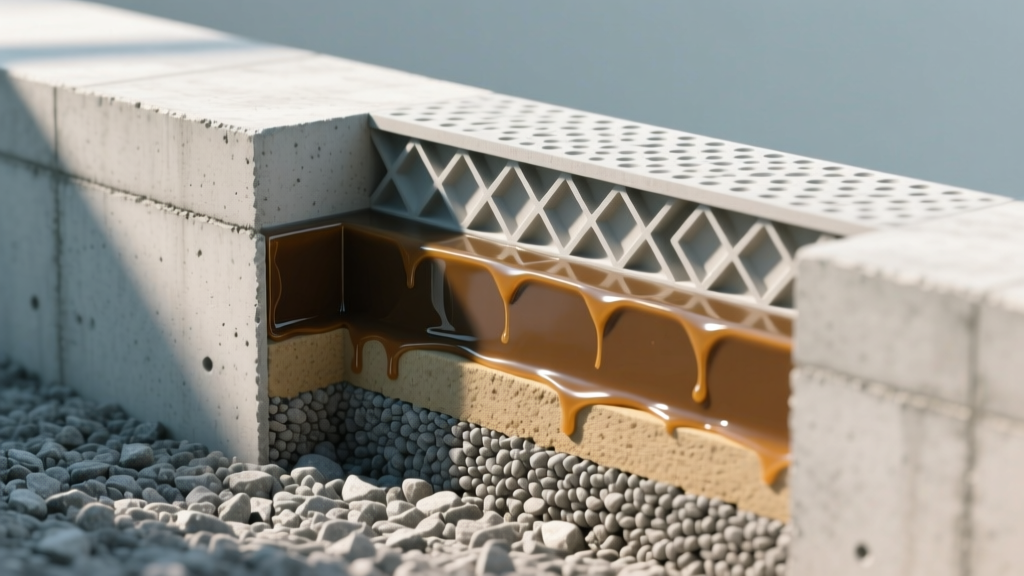
Core Waterproof Building Material Categories for Below-Grade Use
To build a resilient below-grade envelope, you must choose a primary membrane and pair it with a protection/drainage layer. Here are the industry-standard materials currently dominating the commercial and high-end residential markets.
Liquid-Applied Polyurethane Membranes
Liquid polyurethanes, such as Tremco TREMproof 2000 or BASF MasterSeal HLM 5000, are single- or two-component fluid systems that cure into a seamless, fully adhered elastomeric skin. They are applied at a minimum wet thickness of 90 mils to achieve a 60-mil dry film thickness (DFT).
- Performance: Elongation capabilities exceed 600%, allowing the membrane to bridge hairline shrinkage cracks that develop during the concrete's 28-day curing process.
- Cost (2026): $4.50 to $6.00 per square foot, including primer and membrane.
- Best Application: Complex foundation geometries with numerous pipe penetrations, as the liquid conforms perfectly to irregular surfaces without requiring custom cutting.
Bentonite Clay Sheet Systems
Sodium bentonite clay panels (e.g., CETCO Voltex or ECOLINE) consist of a layer of granular bentonite sandwiched between geotextiles. When exposed to water, the clay swells up to 15 times its dry volume, forming an impermeable, self-sealing gel.
- Performance: Unmatched self-healing properties. If a nail punctures the sheet, the swelling clay automatically fills the void. However, bentonite requires moisture to activate; in highly arid soils, it may remain dormant and fail to seal properly unless a hydration layer is added.
- Cost (2026): $3.00 to $4.50 per square foot.
- Best Application: Blind-side waterproofing (applied before the concrete is poured against sheet piling or lagging) and large, flat foundation walls.
HDPE Dimple Drainage Boards (Protection Layer)
While not a primary waterproofing membrane, High-Density Polyethylene (HDPE) dimple boards like Cosella-Dörken DELTA-MS are an absolute necessity for protecting the primary membrane. The 5/16-inch dimples create an air gap that relieves hydrostatic pressure by channeling water down to the footing drain.
- Performance: Resists crushing loads up to 5,200 psf. Protects delicate liquid membranes from sharp angular backfill.
- Cost (2026): $1.50 to $2.50 per square foot.
Comparative Decision Matrix: Performance vs. Cost
Use this framework to select the optimal waterproof building material based on your project's specific constraints.
| Material Type | Avg. Cost / Sq. Ft. | Hydrostatic Resistance | Crack Bridging | Installation Skill Required |
|---|---|---|---|---|
| Liquid Polyurethane | $4.50 - $6.00 | Excellent (225 ft head) | Up to 1/16 inch | High (Requires certified applicator) |
| Bentonite Clay Sheets | $3.00 - $4.50 | Excellent (Self-healing) | N/A (Swells to fill voids) | Moderate (Focus on overlap sealing) |
| Self-Adhered Rubberized Asphalt | $3.50 - $5.00 | Very Good | Up to 1/8 inch | High (Temperature sensitive) |
| HDPE Dimple Board (Protection) | $1.50 - $2.50 | N/A (Drainage only) | N/A | Low (Mechanical fastening) |
Substrate Preparation: The Non-Negotiable Prerequisite
The most expensive waterproof building material will fail if applied to an improperly prepared substrate. According to guidelines published by Penn State Extension, moisture management begins with rigorous concrete surface profiling. Follow this exact sequence:
- Form Release Removal: Mechanically grind the concrete to remove all form release agents, curing compounds, and laitance. The surface must be open-pored to CSP 3 or CSP 4 (Concrete Surface Profile).
- Protrusion Grinding: All snap-ties and form hardware must be cut flush and ground down to a maximum protrusion of 1/16 inch. Any sharper edge will telegraph through and puncture a liquid membrane.
- Moisture Testing: Perform an ASTM D4263 plastic sheet test or use a Tramex moisture meter. Concrete moisture content must be below 5% before applying non-breathable polyurethanes. If pouring schedules require earlier application, use a specialized breathable, moisture-mitigating primer.
- Cold Joint Routing: All horizontal cold joints (where the wall meets the footing) must be routed out to a 1/2-inch by 1/2-inch V-groove and filled with a high-modulus polyurethane sealant like Tremco Dymonic 100 before the main membrane is applied.
Real-World Failure Modes and How to Avoid Them
Industry data, including coastal construction guidelines from FEMA, highlights that the majority of below-grade leaks are not due to material defects, but rather installation errors and site mismanagement.
- Angular Backfill Damage: Using crushed, angular gravel directly against a dimple board or membrane will cause point-loads that exceed the material's puncture resistance during mechanical compaction. Always use rounded pea gravel or washed river stone within 12 inches of the foundation wall.
- UV Degradation: Most liquid polyurethanes and self-adhered membranes are not UV-stable. If left exposed to direct sunlight for more than 30 to 60 days before backfilling or applying rigid insulation, the surface will chalk, micro-crack, and lose its elastomeric properties. Plan your site logistics to ensure prompt covering.
- Footing Drain Inundation: A waterproof membrane is only as good as the drainage system relieving it. If the perimeter footing drain (weeping tile) is not wrapped in filter fabric, or if it lacks a clear daylight exit or sump pump discharge, the trench will fill with silt. This creates a permanent bathtub effect, subjecting the membrane to continuous, multi-story hydrostatic pressure that eventually forces water through microscopic concrete pores.
Sourcing and Specification Guidelines
When drafting your project specifications, avoid generic language like "apply waterproofing to exterior walls." Instead, specify the exact membrane type, required DFT (dry film thickness), primer requirements, and the specific protection board. For example: "Apply two coats of single-component polyurethane membrane to achieve 60 mils DFT, followed by mechanical fastening of 5/16-inch HDPE dimple drainage board with sealed vertical seams." This level of precision ensures the contractor cannot substitute high-performance materials with cheap, code-minimum asphalt sprays, securing the longevity of your structure against relentless subterranean moisture.
Written by
David NakamuraDavid Nakamura is a licensed architect (AIA) and construction technology writer focused on sustainable building methods, mass timber engineering, and high-performance building envelopes. He holds a Master of Architecture from the University of Washington and is a certified Passive House Consultant (CPHC). David spent eight years at the Seattle firm Mithun, where he led the design of three LEED Platinum projects, before founding his own practice specializing in net-zero residential design. He serves on the editorial advisory board of GreenBuilder Magazine and has authored peer-reviewed papers on cross-laminated timber (CLT) connections for the Journal of Structural Engineering. In his spare time, David teaches woodworking at Pratt Fine Arts Center and kayaks the Puget Sound.
More from David Nakamura
View all
Construction Cost
Labor Cost to Build a Deck Per Sq Ft: 2026 Installation Guide
Discover the exact labor cost to build a deck per sq ft in 2026. This installation guide breaks down contractor rates, complexity factors, and hidden fees.
Aug 4, 2026

Construction Cost
How Much Does It Cost to Build a 3 Bedroom House? Financing Guide
Learn exactly how much it costs to build a 3 bedroom house and explore 2026 financing options, construction loan types, and budget frameworks for your build.
Aug 4, 2026

Construction Cost
Cost to Build a Tennis Court: 2026 Guide
How much does it cost to build a tennis court in 2026? Breakdowns for asphalt, concrete, and synthetic surfaces plus fencing and lighting.
Jul 30, 2026