Albanian Building Materials Market Trends 2025: 2026 Cost Analysis
Analyze Albanian building materials market trends 2025 with a 2026 cost breakdown for cement, steel, and imports to optimize construction budgets.

Executive Summary: Transitioning from 2025 Booms to 2026 Realities
The Albanian construction sector experienced an aggressive expansion throughout 2025, fueled by coastal tourism infrastructure, luxury residential developments in Tirana, and EU integration roadworks. As project managers and developers move into 2026, understanding the Albanian building materials market trends 2025 is critical for accurate forecasting. While domestic production of heavy bulk materials has stabilized, reliance on imported structural steel and specialized finishes exposes local contractors to geopolitical pricing shifts and new carbon border tariffs.
According to the World Bank Albania Economic Overview, the construction sector remains a primary pillar of the nation's GDP growth, but inflation stabilization and supply chain normalization have fundamentally altered the cost baseline. This cost analysis dissects the exact pricing dynamics, logistics friction points, and procurement strategies required to maintain margins in the current Albanian market.
- Currency Fluctuations: The Albanian Lek (ALL) has shown resilience against the Euro, hovering near the 100 ALL to 1 EUR mark, stabilizing import costs for European finishes.
- CBAM Implementation: The EU Carbon Border Adjustment Mechanism is now actively impacting steel imports from non-EU neighbors, specifically Turkey.
- Infrastructure Bottlenecks: Ongoing modernization at the Port of Durrës continues to cause intermittent demurrage charges for bulk finish imports.
Core Material Cost Matrix: Local Production vs. Import Reliance
To build an accurate 2026 budget, contractors must bifurcate their material schedules into locally dominated markets and import-dependent categories. The following matrix reflects Q1 2026 wholesale pricing for the Tirana-Durrës corridor, factoring in standard delivery fees.
| Material Category | Specification / Grade | Local Price (ALL) | Import Price (ALL) | 2026 Trend |
|---|---|---|---|---|
| Portland Cement | CEM II/A-L 42.5R (Bulk) | 11,200 / ton | N/A (Local Dom.) | Stable (+2%) |
| Steel Rebar | B500B 12mm (Ribbed) | 98 / kg | 106 / kg (TR/IT) | Volatile (+6%) |
| XPS Insulation | 50mm, 300kPa (Facades) | 440 / m² | 395 / m² (GR) | Declining (-4%) |
| Porcelain Tile | 60x60cm Rectified | 1,350 / m² | 950 / m² (CN/IN) | Stable |
| Gypsum Board | 12.5mm Standard (Knauf) | 410 / sheet | N/A (Local Dom.) | Stable |
The Cement Duopoly and Inland Freight Economics
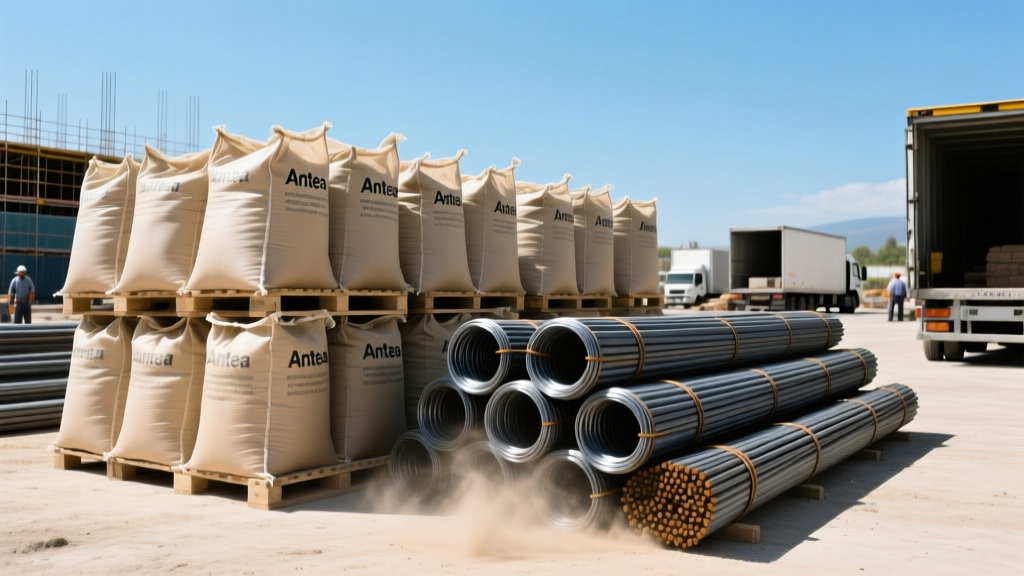
Albania’s cement market is effectively controlled by two major domestic players: Antea Cement (based in Krujë) and Devoll (based in Elbasan). Because cement is heavy and low-margin, importing it is economically unviable for standard structural work. The primary cost variable in 2026 is not the material itself, but inland freight. Transporting bulk cement via the SH3 highway from Elbasan to Tirana adds approximately 1,200 ALL to 1,500 ALL per ton in logistics costs. Developers in southern coastal regions (Vlorë, Sarandë) face even higher premiums, often paying up to 13,500 ALL/ton delivered, making local batching plants a mandatory investment for large-scale resort projects.
Structural Steel: CBAM Pressures and Turkish Supply Lines
Unlike cement, Albania relies heavily on imported steel reinforcement, primarily from Turkey (e.g., Çolakoğlu, İÇDAŞ) and Italy. The most significant shift in the Albanian building materials market trends 2025 carrying into 2026 is the financial impact of the EU Carbon Border Adjustment Mechanism (CBAM). As Albania aligns its customs frameworks with EU accession requirements, high-carbon Turkish rebar is facing new import levies. This has pushed the wholesale price of B500B 12mm rebar from an 2024 average of 88 ALL/kg to over 100 ALL/kg in early 2026. Contractors must now factor a 5-8% contingency specifically for structural steel to account for quarterly carbon tariff adjustments.
Supply Chain Frictions: Durrës Port and Customs Clearance
For imported finishing materials—such as Italian sanitary ware, Spanish ceramics, and specialized HVAC systems—the Port of Durrës remains the primary choke point. While the EBRD Albania Country Strategy highlights ongoing investments in national logistics corridors, port congestion during the peak summer tourism season severely impacts construction supply chains.
"In 2025, we saw demurrage charges spike by 30% for LCL (Less than Container Load) shipments arriving in July and August. If you are importing high-end finishes for a coastal hotel, the customs clearance delays at Durrës can wipe out your material margin if you haven't secured your EUR.1 movement certificates and CE marking documentation prior to the vessel's departure."
— Senior Procurement Manager, Tirana-based Commercial Developer
To mitigate these risks, smart contractors are shifting their import schedules. Ordering Q3 and Q4 finishing materials in late winter ensures containers clear customs before the port reaches maximum TEU capacity. Furthermore, utilizing the dry port facilities in Kashar for pre-clearance inspections has reduced warehouse holding times by an average of 48 hours for compliant shipments.
Strategic Procurement Framework for Albanian Developers
Navigating the current market requires moving away from just-in-time purchasing toward strategic stockpiling and hedging. Use the following decision framework to optimize your 2026 material procurement:
- Heavy Bulk (Cement, Aggregates, Blocks): Buy Local, Negotiate Volume. Lock in annual supply agreements with Antea or Devoll in January. Prices are historically lowest before the spring construction surge. Require the supplier to absorb inland freight costs for orders exceeding 500 tons/month.
- Structural Steel (Rebar, I-Beams): Hedge and Stockpile. Do not buy steel on the spot market. Utilize forward contracts with major importers in the Tirana industrial zone to lock in prices. Store excess rebar in covered, elevated yards to prevent oxidation, which can lead to failed EN 10080 compliance tests during municipal inspections.
- Thermal Insulation (EPS/XPS): Import from Greece. Local EPS production is sufficient for basic needs, but for high-compressive XPS required for foundation and plaza deck applications, Greek imports (e.g., Durosol) offer a 10-15% cost advantage over Italian equivalents, with significantly faster transit times via the SH2 highway corridor.
- Premium Finishes (Ceramics, Sanitary): Consolidate and Pre-Clear. Avoid fragmented LCL shipments. Consolidate all interior finishes into FCL (Full Container Load) shipments. Hire a specialized customs broker in Durrës to pre-audit all CE certifications and Declarations of Performance (DoP) to prevent quarantine at the port.
Frequently Asked Questions
How is the push for Euro adoption affecting material pricing?
While Albania has not yet officially adopted the Euro, the Bank of Albania's tight monetary policy has kept the ALL/EUR exchange rate remarkably stable (hovering near 100-102 ALL). For importers, this stability eliminates the need for expensive currency hedging instruments, allowing for more accurate long-term budgeting on European-sourced materials like Knauf drywall systems and Geberit plumbing frameworks.
Are there viable alternatives to Turkish rebar to avoid CBAM costs?
Some developers are exploring rebar imports from Egypt and the UAE, but the freight costs via the Mediterranean often negate the base material savings. The most effective strategy is not avoiding the tariff, but optimizing structural design. Utilizing advanced structural engineering software to minimize steel tonnage per square meter, and specifying high-strength B500C grades where applicable, reduces overall weight and offsets the per-kilogram tariff increase.
What are the hidden costs in Albanian concrete batching?
The primary hidden cost is aggregate quality and washing. Many local quarries provide limestone aggregates with high clay content. If not properly washed, this requires the addition of specialized polycarboxylate ether (PCE) superplasticizers to maintain workability, adding roughly 400 ALL per cubic meter to the ready-mix cost. Always mandate washed, EN 12620 compliant aggregates from certified quarries in the Krujë or Dajt regions to maintain strict water-cement ratios.
Written by
Marcus ChenMarcus Chen is a licensed structural engineer (PE) and building materials analyst with over 12 years of experience across residential, commercial, and industrial construction. He holds a Master of Science in Civil Engineering from UC Berkeley and spent six years at Thornton Tomasetti before transitioning to independent consulting and technical writing. Marcus specializes in material selection for seismic-prone regions, concrete reinforcement strategies, and lifecycle cost analysis. His work has been cited by the American Concrete Institute (ACI) and the Structural Engineers Association of California (SEAOC). When he is not on a job site or at his desk, you will find him hiking the Sierra Nevada or restoring a 1920s craftsman bungalow in Oakland, CA.
More from Marcus Chen
View all
Construction Cost
How Much Did the Eiffel Tower Cost to Build?
How much did the Eiffel Tower cost to build in 1889? We adjust for inflation and compare its budget to modern skyscraper construction.
Aug 4, 2026

Fire Resistance
What Is a Fire Resistant Material? Testing & Certification Guide
Discover what is a fire resistant material through ASTM and UL testing. Learn how fire ratings, certifications, and assemblies work in construction.
Aug 4, 2026

Construction Cost
How Much Did the Burj Khalifa Cost to Build?
How much did the Burj Khalifa cost to build? We break down the $1.5B project and extract 5 money-saving strategies for your next build.
Jul 30, 2026