Building Material Testing Costs: Line-Item Budget Guide
Analyze building material testing costs for commercial projects. Get line-item pricing for concrete, steel, and soil testing to optimize your QA/QC budget.

The True Cost of Building Material Testing in Commercial Construction
Allocating funds for building material testing is often treated as a grudge purchase by general contractors, yet it remains the most cost-effective insurance policy against catastrophic structural failure and expensive rework. In commercial and heavy civil construction, third-party quality assurance and quality control (QA/QC) testing typically consumes 0.5% to 1.5% of total hard construction costs. However, the financial exposure of skipping or minimizing these tests can easily exceed 10x to 50x the initial testing budget through remediation, schedule delays, and liquidated damages.
For a standard $10 million commercial mid-rise project, anticipate a third-party building material testing budget between $65,000 and $110,000. Projects with deep foundations, extensive structural steel, or poor native soil conditions will push toward the upper end of this range.
Line-Item Cost Breakdown by Material Type
Pricing for testing services fluctuates based on regional labor rates, lab accreditation requirements, and project volume. The following matrix outlines current average market rates for standard commercial construction testing.
| Material | Test Type | Standard | Average Cost | Frequency |
|---|---|---|---|---|
| Concrete | Compressive Strength | ASTM C39 | $45 - $65 / cylinder | 1 set per 50 CY |
| Concrete | Slump, Air, Temp | ASTM C143 / C231 | $85 - $130 / visit | 1 per 50 CY |
| Steel | Ultrasonic (UT) | AWS D1.1 | $175 - $250 / hour | Per weld joint |
| Steel | Magnetic Particle (MT) | AWS D1.1 | $125 - $185 / hour | Per weld joint |
| Soil | Proctor Compaction | ASTM D1557 | $250 - $400 / test | 1 per soil type |
| Soil | Field Density (Nuke) | ASTM D2922 | $150 - $225 / test | 1 per 2,500 SF |
Concrete and Masonry Testing Expenses
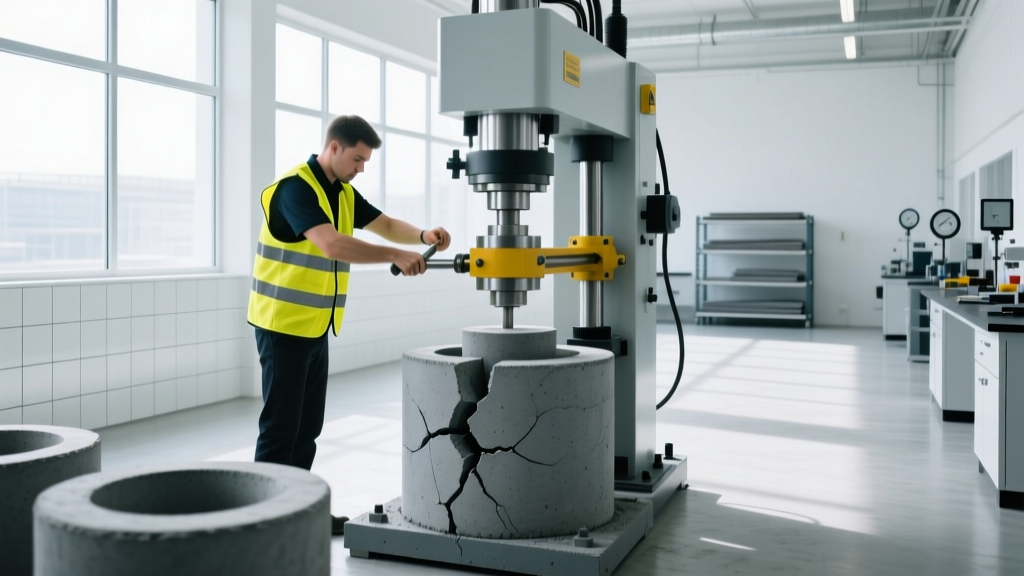
Concrete testing represents the highest volume of QA/QC expenditures on most vertical construction projects. According to guidelines maintained by the American Concrete Institute (ACI), compressive strength testing requires casting cylindrical specimens and curing them in a controlled environment before breaking them at 7 and 28 days. The $45 to $65 per-cylinder cost covers the lab's curing room overhead, hydraulic press operation, and reporting. However, if a 28-day cylinder fails to meet the specified psi (e.g., falling short of a 4,000 psi design mix), the contractor must pay for in-situ core drilling. Core extraction and testing costs between $350 and $550 per location, turning a $60 routine test into a $500+ remediation event.
Structural Steel and Welding Inspection Costs
Non-destructive testing (NDT) for structural steel is governed by AWS D1.1 standards and requires certified inspectors. The American Society for Nondestructive Testing (ASNT) certifies technicians across multiple disciplines. Ultrasonic Testing (UT) and Magnetic Particle Testing (MT) are the most common and cost-effective methods for moment frame connections. Radiographic Testing (RT), which uses X-rays to inspect internal weld integrity, carries a massive premium. Because RT requires establishing a safe radiation exclusion zone, it is almost exclusively performed on night shifts or weekends, pushing the cost to $400 to $650 per joint when factoring in shift differentials and safety perimeters.
Hidden Fees and Mobilization Surcharges
The base unit rates for testing rarely reflect the final invoice. General contractors must account for logistical surcharges that can inflate the testing budget by 15% to 30% if not managed proactively.
- Mobilization and Demobilization: Labs charge a flat fee to dispatch a technician and a nuclear density gauge or concrete testing kit to the site. Expect $150 to $350 per trip, regardless of whether the technician performs one test or five.
- Wait Time and Standby Rates: If a concrete truck is delayed in traffic or a steel crew is not ready for weld inspection, labs bill standby time. This typically triggers after 30 minutes at a rate of $85 to $125 per hour.
- Rush Reporting Premiums: Standard turnaround for soil and concrete reports is 3 to 5 business days. Requesting 24-hour or same-day turnaround to keep a critical path schedule moving will incur a 25% to 50% surcharge on the base test rate.
- Weekend and Holiday Multipliers: Pouring concrete or erecting steel on a Saturday will subject you to 1.5x or 2.0x hourly rates for the testing technician, plus premium lab fees for weekend curing and breaking.
Cost vs. Risk: The Financial Impact of Skipping Tests
Value engineering often targets QA/QC budgets, but reducing testing frequency introduces asymmetric financial risk. The matrix below illustrates the disproportionate cost of failure compared to the cost of verification.
Scenario A: Soil Subgrade Verification
Testing Cost: $1,200 for 6 nuclear density tests and proof-rolling observation.
Risk of Omission: Slab-on-grade settlement causing cracked flooring and misaligned doors.
Remediation Cost: $35,000 - $60,000 for slab jacking, floor replacement, and schedule delays.
Scenario B: Fireproofing Thickness Inspection
Testing Cost: $800 for wet/dry film thickness gauging per floor.
Risk of Omission: Failure to meet the 2-hour fire rating required by the building code.
Remediation Cost: $15,000+ per floor to re-apply sprayed fire-resistive material (SFRM) after drywall is removed.
Strategic Framework for Optimizing Your Testing Budget
Controlling building material testing costs requires operational discipline rather than simply negotiating lower unit rates. Implement the following procurement and scheduling protocols:
- Consolidate Mobilizations: Align concrete pours, soil compaction checks, and steel inspections to occur on the same days. Paying one $250 mobilization fee for three trades is vastly superior to paying it three separate times.
- Establish Unit-Rate Ceilings: During the subcontractor buyout process, require the testing firm to lock in unit rates for the project duration and cap mobilization fees. Include a clause that standby time is only billable if the delay exceeds 45 minutes.
- Leverage CCRL Accreditation: Ensure your selected lab is accredited by the Construction Materials Reference Labs (CCRL) or AASHTO. While unaccredited 'trunk-slammer' labs may offer 20% lower rates, their reports are frequently rejected by municipal inspectors and structural engineers, forcing you to pay for re-testing by an approved firm.
- Optimize Cylinder Casting: For massive foundation mat pours, work with the structural engineer to see if statistical averaging allows for reduced cylinder frequency, or if casting extra cylinders on-site (stored in your own temperature-controlled job trailer) can save on lab casting fees.
Frequently Asked Questions on Testing Economics
Who pays for re-testing if a concrete cylinder fails?
The financial responsibility depends on the root cause. If the core test confirms the in-situ concrete is genuinely under-strength, the general contractor (and ultimately the concrete supplier) bears the cost of the core drilling, testing, and any structural remediation. However, if the core test proves the concrete is adequate and the initial cylinder failure was due to improper lab curing or a faulty hydraulic press calibration, the testing firm is liable for the re-testing costs, and their errors and omissions (E&O) insurance should cover the contractor's delay damages.
Can we use in-house testing to save money?
General contractors can perform their own internal QA testing for process control (e.g., checking slump before the official inspector arrives to avoid rejected trucks). However, for official QC acceptance testing required by the building department and the Engineer of Record, the testing must be performed by an independent, third-party agency. Using in-house personnel for acceptance testing violates standard conflict-of-interest protocols in commercial construction and will not be accepted for final sign-off.
Written by
James ThorntonJames Thornton is a construction industry veteran with 25 years of hands-on experience in wood framing, lumber grading, and residential building codes. He started as a framing carpenter in rural Oregon, earned his ICC Residential Building Inspector certification, and eventually became a senior plan reviewer for the City of Portland Bureau of Development Services. James holds a B.S. in Wood Science & Technology from Oregon State University and is a certified lumber grader through the West Coast Lumber Inspection Bureau (WCLIB). He has inspected over 3,000 residential construction sites and authored the city's internal guide on advanced framing techniques (2x6 at 24" O.C.). James lives in Bend, OR, where he builds custom timber-frame cabins and competes in lumberjack sports.
More from James Thornton
View all
Insulation
Best Home Insulation Materials: Complete 2026 Guide
Compare top home insulation materials for 2026. Find R-values, installed costs per square foot, and best uses for fiberglass, spray foam, and mineral wool.
Aug 4, 2026

Sustainable Building
Certify Your Green Building Material for LEED and WELL
Step-by-step guide to certifying a green building material for LEED v5 and WELL v2. Master EPDs, HPDs, and VOC limits for 2026 project specifications.
Aug 4, 2026

Stone & Masonry
Veneer Stacked Stone Panels: Interior Design & Style Showcase
Discover how veneer stacked stone panels transform interiors. Explore modern design profiles, material pairings, and technical installation specs.
Aug 4, 2026