Top Biodegradable Building Materials Compared for 2026 Projects
Compare top biodegradable building materials including hempcrete, mycelium, straw, and cork. Get 2026 pricing, R-values, and structural limits.

Beyond the Build: Designing for Deconstruction
Specifying biodegradable building materials requires shifting the focus from initial embodied carbon to end-of-life material flows. When a structure is demolished in 50 years, organic assemblies can return to the biosphere, provided they are free of synthetic binders, formaldehyde, and toxic preservatives. According to the EPA Sustainable Materials Management guidelines, prioritizing biological nutrients over technical nutrients drastically reduces landfill burden. This comparison reviews four leading biodegradable options for 2026 construction, evaluating their thermal performance, structural limits, and real-world failure modes.
Hempcrete (Hemp-Lime Bio-Composite): The Breathable Monolith
Technical Specs & 2026 Pricing
Hempcrete is a non-load-bearing bio-composite made from the woody core of the hemp plant (hurd) mixed with a lime-based binder. Standard mixes using binders like Tradical HF yield a density of 220–250 kg/m³. It provides an R-value of approximately 2.4 per inch. Because it is not structural, it requires a timber or steel post-and-beam frame to carry roof and floor loads. In 2026, installed costs for cast-in-place or block-laid hempcrete range from $3.50 to $5.00 per square foot of wall area, heavily dependent on local hemp hurd availability.
Failure Modes & Edge Cases
The most common failure mode is moisture entrapment caused by incompatible finishes. Hempcrete is highly vapor-permeable. Applying Portland cement stucco or acrylic-based elastomeric paints traps moisture inside the wall, leading to fungal degradation of the hemp hurd. Always finish hempcrete with breathable lime plaster or clay render. Additionally, the high alkalinity (pH ~12) of the lime binder naturally deters pests and mold, but this alkalinity can corrode unprotected steel fasteners; use stainless steel or hot-dipped galvanized hardware for the structural frame.
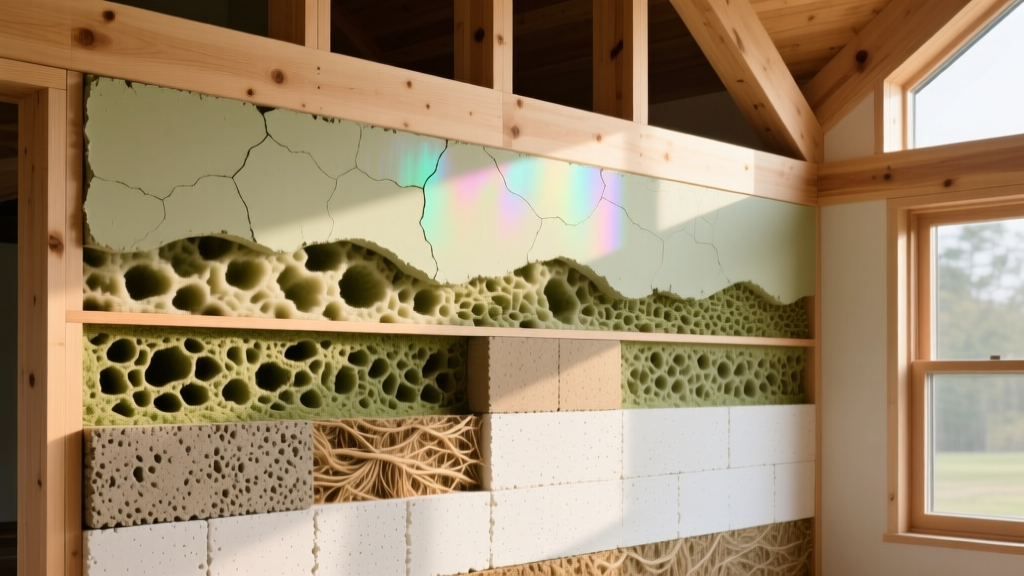
Mycelium Composites: The Grown Insulator
Technical Specs & 2026 Pricing
Mycelium insulation is grown by inoculating agricultural waste (like corn stalks or hemp hurds) with fungal spores. The mycelium digests the substrate and binds it into a solid, lightweight matrix. Products like Ecovative’s MycoComposite offer an R-value of 3.8 per inch with a density of 100–150 kg/m³. As a premium, cutting-edge material, 2026 pricing sits between $9.00 and $12.00 per square foot. It is strictly limited to non-load-bearing applications, with a compressive strength of only 10–20 psi.
Failure Modes & Edge Cases
Mycelium is highly susceptible to UV degradation and prolonged liquid water exposure. It must be installed as cavity fill or protected behind interior drywall and exterior weather-resistive barriers (WRB). If the wall assembly experiences a bulk water leak, mycelium can reactivate and begin decomposing. It is best suited for interior acoustic panels, protected exterior sheathing layers, or above-grade cavity insulation in highly controlled, low-humidity assemblies.
High-Density Straw Bale Panels: The Carbon Sink
Technical Specs & 2026 Pricing
Modern straw bale construction utilizes pre-compressed, high-density bales (110–130 kg/m³) bound by biodegradable sisal or jute twine. A standard 18-inch-thick bale wall delivers an R-value of 2.8 per inch, resulting in a whole-wall R-value exceeding R-35. Prefabricated straw bale panels (SIPs with OSB or magnesium oxide faces) cost between $2.00 and $4.00 per square foot. When encased in lime or earth plaster, plastered straw bale walls achieve a 2-hour fire rating per ASTM E119, as the dense packing limits oxygen availability.
Failure Modes & Edge Cases
Capillary wicking is the primary enemy of straw. The bottom course of bales must be elevated at least 8 inches above the finished exterior grade using a stem wall or gravel-filled toe-up. During the construction phase, before plastering, loose straw is a severe fire hazard and highly vulnerable to rain. Builders must sequence exterior plastering immediately after bale stacking and utilize temporary tarps if weather delays occur.
Expanded Cork Boards: The Hydrophobic Biodegradable
Technical Specs & 2026 Pricing
Expanded insulation cork board (ICB) is produced by heating cork granules (Quercus suber bark) in an autoclave. The heat expands the granules and releases suberin, a natural resin that binds the board without synthetic adhesives. It offers an R-value of 3.6 per inch and a density of 100–120 kg/m³. Unlike other organic materials, cork is naturally hydrophobic and fire-retardant (typically achieving Class B surface burning characteristics). Installed costs for exterior continuous insulation applications range from $5.50 to $8.00 per square foot.
Failure Modes & Edge Cases
While cork resists liquid water, it is vapor semi-permeable. In cold climates (IECC Zones 5 and above), placing thick layers of exterior cork without calculating the dew point can lead to interstitial condensation on the structural sheathing. Always run a WUFI hygrothermal analysis when specifying more than 4 inches of exterior cork in northern climate zones.
Head-to-Head Biodegradable Material Matrix
| Material | R-Value / Inch | Compressive Strength | Vapor Permeability | 2026 Installed Cost (sq ft) | Best Application |
|---|---|---|---|---|---|
| Hempcrete | 2.4 | 100–150 psi | High (Open) | $3.50 – $5.00 | Monolithic wall infill, thermal mass |
| Mycelium | 3.8 | 10–20 psi | Moderate | $9.00 – $12.00 | Interior acoustics, protected cavity fill |
| Straw Bale | 2.8 | 15–30 psi | High (Open) | $2.00 – $4.00 | Thick wall assemblies, rural builds |
| Expanded Cork | 3.6 | 40–60 psi | Semi-Permeable | $5.50 – $8.00 | Exterior continuous insulation, flat roofs |
Decision Framework: Matching Material to Climate Zone
Selecting the right biodegradable material depends heavily on your local climate and hygrothermal requirements. Use the NIST BEES software to model the lifecycle environmental impact of your specific assembly.
- Hot-Humid (IECC Zones 1-3): Hempcrete excels here. Its high thermal mass and vapor openness allow it to buffer high interior humidity levels without trapping condensation, reducing HVAC latent loads.
- Mixed-Humid (IECC Zone 4): Straw bale and hempcrete both perform well, provided you utilize a smart vapor retarder like Pro Clima Intello Plus on the interior to manage seasonal vapor drive reversals.
- Cold & Very Cold (IECC Zones 5-8): Expanded cork is the superior choice for exterior continuous insulation. Its hydrophobic nature prevents exterior moisture accumulation, while its R-value keeps the structural sheathing warm, pushing the dew point safely outward.
Critical Moisture Management Rules for Organic Assemblies
Written by
Priya KapoorPriya Kapoor is a real estate market analyst and construction economics researcher with expertise in housing affordability, development feasibility, and infrastructure investment. She holds a Master of Regional Planning from Cornell University and previously worked as a senior analyst at CBRE's Investment Properties group, where she modeled returns for $4B in mixed-use development pipelines. Priya now runs an independent research practice advising developers, municipalities, and REITs on construction cost forecasting and market timing. She publishes the quarterly "BuildMat Market Pulse" report tracking material price indices across 12 commodity categories. Based in Austin, TX, Priya serves on the board of Habitat for Humanity Austin and is a marathon runner.
More from Priya Kapoor
View all
Construction Cost
Cost to Build a 1600 Sq Ft Home in 2026: Full Breakdown
Accurate 2026 cost to build a 1600 sq ft home—material, labor, and regional pricing breakdowns included. Plan your budget with real-time estimates.
Aug 11, 2026

Wood & Lumber
Name the Types of Wood for Pressure Treatment and Preservation
Learn how to name the types of wood best suited for pressure treatment. Compare species treatability, chemical retention levels, and 2026 preservation costs.
Aug 4, 2026

Stone & Masonry
Stone Veneer Suppliers Lindenhurst: 2026 Cost Analysis
Analyze 2026 stone veneer costs in Lindenhurst, NY. Compare local supplier pricing, delivery fees, and Suffolk County installation labor rates.
Aug 4, 2026