Evaluating the Sustainability of Building Materials: A Selection Guide
Learn how to evaluate the sustainability of building materials using EPDs, LCA metrics, and embodied carbon data to make eco-friendly construction choices.
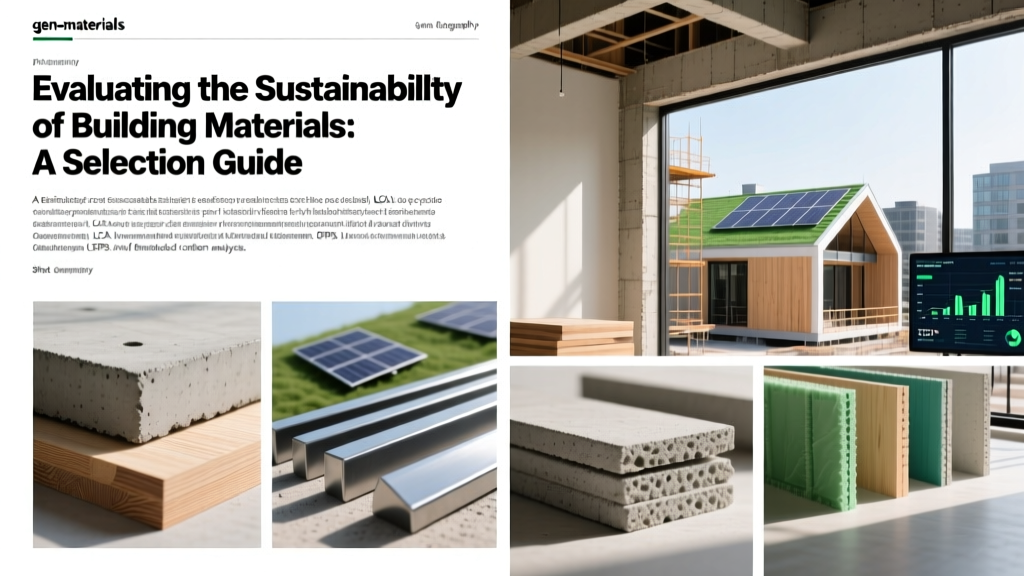
The Paradigm Shift: Embodied vs. Operational Carbon
Historically, green building standards prioritized operational carbon—the emissions generated by heating, cooling, and lighting a structure over its lifespan. However, as building envelopes become hyper-efficient and grid electricity decarbonizes, operational emissions are dropping. Consequently, the Architecture 2030 initiative reports that embodied carbon—the greenhouse gas emissions arising from the manufacturing, transportation, installation, maintenance, and disposal of building materials—will account for nearly half of all new construction emissions between now and 2050.
Evaluating the sustainability of building materials now requires a rigorous, data-driven approach focused on upfront embodied carbon (A1-A5 modules) and whole-life lifecycle assessments (LCA). Specifiers can no longer rely on vague 'eco-friendly' marketing claims; procurement decisions must be anchored in verified, quantitative metrics.
When reviewing material data, focus on the 'Product and Construction Process' stages. A1-A3 covers raw material extraction, transport to the factory, and manufacturing (cradle-to-gate). A4-A5 covers transport to the job site and physical installation. Specifying materials with low A1-A3 impacts but high A4 transport emissions (e.g., importing heavy stone across oceans) negates the environmental benefit.
Decoding Environmental Product Declarations (EPDs)
An Environmental Product Declaration (EPD) is a standardized, third-party-verified document that communicates the environmental performance of a product based on a Life Cycle Assessment (LCA) conforming to ISO 14025 and EN 15804 standards. To properly evaluate the sustainability of building materials, procurement teams must know how to read and compare EPDs.
EPD Classification Matrix
| EPD Type | Verification Level | Use Case in Procurement |
|---|---|---|
| Type I (ISO 14024) | Third-party certified eco-labels (e.g., GreenGuard, FSC) | Quick filtering for low-VOC paints, sustainably harvested wood, and non-toxic adhesives. |
| Type II (ISO 14021) | Self-declared claims by manufacturer (e.g., 'Contains 30% recycled content') | Low reliability. Use only for preliminary screening; always request backing data. |
| Type III (ISO 14025) | Third-party verified LCA data with strict Product Category Rules (PCRs) | The gold standard. Required for structural materials (concrete, steel, mass timber) to calculate exact Global Warming Potential (GWP). |
When comparing Type III EPDs, ensure the declared unit is identical (e.g., comparing 1 cubic meter of concrete to 1 cubic meter of concrete, not 1 kg to 1 cubic meter). Furthermore, verify that the EPD is less than five years old, as manufacturing processes and grid carbon intensities change rapidly.
Material Selection Matrix: Embodied Carbon & Cost Profiles
The following matrix contrasts conventional high-carbon materials with lower-carbon alternatives, providing realistic 2026 cost baselines and structural parameters for commercial and high-end residential projects.
| Material Category | Estimated Embodied Carbon (kg CO2e) | Approx. Installed Cost (USD) | Structural / Envelope Notes |
|---|---|---|---|
| Conventional Portland Cement Concrete (3000 psi) | ~350 - 450 per m³ | $125 - $150 / cubic yard | High compressive strength, universal availability. High baseline GWP. |
| Carbon-Injected Concrete (e.g., CarbonCure) | ~250 - 320 per m³ (Net reduction of 5-10%) | $135 - $165 / cubic yard | Injects captured CO2 during batching. Maintains identical structural specs to conventional mixes. |
| Virgin Structural Steel (W-Shapes) | ~2.5 - 3.2 per kg | $1.80 - $2.50 / lb (fabricated) | Excellent tensile strength. High energy intensity in blast furnace production. |
| EAF Recycled Steel (90%+ scrap) | ~0.8 - 1.2 per kg | $1.60 - $2.20 / lb (fabricated) | Produced in Electric Arc Furnaces. Ensure EPD specifies EAF routing, not Basic Oxygen Furnace (BOF). |
| Cross-Laminated Timber (CLT) | Biogenic carbon storage (often net-negative in A1-A3) | $45 - $70 / sq ft (floor panels) | Requires precise moisture management during A5 installation. Excellent for mid-rise floor and roof assemblies. |
| Hempcrete (Hurd + Lime Binder) | Net-negative (sequesters more CO2 than emitted) | $18 - $28 / sq ft (wall assembly) | Non-load bearing. Requires a structural frame (timber/steel). Excellent thermal mass and moisture buffering (R-value ~2.5 per inch). |

The 4-Step Sustainable Procurement Framework
To systematically integrate low-carbon materials into your project, execute the following procurement workflow during the Design Development (DD) and Construction Documents (CD) phases.
- Establish a Project-Specific Embodied Carbon Baseline
- Use the Building Transparency's EC3 tool to model the baseline GWP of your structural and envelope materials based on standard regional averages.
- Set a hard reduction target (e.g., 20% reduction in A1-A3 GWP compared to the baseline) aligned with LEED v5 or Living Building Challenge requirements.
- Specify Performance-Based Requirements, Not Brand Names
- Instead of specifying 'Brand X Insulation', specify 'Mineral wool batt insulation, minimum R-4.2 per inch, with a Type III EPD demonstrating a GWP of less than 3.5 kg CO2e per kg of product'.
- This forces contractors to source compliant, verified materials while maintaining competitive bidding.
- Mandate EPD Submission in Bid Packages
- Include a Division 01 specification section requiring all structural concrete, steel, aluminum, and insulation subcontractors to submit valid Type III EPDs for their proposed materials prior to contract award.
- Reject bids that rely on Type II self-declarations or industry-average EPDs rather than product-specific EPDs.
- Optimize Logistics and A4 Transport Emissions
- Heavy materials like masonry, concrete aggregates, and dimensional lumber incur massive A4 transport emissions. Mandate a 500-mile (800 km) extraction and manufacturing radius for all high-mass materials to keep transport-related carbon below 5% of the total product GWP.
Greenwashing Red Flags in Material Specs
As demand for sustainable construction grows, manufacturers frequently employ deceptive marketing tactics. Watch for these specific red flags when reviewing submittals:
A product boasting '50% post-consumer recycled content' does not automatically mean it has a low carbon footprint. The recycling process itself (collection, sorting, melting, re-extruding) can be highly energy-intensive. For example, recycled aluminum still requires significant electricity for remelting. Always verify the actual Global Warming Potential (GWP) metric on the EPD (measured in kg CO2e) rather than relying solely on recycled content percentages.
Another common trap is the 'Biogenic Carbon Loophole'. Some wood product manufacturers claim their materials are 'carbon negative' by counting the carbon sequestered in the tree (Module A1) but deliberately excluding the end-of-life emissions (Module C4) where the wood may decompose or be incinerated, releasing that carbon back into the atmosphere. According to U.S. EPA Green Building guidelines, a holistic view requires evaluating the full A-C lifecycle to ensure long-term carbon storage, particularly by designing for deconstruction and material reuse rather than demolition.
Final Sourcing Directives
True material sustainability is not achieved through isolated product swaps; it requires systemic optimization. Prioritize material reduction first (designing out excess structural mass), then substitute high-carbon materials with verified low-carbon alternatives, and finally, optimize the supply chain logistics. By enforcing Type III EPD requirements and utilizing open-access databases like EC3, project teams can definitively quantify their environmental impact and eliminate guesswork from the procurement process.
Written by
Elena RodriguezElena Rodriguez is a civil engineer and technical writer specializing in concrete technology, masonry systems, and ASTM/ACI compliance. She earned her B.S. in Civil Engineering from Texas A&M University and spent a decade at a materials testing laboratory, performing over 2,000 concrete compressive strength tests and masonry prism evaluations. Elena is an ACI-certified Field Testing Technician (Grade I) and a member of ASTM Committee C12 on Natural Building Stone. She currently consults on forensic engineering cases involving concrete failures and moisture intrusion. Based in San Antonio, TX, Elena is a proud member of the Society of Women Engineers (SWE) and coaches her daughter's FIRST Robotics team.
More from Elena Rodriguez
View all
Walls & Panels
Cost Analysis: Light Gauge Steel Framing Advantages and Disadvantages
Evaluate light gauge steel framing advantages and disadvantages through a strict cost analysis lens, comparing material, labor, and lifecycle expenses.
Aug 4, 2026

Walls & Panels
Gypsum Board Types: Exact Specifications, Thickness & Dimensions
Compare standard, Type X, and moisture-resistant gypsum board types. Get exact specifications, thicknesses, dimensions, and ASTM standards for your project.
Aug 4, 2026

Fire Resistance
Best Fire-Resistant Outdoor Decking Materials: 2026 Buyer Guide
Discover the best fire-resistant outdoor decking materials for 2026. Compare Class A PVC, aluminum, and hardwood options for WUI compliance and safety.
Aug 4, 2026