Building Materials News Japan: 2026 Sourcing & Selection Guide
Track building materials news Japan to source advanced CLT, seismic dampers, and photocatalytic cladding. A 2026 guide for global architects and buyers.

The Global Shift: Why Monitor Japanese Material Innovations?
For global architects, structural engineers, and procurement managers, tracking building materials news Japan is no longer a niche activity—it is a strategic necessity. Japan’s construction sector operates under extreme environmental pressures, including severe seismic activity, typhoon-force winds, and aggressive carbon-reduction mandates. Consequently, Japanese manufacturers consistently pioneer high-performance materials that anticipate global building code shifts by 3 to 5 years.
In 2026, the focus has shifted heavily toward mid-rise mass timber, photocatalytic exterior cladding, and next-generation seismic isolation systems. However, discovering these materials through industry news is only the first step. Sourcing them requires navigating Japanese Industrial Standards (JIS), understanding export logistics, and translating domestic innovations to international code compliance.
Industry Insight: Japanese domestic construction news often highlights Ministry of Land, Infrastructure, Transport and Tourism (MLIT) approvals for new composite materials up to two years before these products receive IAPMO or CE certifications for Western markets. Early monitoring allows firms to secure exclusive regional distribution agreements.
Decoding the Trends: High-Performance Categories for 2026
When parsing Japanese construction trade publications, three specific material categories dominate the current innovation cycle. Here is what global buyers need to know about specifying and sourcing them.
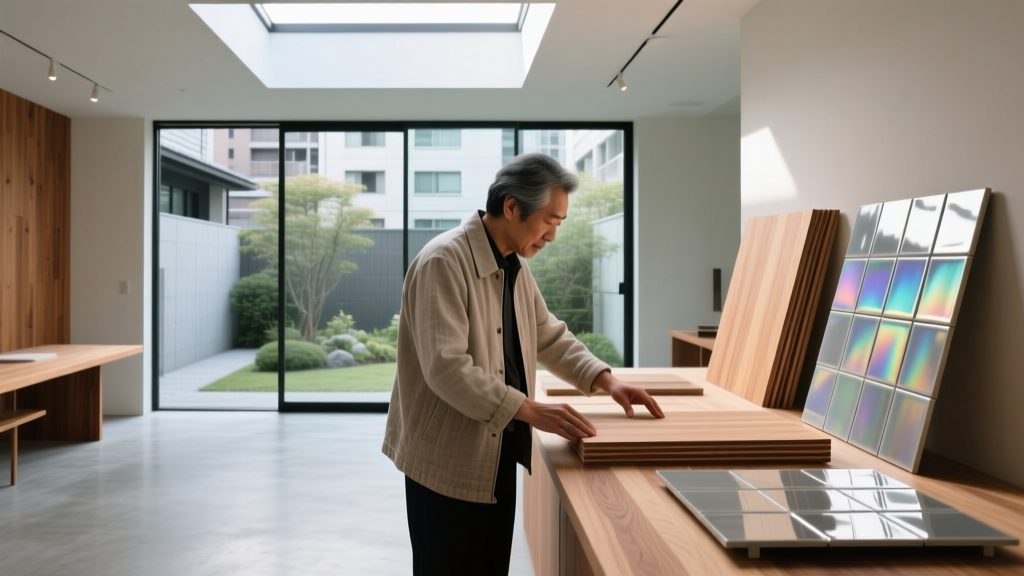
1. Cross-Laminated Timber (CLT) from Sugi (Japanese Cedar)
Japan’s Forestry Agency has heavily subsidized CLT manufacturing to utilize domestic Sugi plantations. Unlike European Spruce CLT, Sugi CLT offers distinct acoustic dampening properties and a lower density (approx. 450 kg/m³), reducing dead loads on foundations. Selection criteria: Ensure the supplier holds JAS (Japanese Agricultural Standard) certification for structural laminated wood, specifically verifying that the moisture content is kiln-dried to below 15% to prevent delamination during oceanic transit.
2. Photocatalytic Ceramic Cladding
Manufacturers like TOTO and LIXIL are leading the market in Titanium Dioxide (TiO2) coated exterior panels. When exposed to UV light, these panels break down airborne nitrogen oxides (NOx) and prevent dirt adhesion, drastically reducing facade maintenance costs. Selection criteria: Request accelerated weathering test data (ISO 4892-2) to ensure the photocatalytic coating maintains a minimum 85% NOx reduction efficiency after 5,000 hours of UV exposure.
3. High-Damping Rubber Bearings (HDRB)
For projects in seismic zones (e.g., California, New Zealand, Turkey), Japanese base isolation technology remains the gold standard. Companies like Oiles Corporation produce HDRBs that combine natural rubber with specialized oils to achieve damping ratios of 20-30% without requiring separate steel dampers. Selection criteria: Verify the bearings meet JIS K 6518 standards and request full-scale dynamic testing certificates confirming performance at shear strains up to 400%.
Standards Translation Matrix: JIS vs. Global Equivalents
A major hurdle in acting on Japanese building materials news is the standards gap. Japanese materials are rigorously tested, but local building inspectors require familiar certifications. Use this matrix to map Japanese standards to international equivalents during the specification phase.
| Material Category | Japanese Standard (JIS / JAS) | International Equivalent (ASTM / ISO / EN) | Sourcing & Compliance Action |
|---|---|---|---|
| Structural CLT Panels | JAS MAFF (Laminated Wood) | APA PRG 320 / EN 16351 | Require third-party grading agency stamp (e.g., JAS-ANZ) for mutual recognition. |
| Phenolic Foam Insulation | JIS A 9511 | ASTM C1289 / EN 13166 | Verify thermal conductivity (0.018 W/m·K) and request UL fire classification reports. |
| Seismic Isolation Bearings | JIS K 6518 / MLIT Notices | ASCE 7-22 (Chapter 17) | Submit manufacturer's dynamic test data to a local licensed structural engineer for peer review. |
| Photocatalytic Tiles | JIS R 1703-1 (Test Method) | ISO 22197-1 | Confirm TiO2 coating thickness (typically 1-5 µm) and substrate frost-thaw resistance. |
Strategic Sourcing Framework: From News to Procurement
Reading about a breakthrough material in a Japanese trade journal does not mean you can simply order it online. Japanese B2B manufacturing relies heavily on established trading networks. Follow this step-by-step framework to bridge the gap between discovery and delivery.
- Monitor Official Channels: Track the Japan External Trade Organization (JETRO) and MLIT press releases. JETRO frequently publishes English-language dossiers on construction tech startups and export-ready manufacturers.
- Engage a Sogo Shosha (General Trading Company): For high-volume orders (e.g., container loads of phenolic insulation or custom-milled CLT), direct factory contact is often blocked. Partner with mid-tier trading houses like Sojitz or Toyota Tsusho, which have dedicated construction material divisions and handle export compliance.
- Request Mill Test Reports (MTRs): Never accept a simple spec sheet. Demand original MTRs or JIS-certified factory inspection reports. For timber, this includes chain-of-custody (CoC) documentation under the SGEC (Sustainable Green Ecosystem Council) certification.
- Attend the Japan Home & Building Show: Held annually in Tokyo, this is the premier venue for establishing face-to-face relationships with mid-sized manufacturers who are actively seeking overseas distributors but lack the English-language marketing infrastructure to advertise globally.
Risk Mitigation in Cross-Border Procurement
Importing specialized building materials from Japan introduces specific logistical and financial risks that must be managed during the 2026 project planning cycle.
- Dimensional Shipping Constraints: Japanese CLT panels are often manufactured in oversized formats (up to 3m x 12m) to maximize floorplate efficiency. Standard 40ft High Cube containers cannot accommodate these. Buyers must negotiate Breakbulk or RORO (Roll-on/Roll-off) shipping, which requires a 15-20% higher freight budget and advanced port scheduling.
- Moisture Sensitivity During Transit: High-performance Japanese timber and certain acoustic gypsum boards are highly sensitive to humidity. Mandate the use of desiccant poles (e.g., Calcium Chloride based) inside shipping containers and require digital data loggers to track humidity levels throughout the 30-45 day ocean transit.
- Warranty Voidance Clauses: Japanese manufacturers frequently void warranties if their proprietary installation accessories (e.g., specific EPDM gaskets for curtain walls or specialized structural adhesives) are substituted with local generic alternatives. Always bundle the primary material with its OEM-specified consumables.
FAQ: Importing Japanese Construction Materials
Q: Are JIS marks automatically accepted by US or European building inspectors?
A: No. While JIS standards are globally respected for their rigor, local building codes require local certification marks (e.g., ICC-ES in the US, CE in Europe). You will need to hire a local code consultant to submit the JIS testing data for an equivalency evaluation report.
Q: What is the typical Minimum Order Quantity (MOQ) for custom Japanese facade panels?
A: For standard catalog items, MOQs are usually one 20ft container. For custom-extruded or custom-glazed architectural panels, factories typically require a minimum production run of 500 to 1,000 square meters to justify the setup of specialized kiln molds and coating lines.
Q: How do I verify if a Japanese material supplier is export-ready?
A: Check if the company is registered with JETRO's export directory or holds ISO 9001 certification with an English-language scope. Suppliers lacking these usually rely entirely on domestic wholesalers and are not equipped to handle international logistics, customs documentation, or foreign liability claims.
Written by
David NakamuraDavid Nakamura is a licensed architect (AIA) and construction technology writer focused on sustainable building methods, mass timber engineering, and high-performance building envelopes. He holds a Master of Architecture from the University of Washington and is a certified Passive House Consultant (CPHC). David spent eight years at the Seattle firm Mithun, where he led the design of three LEED Platinum projects, before founding his own practice specializing in net-zero residential design. He serves on the editorial advisory board of GreenBuilder Magazine and has authored peer-reviewed papers on cross-laminated timber (CLT) connections for the Journal of Structural Engineering. In his spare time, David teaches woodworking at Pratt Fine Arts Center and kayaks the Puget Sound.
More from David Nakamura
View all
Construction Cost
Labor Cost to Build a Deck Per Sq Ft: 2026 Installation Guide
Discover the exact labor cost to build a deck per sq ft in 2026. This installation guide breaks down contractor rates, complexity factors, and hidden fees.
Aug 4, 2026

Construction Cost
How Much Does It Cost to Build a 3 Bedroom House? Financing Guide
Learn exactly how much it costs to build a 3 bedroom house and explore 2026 financing options, construction loan types, and budget frameworks for your build.
Aug 4, 2026

Construction Cost
Cost to Build a Tennis Court: 2026 Guide
How much does it cost to build a tennis court in 2026? Breakdowns for asphalt, concrete, and synthetic surfaces plus fencing and lighting.
Jul 30, 2026