Top Durable Building Materials Compared: 2026 Cost & Lifespan
Compare the top durable building materials for 2026. We analyze lifespan, cost per square foot, and failure modes for concrete, steel, and masonry.

The True Cost of Durability: Beyond Initial Price
When specifying durable building materials for commercial or high-end residential projects, the initial cost per square foot is only a fraction of the total lifecycle expense. True durability encompasses compressive strength, resistance to environmental degradation (such as chloride ingress and freeze-thaw cycling), and fire resilience. In 2026, supply chain stabilization has normalized material costs, but the engineering requirements for climate resilience have driven up the specification of high-performance mix designs and advanced steel alloys.
Material Showdown: Concrete vs. Structural Steel vs. Masonry
To evaluate the most durable building materials, we must compare them across standardized metrics. The following matrix contrasts cast-in-place concrete, structural steel, and concrete masonry units (CMU) based on current 2026 market data and ASTM testing standards.
| Material | Initial Cost (Installed) | Expected Lifespan | Maintenance Cycle | Fire Rating (ASTM E119) |
|---|---|---|---|---|
| Cast-in-Place Concrete (5,000 PSI) | $8.50 - $12.00 / SF | 75 - 100+ Years | Sealing every 5-7 years | 2 to 4 Hours (depending on thickness) |
| Structural Steel (ASTM A992) | $14.00 - $19.50 / SF | 50 - 75 Years | Intumescent coating inspection / 15 years | Requires fireproofing for 2-Hour rating |
| CMU Block (ASTM C90, 8-inch) | $11.00 - $15.00 / SF | 100+ Years | Repointing mortar joints / 25 years | 2 Hours (4-inch), 4 Hours (8-inch) |
Concrete: The Baseline for Mass and Longevity
According to the Portland Cement Association, modern concrete mixes utilizing 20% to 30% fly ash or slag substitution not only reduce the carbon footprint but significantly decrease permeability. A 5,000 PSI mix with a water-cement ratio of 0.40 is the current standard for exterior load-bearing walls in aggressive freeze-thaw environments. The primary failure mode is not the concrete itself, but the corrosion of embedded rebar due to carbonation or chloride exposure. Specifying epoxy-coated or galvanized rebar adds roughly $0.40 to $0.65 per square foot but extends the structural lifespan by decades in coastal regions.
Structural Steel: Tensile Strength vs. Environmental Vulnerability
Steel offers unmatched tensile strength and allows for larger clear spans, but its durability is entirely dependent on protective coatings. The American Institute of Steel Construction notes that while steel does not combust, it loses approximately 50% of its yield strength at 1,100°F (593°C). Therefore, achieving a 2-hour fire rating requires either cementitious spray-applied fire-resistive materials (SFRM) at $2.50 - $4.00 per SF, or intumescent paint at $8.00 - $12.00 per SF. In highly corrosive environments, hot-dip galvanizing (ASTM A123) is mandatory, adding 15% to the initial steel budget.
Deep Dive: Insulated Concrete Forms (ICF) vs. Traditional CMU
For exterior envelope durability, the debate often narrows to Insulated Concrete Forms (ICF) versus traditional Concrete Masonry Units (CMU). Both are highly durable building materials, but their installation tolerances and thermal performance differ drastically.
ICF Systems (e.g., Fox Blocks, Nudura)
- Core Strength: 6-inch reinforced concrete core (typically 3,000 to 4,000 PSI slump mix).
- Thermal Performance: Continuous R-23+ insulation, eliminating thermal bridging.
- Installation Edge Case: Concrete blowouts during the pour if bracing is spaced greater than 4 feet on center.
- Moisture Management: The EPS foam is impervious to water, but interior vapor barriers must be carefully detailed to prevent condensation within the wall cavity.
Traditional CMU (8x8x16 Block)
- Core Strength: ASTM C90 standard, typically grouted and reinforced with #4 or #5 rebar at 32 inches on center.
- Thermal Performance: Poor inherent R-value (R-2 to R-3). Requires exterior continuous insulation (ci) to meet 2026 IECC codes.
- Installation Edge Case: Efflorescence and mortar joint degradation if Type S mortar is not properly tooled and cured.
- Moisture Management: Requires a parge coat and fluid-applied elastomeric waterproofing on the exterior positive side.
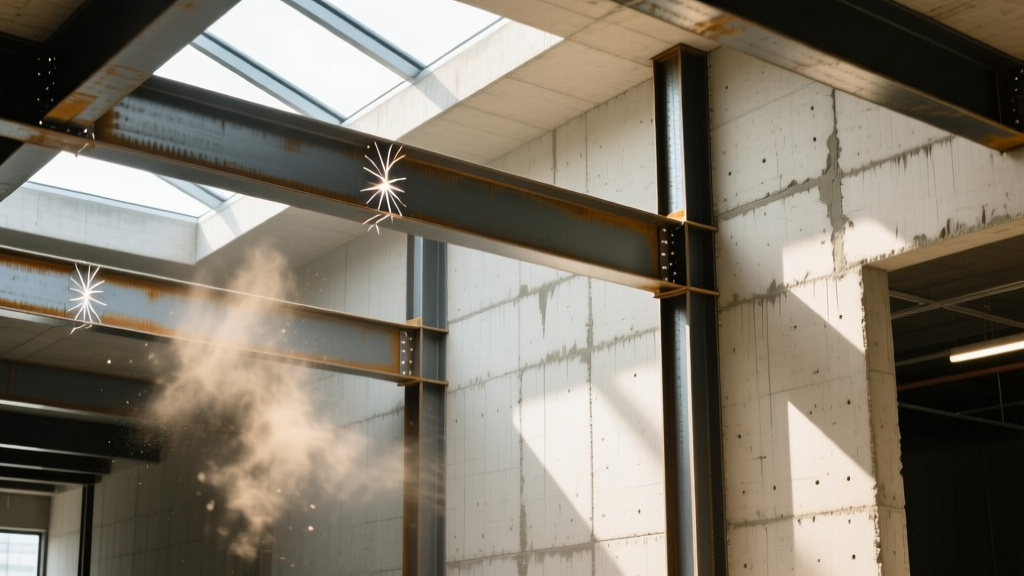
Edge Cases: Where "Durable" Materials Fail
Even the most durable building materials will fail prematurely if specific environmental edge cases are ignored during the design phase. Based on FEMA Building Science post-disaster assessments, here are the most common non-obvious failure modes:
- Concrete Spalling from Alkali-Silica Reaction (ASR): When reactive silica in the aggregate meets high-alkali cement and moisture, a gel forms and expands, cracking the concrete from the inside out. Fix: Mandate low-alkali cement (ASTM C150 Type II) and limit the total alkali content of the mix design.
- Steel Connection Crevice Corrosion: While the main flanges of a steel beam may be perfectly galvanized, the bolted connections and faying surfaces trap moisture, leading to rapid localized corrosion. Fix: Specify slip-critical connections with sealed faying surfaces or use stainless steel (Type 316) hardware for exterior connections.
- Masonry Lintel Deflection: CMU walls are incredibly durable in compression, but the steel lintels spanning window openings are prone to rust-jacking. As the lintel rusts, it expands and cracks the masonry above the window. Fix: Use hot-dip galvanized lintels and ensure weep holes are spaced every 24 inches to drain cavity moisture.
2026 Pricing & ROI Framework
Selecting durable building materials requires a lifecycle cost analysis (LCCA). While structural steel may offer a faster erection time (saving 10-15% on labor), the long-term fireproofing maintenance and corrosion mitigation often make concrete the superior financial choice for a 50-year hold.
Rule of Thumb for 2026 Commercial Builds: If the building envelope is subject to high wind-borne debris (HVHZ zones) or requires blast resistance, cast-in-place concrete or reinforced CMU provides the highest ROI. The cost to upgrade a steel-framed curtain wall to meet Miami-Dade NOA (Notice of Acceptance) hurricane standards often exceeds the cost of a solid concrete shear wall system.
Decision Flowchart: Choosing Your Primary Structural Material
- Is the project a high-rise (>6 stories) in a seismic zone?
- Yes: Structural Steel with buckling-restrained braces (BRBs) or post-tensioned concrete.
- Is the project a low-rise warehouse or distribution center?
- Yes: Tilt-up concrete panels (fastest ROI, highly durable against forklift impact).
- Is the project in a severe coastal or flood zone?
- Yes: ICF or Poured Concrete with epoxy-coated rebar and a 0.40 w/c ratio mix.
Ultimately, the most durable building material is the one correctly detailed for its specific microclimate and load requirements. Prioritize mix designs, connection details, and moisture management over raw material strength to ensure a structure that outlasts its intended lifecycle.
Written by
Sarah WhitfieldSarah Whitfield is a chartered quantity surveyor (MRICS) and construction cost analyst with 15 years of experience in material pricing, procurement strategy, and project budgeting. She earned her degree in Construction Management from the University of Reading (UK) and has worked on projects ranging from $2M custom homes to $180M mixed-use developments across North America and Europe. Sarah currently leads cost estimating for BuildMat Insight, maintaining a proprietary database of 4,000+ material price points updated quarterly. She is a frequent contributor to RSMeans cost data panels and has presented at the International Cost Engineering Council (ICEC) congress. Based in Denver, CO, Sarah is an avid trail runner and volunteer mentor for Women in Construction.
More from Sarah Whitfield
View all
Wood & Lumber
What Are the Different Types of Wood? A Builder's Guide
Compare structural softwoods, finish hardwoods, and engineered lumber. Analyze Janka ratings, MOE values, and 2026 pricing for construction.
Aug 4, 2026

Walls & Panels
Steel Framing vs Wood Framing: Corrosion and Moisture Defense
Compare steel framing vs wood framing for moisture resistance. Learn about galvanized coatings, condensation risks, and corrosion protection strategies.
Jul 21, 2026

Stone & Masonry
How to Cut Stone Veneer: Wet Saw vs Grinder Comparison
Compare the best tools for cutting stone veneer. We review wet saws, angle grinders, and chop saws to help you achieve clean, chip-free cuts.
Jul 21, 2026