Enshrouded Building Materials: 2026 Encapsulation Trends
Explore 2026 industry trends in enshrouded building materials, focusing on protective encapsulation for mass timber, prefab modules, and moisture control.

The Economics of Material Encapsulation
The construction industry's approach to material logistics has fundamentally shifted from just-in-time delivery to climate-resilient staging. As extreme weather events and atmospheric rivers become more frequent, general contractors are increasingly relying on enshrouded building materials—factory-sealed or site-wrapped bundles and modules that remain completely encapsulated until the moment of installation. This trend is not merely a precaution; it is a calculated financial strategy to protect high-value, moisture-sensitive components from warping, mold, and corrosion.
Enshrouding involves the complete wrapping of material pallets, structural members, or volumetric modules in specialized polymeric films, vapor barriers, or desiccant-loaded foils. In 2026, the upfront cost of advanced encapsulation is offset by drastic reductions in builders risk insurance premiums and the elimination of catastrophic remediation schedules. For project managers and procurement teams, understanding the specifications of enshrouded materials is now a critical competency.
Material-Specific Shrouding Requirements
Not all building materials require the same level of encapsulation. The shift toward enshrouded logistics is primarily driven by three highly sensitive material categories:
Mass Timber and Cross-Laminated Timber (CLT)
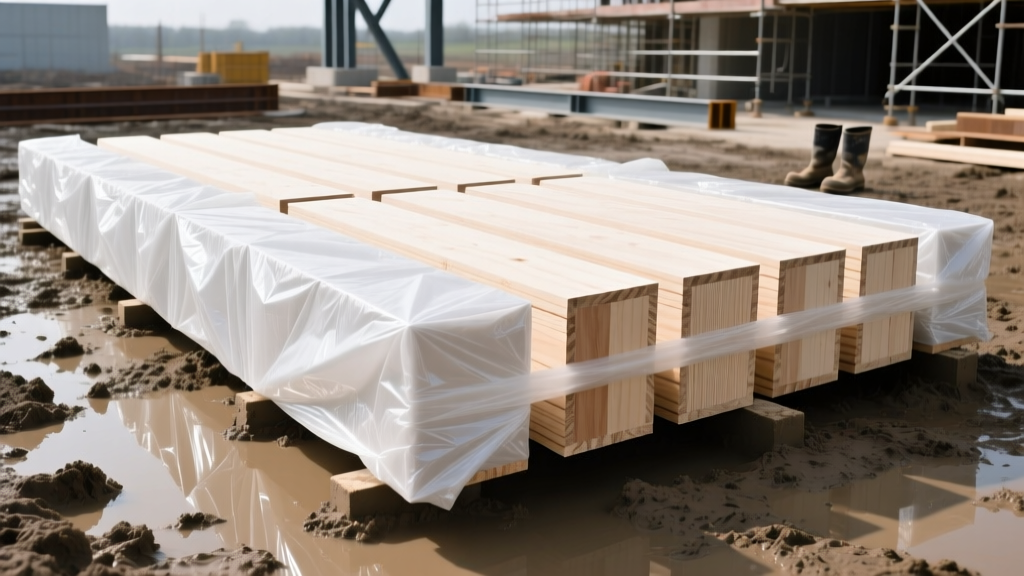
Mass timber is notoriously hygroscopic. If exposed to liquid water during staging, CLT panels can absorb moisture deep into their laminations, leading to delamination, swelling, and mold growth. According to the WoodWorks moisture management guidelines, mass timber must be kept below 19% moisture content (MC) during construction, and ideally between 12% and 16% for interior conditioning. Enshrouding CLT bundles in breathable, non-woven transit membranes allows trapped ambient humidity to escape while completely blocking liquid rain and snow.
Cold-Formed Steel (CFS) and Structural Steel
While steel does not rot, it is highly susceptible to white rust (zinc oxide) when galvanized coatings are exposed to trapped condensation. White rust compromises the sacrificial corrosion resistance of the zinc layer. Modern enshrouded steel bundles utilize Vapor Corrosion Inhibitor (VCI) films that emit a microscopic, rust-preventing vapor into the enclosed air space, protecting the metal even if the shroud is punctured.
Prefabricated MEP Racks and Volumetric Modules
Prefabricated mechanical, electrical, and plumbing (MEP) racks are assembled in controlled factory environments. If exposed to construction dust and ambient humidity on-site, the internal components can degrade before the building is even enclosed. These modules are enshrouded in heavy-duty, anti-static polyethylene shrink wrap, often with integrated desiccant sachets to maintain a micro-climate of less than 40% relative humidity inside the shroud.
CRITICAL SPECIFICATION: The 19% Moisture Rule
Never install enshrouded mass timber if a pin-type moisture meter reads above 19% MC. If a shroud is breached and the timber is exposed to rain, the encapsulation must be immediately repaired, and the material must be allowed to equilibrate. Forced drying with industrial heaters can cause severe checking and splitting of the wood fibers.
2026 Shrouding Technologies and Material Matrix
The market for construction encapsulation has matured significantly. Standard hardware-store shrink wrap is no longer acceptable for high-value structural components. Below is a comparison of the primary enshrouding technologies utilized in commercial and multi-family construction today.
| Wrap Technology | Cost (per sq ft) | Breathability | Primary Use Case | UV Resistance |
|---|---|---|---|---|
| XLPE Heat-Shrink (9-12 mil) | $0.45 - $0.75 | None (Requires weep vents) | Volumetric modules, scaffolding, long-term outdoor staging | 12-24 Months |
| Spunbond Non-Woven Membrane | $0.20 - $0.35 | High (Vapor permeable) | Mass timber, glulam beams, engineered wood | 3-6 Months |
| VCI Polyethylene Film | $0.30 - $0.50 | Low | Galvanized steel, cold-formed steel, fasteners | 6 Months |
| Foil-Laminate with Desiccants | $0.80 - $1.25 | Zero (Hermetic seal) | Prefabricated MEP racks, sensitive electronics | Indefinite |
Cost-Benefit Analysis: Upfront Logistics vs. Remediation
Procurement officers often push back on the added cost of factory-enshrouded materials. However, a comprehensive risk analysis reveals that encapsulation is a net-positive investment. Shrouding a bundle of CLT panels adds approximately $0.65 per square foot to the material cost. Conversely, if that same bundle is exposed to a week of continuous rain, the remediation costs are staggering.
Remediation requires heavy-duty dehumidification, surface sanding to remove water stains (which can alter the structural dimensions of the timber), anti-microbial treatments, and third-party structural engineering inspections. According to data referenced by the APA - The Engineered Wood Association, moisture-related delays and repairs on mass timber projects can inflate framing budgets by 15% to 22%. Furthermore, insurance underwriters are now offering 2% to 4% reductions on builders risk policies for projects that mandate documented, enshrouded material protocols from factory to final installation.
Execution: Implementing an Enshrouded Protocol on Site
Specifying enshrouded building materials is only half the battle; site execution dictates the success of the encapsulation. Site superintendents must enforce the following protocols to maintain the integrity of the shroud:
- Factory-Applied vs. Site-Applied: Always specify factory-applied shrouding for MEP racks and steel bundles. Site-applied shrink wrapping is prone to human error, uneven tension, and poor seaming. Factory encapsulation uses automated rotary heat tunnels for uniform adhesion.
- Proper Heat-Welding Seams: When site-repairing a breached XLPE shroud, crews must use specialized 120,000 BTU propane heat guns with spreader nozzles. Open-flame torches are strictly prohibited, as they cause micro-burns that compromise the UV inhibitors in the polyethylene, leading to premature shattering in sunlight.
- Ventilation Weep Holes: Non-breathable shrouds (like XLPE) will trap ground moisture and cause condensation on the underside of the material. Installers must cut 2-inch diagonal slits at the lowest points of the vertical shroud to act as weep holes, allowing liquid water to drain while maintaining the primary weather barrier.
- Dunnage and Elevation: Enshrouded materials must never sit directly on soil or concrete slabs. They must be elevated on minimum 4x4 pressure-treated timber dunnage to prevent capillary action and ground-splash from breaching the bottom seams of the wrap.
Regulatory and Code Implications
The push toward enshrouded materials aligns directly with the stricter moisture management plans required by recent updates to the International Building Code (IBC), particularly concerning Type IV-A, IV-B, and IV-C mass timber construction. Code officials now routinely demand a site-specific moisture management plan prior to issuing framing permits. By utilizing factory-enshrouded materials, general contractors can satisfy these code requirements by default, providing the manufacturer's encapsulation specifications as proof of compliance. This eliminates the need for costly, ad-hoc site tarping and reduces the frequency of municipal moisture inspections.
Future Outlook for Wrapped Construction
As the industry moves toward more off-site manufacturing and modular construction, the building site is increasingly becoming an assembly yard rather than a fabrication zone. In this paradigm, enshrouded building materials are the physical bridge between the controlled factory environment and the chaotic job site. Expect to see the integration of RFID tags and Bluetooth moisture sensors embedded directly inside the shrouds by 2027, allowing site managers to monitor the internal humidity of material bundles via smartphone apps without ever breaking the seal. For now, mastering the specification and handling of current encapsulation technologies remains a vital competitive advantage for builders aiming to protect their margins and their schedules.
Written by
James ThorntonJames Thornton is a construction industry veteran with 25 years of hands-on experience in wood framing, lumber grading, and residential building codes. He started as a framing carpenter in rural Oregon, earned his ICC Residential Building Inspector certification, and eventually became a senior plan reviewer for the City of Portland Bureau of Development Services. James holds a B.S. in Wood Science & Technology from Oregon State University and is a certified lumber grader through the West Coast Lumber Inspection Bureau (WCLIB). He has inspected over 3,000 residential construction sites and authored the city's internal guide on advanced framing techniques (2x6 at 24" O.C.). James lives in Bend, OR, where he builds custom timber-frame cabins and competes in lumberjack sports.
More from James Thornton
View all
Insulation
Best Home Insulation Materials: Complete 2026 Guide
Compare top home insulation materials for 2026. Find R-values, installed costs per square foot, and best uses for fiberglass, spray foam, and mineral wool.
Aug 4, 2026

Sustainable Building
Certify Your Green Building Material for LEED and WELL
Step-by-step guide to certifying a green building material for LEED v5 and WELL v2. Master EPDs, HPDs, and VOC limits for 2026 project specifications.
Aug 4, 2026

Stone & Masonry
Veneer Stacked Stone Panels: Interior Design & Style Showcase
Discover how veneer stacked stone panels transform interiors. Explore modern design profiles, material pairings, and technical installation specs.
Aug 4, 2026